Back To Blog
Wholesale Bluetooth Speakers: Selecting Reliable Suppliers
Buying Bluetooth speakers wholesale starts with choosing a supplier whose products, documentation, delivery terms, and after-sales support fit your business—not simply finding the lowest unit price.
This guide explains how to compare sourcing options, evaluate samples, and negotiate a manageable first order.
Use it to build a supplier shortlist and avoid committing to inventory before the important questions are answered.
How do you choose a wholesale Bluetooth speaker supplier?
Choose a wholesale Bluetooth speaker supplier by checking five things: product suitability, business identity, model-specific documentation, total delivered cost, and written support terms.
Request comparable quotes, test samples, and place a controlled pilot order before making a larger commitment. Treat missing documentation or unclear product condition as reasons to pause, not details to resolve after payment.
Start with a buying brief that every candidate receives. Without one, you may compare a compact promotional speaker against a larger retail model and mistake the price difference for better value.
Include these details:
Intended use: Retail resale, corporate gifts, hospitality, events, or another defined application.
Product requirements: Size, controls, charging connection, accessories, and any performance claims you need verified.
Order structure: Initial quantity, acceptable colors, packaging preferences, and likely reorder needs.
Commercial limits: Target delivered cost, required arrival date, and acceptable payment arrangements.
Support expectations: Defect handling, warranty information, replacement availability, and response ownership.
Separate essential requirements from preferences. A particular color might be negotiable; traceable product identity should not be. This distinction helps you negotiate without quietly lowering your acceptance standards.
Match the sourcing channel to your business
Consider several supplier categories, but ask each candidate to explain its actual role. Is it manufacturing the product, distributing branded inventory, arranging production, or reselling a specific lot? Evaluate the proposed arrangement rather than assuming a business label guarantees certain capabilities.
|
Sourcing option |
Consider it when |
Verify before ordering |
|---|---|---|
|
Branded distributor |
You want identifiable branded inventory |
Supply-chain traceability, condition, warranty coverage, and channel restrictions |
|
Manufacturer or private-label partner |
You need customized products or packaging |
Sample approval, qualification responsibilities, production controls, and minimum quantities |
|
Domestic wholesaler |
You want a domestic fulfillment relationship |
Physical stock locati0n, dispatch timing, replenishment, and return destination |
|
Closeout or liquidation seller |
You are evaluating a specific inventory lot |
New versus returned condition, completeness, recall status, and repeat availability |
|
Warehouse club |
You are considering a particular stocked model |
Quantity availability, purchase conditions, delivery, and relevant support terms |
BJ’s lists Bluetooth speakers within its speaker assortment. If you are comparing Bluetooth speakers at BJ’s Wholesale Club with trade-supplier offers, use the exact model and purchase conditions—not the word “wholesale”—as your comparison point. (bjs.com)
For local sourcing, such as wholesale Bluetooth speakers in Los Angeles, ask whether the quoted inventory is physically available at the stated warehouse. Request a pickup appointment, inspection arrangements, and written collection terms. Evaluate that offer against a delivered quote so proximity does not replace a full cost comparison.
Establish who is responsible for your order
Before discussing a large deposit, request the supplier’s legal business name, invoicing details, operating address, and primary contact. Check that the purchase order, invoice, and payment instructions identify a consistent contracting party. Ask for an explanation and supporting documentation if another company will receive payment or fulfill the order.
For branded Bluetooth speakers, request evidence of the supply chain and clarify whether the seller is claiming authorized-distributor status. Ask what documentation it can provide for your intended sales channel. Do not present the business as authorized based only on a logo in its catalog.
Request a written statement of product condition. Your order should distinguish new, refurbished, open-box, customer-returned, and mixed-condition goods. Also specify included cables, manuals, retail packaging, and any adapters.
Use the quotation stage to assess communication. Ask one specific question about model identification, another about defects, and another about replenishment. Record whether the answers are complete and consistent; use unresolved issues as follow-up items before approval.
What documentation should you verify before buying?
Verify documentation that identifies the exact speaker model, its applicable radio authorization, Bluetooth qualification, battery transport information, and recall status. Match records to the product and packaging you will receive rather than accepting an unrelated report from the same factory. Where the authorization or product configuration is unclear, obtain qualified compliance help before committing.
Radio authorization and Bluetooth qualification
Request the relevant FCC equipment-authorization information and labeling details. FCC rules specify identification requirements for equipment covered by certification applications, including the FCC identifier. Use those details to check the quoted product’s identity; an FCC logo image alone is not your verification process.
Bluetooth qualification is a separate check. Bluetooth SIG distinguishes between reselling another company’s product without representing it as your own and marketing a product under your own brand. For resale, verify that the company has qualified the product; for private labeling, establish your own qualification responsibilities rather than assuming the supplier’s listing transfers to you.
Battery records and recall screening
For lithium-powered speakers, request the applicable UN 38.3 battery test summary and confirm that it corresponds to the battery design used. PHMSA explains that lithium cells and batteries offered for transportation must pass the relevant design tests and that test summaries provide traceability.
Ask your logistics provider what packaging, marking, and shipping requirements apply to the planned shipment.
Search CPSC recall records before purchasing and again before listing inventory for sale. CPSC guidance states that selling recalled products is illegal and recommends checking recall status before listing. Keep model numbers, lot information, and supplier invoices accessible for follow-up.
Test samples against a repeatable checklist
Request samples of the exact model and configuration you intend to buy, including the planned packaging and accessories. Write down your acceptance criteria before testing. Keep an approved reference sample and attach its identifying details to the purchase agreement.
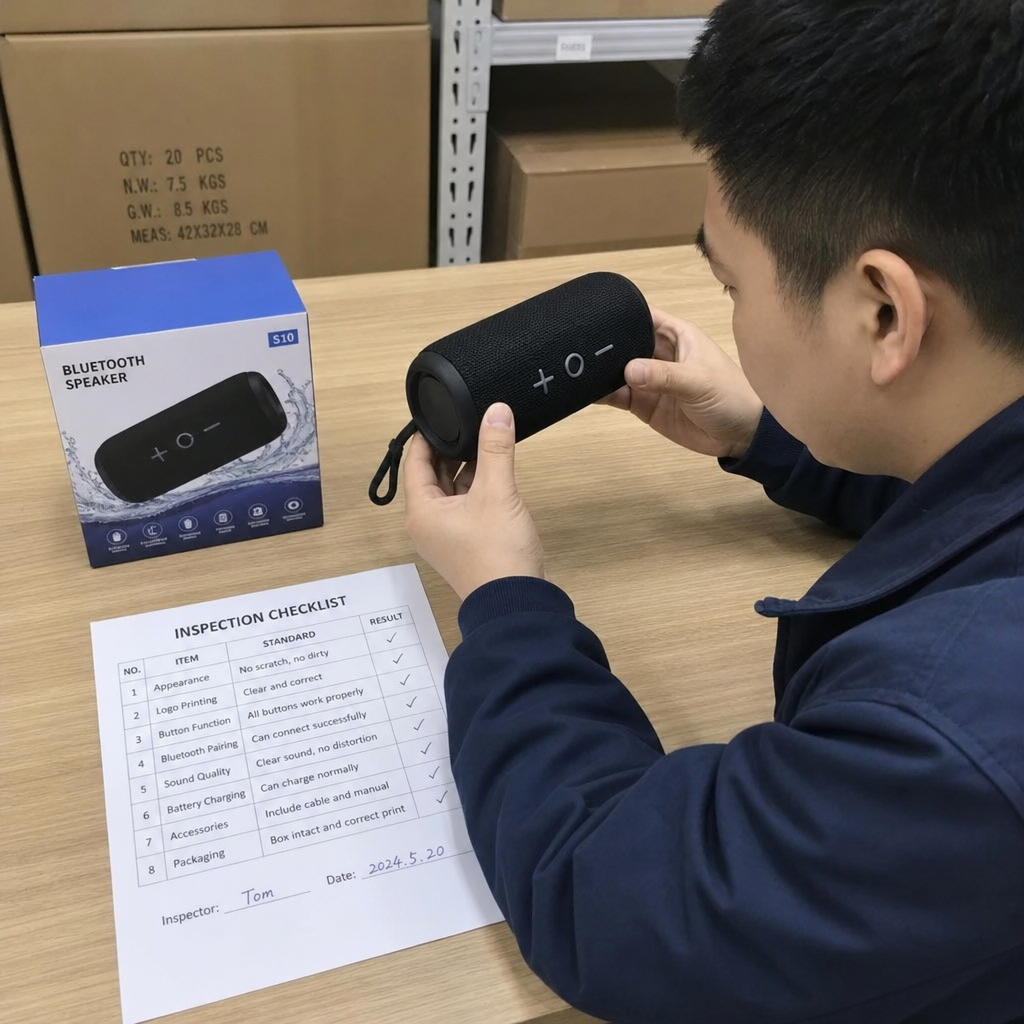
Use the same procedure for every candidate:
Pairing and reconnection: Connect to the devices your customers are likely to use, then restart both devices and repeat.
Playback: Use the same recordings and listening conditions. Note speech clarity, distortion, rattles, and control behavior.
Battery runtime: Test at a documented volume and feature setting. Ask the supplier for the conditions behind its advertised claim.
Charging: Check the supplied cable, connector fit, indicator behavior, and charging instructions.
Physical condition: Inspect buttons, ports, seams, labels, accessories, and packaging for visible defects.
Instructions: Follow the manual without supplier assistance and record unclear or missing steps.
Do not improvise immersion, electrical, or destructive safety tests. Request suitable evidence for water-resistance or other technical claims, and use qualified testing support where necessary.
Ask the supplier how production units will be checked against the approved sample. Specify whether component, firmware, packaging, or accessory substitutions require your written approval. For bulk Bluetooth speakers intended for an event, include branding placement and packaging presentation in sample acceptance.
How should you compare wholesale prices fairly?
Compare wholesale prices using the same model, condition, quantity, delivery destination, and support assumptions. Build a delivered-cost worksheet instead of ranking suppliers by the headline unit price. Then check whether the order size and payment schedule fit your inventory budget.
For each quote, capture the following:
|
Cost or term |
Detail to request |
|---|---|
|
Merchandise |
Unit price, quantity breaks, currency, and quote validity |
|
Customization |
Artwork, printing, setup, and packaging charges |
|
Shipping |
Collection point, destination, freight responsibility, and insurance |
|
Import handling |
Responsibility for customs clearance, duties, taxes, and brokerage |
|
Receiving |
Inspection, handling, storage, and any delivery appointment requirements |
|
Defect resolution |
Return freight, replacement shipping, credits, and exclusions |
Calculate landed product cost per unit by dividing the applicable acquisition and delivery costs by the quantity received. Track inspection expenses and defect allowances separately so you can see both the acquisition cost and your broader planning assumptions. Avoid inserting an assumed defect percentage unless you have evidence or clearly label it as a scenario.
When assessing bluetooth speaker deals, compare the offer with your own requirements rather than an advertised reference price. Ask whether the quoted price applies to every color, whether cartons contain mixed models, and whether the offer covers repeat orders.
Cheap Bluetooth speakers deserve the same checks as higher-priced stock. Do not accept missing documentation, unverified claims, or undefined condition simply to meet a target cost. If the quote only works at a quantity you cannot justify, negotiate a smaller trial rather than buying excess inventory.
Negotiate the terms that matter after payment
Put the approved model, quantity, condition, accessories, packaging, and reference sample into the purchase order. Define the delivery milestone precisely: goods ready for collection, dispatched, or received at your destination. Ask the supplier to identify which dates are estimates and which commitments it will accept in writing.
Clarify minimum order quantities by model, color, and customization choice. Ask whether a mixed assortment is permitted and whether it changes carton quantities or pricing. Request separate terms for the opening order and subsequent replenishment.
For warranty and defect handling, get written answers to four practical questions:
What qualifies? Define dead-on-arrival units, functional faults, cosmetic damage, and incomplete packages.
When must you report it? Establish the inspection period and the evidence required with a claim.
What remedy applies? Specify refunds, replacements, repairs, or credits rather than leaving the choice unstated.
Who pays and when? Address return freight, replacement delivery, processing time, and responsibility for customer communication.
Distinguish your agreement with the supplier from any manufacturer warranty offered to end customers. Ask who will actually receive and resolve each type of claim. If the supplier offers only credit against a future order, decide whether that remedy suits your purchasing plans before accepting it.
Use a pilot order before scaling
Make the first order large enough to evaluate fulfillment but small enough to remain manageable if problems arise. Define what a successful pilot means before paying: correct products, complete paperwork, acceptable inspection results, and delivery against the agreed milestone. Avoid increasing the order merely because another discount tier is close.
At receiving, reconcile cartons and units with the packing list. Record visible damage, model identifiers, lot details where available, and inspection results. Keep any questionable units separate while you investigate.
After the pilot, review more than the speaker itself. Did the supplier provide accurate updates? Were shortages or defects resolved as agreed? Could it explain the next order’s availability without changing the product specification?
Approve a larger purchase only after those questions have satisfactory answers. Retain the sample, quotation, purchase order, correspondence, and inspection record together. For future orders, reconfirm product configuration and terms instead of assuming the original agreement still applies.
Choose evidence over the lowest quote
The strongest approach to buying wholesale Bluetooth speakers is straightforward: define the requirement, verify the supplier and product, test a sample, compare complete costs, and prove the relationship with a pilot order.
Keep unresolved issues visible until they are answered in writing. Your next step is to send the same buying brief to a small shortlist and compare the evidence each supplier returns.
Frequently Asked Questions About Bluetooth Speakers Wholesale
What should I look for in a wholesale Bluetooth speaker supplier?
When choosing a wholesale Bluetooth speaker supplier, consider the supplier's product suitability, documentation, total delivered cost, and after-sales support. Always request samples and verify the supplier's business identity.
How can I ensure the quality of Bluetooth speakers before purchasing?
To ensure quality, request samples of the specific model you intend to buy and conduct tests for pairing, playback, battery runtime, and physical condition. Keep an approved reference sample for comparison.
What documentation is essential for purchasing wholesale Bluetooth speakers?
Essential documentation includes model identification, radio authorization, Bluetooth qualification, battery transport information, and recall status. Verify all documents match the products you plan to receive.
How do I compare wholesale prices fairly?
Compare wholesale prices by building a delivered-cost worksheet that includes unit price, customization, shipping, import handling, and defect resolution costs. Ensure you are comparing the same model and condition across suppliers.
Why is a pilot order important in the wholesale purchasing process?
A pilot order allows you to evaluate a supplier's fulfillment capability while managing your risk. It helps you assess product correctness, documentation accuracy, and the supplier's communication effectiveness before committing to larger orders.