Back To Blog
LED Strip Lights Wholesale: Suppliers, Prices & MOQ
Buying LED strip lights wholesale starts with three decisions: which supplier fits your project, what the complete order will cost, and how much you must purchase.
Published supplier programs range from professional accounts with no minimum order to custom manufacturing with specification-dependent minimums.
This article explains how to compare suppliers, evaluate prices and MOQ, and approve bulk orders without overlooking compatibility or delivery terms.
Where should you buy LED strip lights wholesale?
Start with suppliers whose purchasing model matches your requirements: professional-account sellers for repeat installation work, commercial distributors for project purchasing, or custom manufacturers for a defined product specification.
For example, HitLights offers professional accounts, Super Bright LEDs advertises commercial volume discounts, and SunroLEDs offers customized strip manufacturing. These are different purchasing routes, not interchangeable offers.
Use the following shortlist as a starting point for inquiries, not a ranking or guarantee of suitability:
|
Supplier |
Published purchasing information |
What to clarify before ordering |
|---|---|---|
|
HitLights |
Its professional wholesale page states that professional installers can buy without a minimum order. |
Account eligibility, exact product pricing, stock availability, and custom-order conditions. |
|
Super Bright LEDs |
Its commercial program advertises volume discounts and dedicated account representatives. |
Quantity breaks, project quotations, product availability, and account terms. |
|
SunroLEDs |
Its customization page states that minimums vary with the requested modifications. |
MOQ for your exact design, sample approval, certification scope, and production schedule. |
These details come from the suppliers’ published programs; obtain written confirmation for your purchase order.
Ask each candidate to quote the same specification and delivery destination. A useful response should identify the exact product, available quantity, included accessories, shipping basis, and warranty terms. Avoid comparing one supplier’s complete installation package with another supplier’s strip-only quotation.
For a repeat rollout, also ask how replenishment works. Can the supplier reserve stock, identify production batches, or notify you before a product revision? Put those requirements in the conversation before negotiating a larger discount.
What determines the LED strip lights wholesale price?
The LED strip lights wholesale price is meaningful only when the product specification, quantity, and included components are clear. Compare voltage, light output, color quality, environmental suitability, reel length, and required accessories before treating two quotations as equivalent.
Manufacturers publish different combinations of these characteristics, so a low reel price alone does not establish comparable value.
A verified public price provides context, but it should not be presented as an industry-wide wholesale rate. At the time of research, Waveform Lighting listed its CENTRIC HOME strip at $139 for a five-meter reel, with the power supply sold separately.
That equals $27.80 per meter for the strip alone; it is a public catalog benchmark, not a negotiated bulk quotation or a market average. Reconfirm pricing before purchasing.
When reviewing wholesale led strip lights, request these figures separately:
Strip price per meter: Normalize different reel lengths to one unit.
Price at each quantity break: Ask what changes at your planned order volume and the next practical tier.
Accessories: Identify drivers, controllers, connectors, channels, and mounting hardware separately.
Customization charges: Request separate lines for design work, tooling, printing, or special packaging.
Delivery costs: Ask which freight and handling charges are included.
Also request a quotation expiry date and currency. If a supplier offers a discount, check whether it applies to strips only or to the complete order. A percentage reduction is less useful than a clear total for the exact bill of materials you need.
How does MOQ work for bulk LED strips?
MOQ means minimum order quantity: the smallest quantity a supplier will accept under a particular offer. It is not necessarily the quantity needed for the best discount.
HitLights publishes no minimum order for eligible professional installers, while SunroLEDs states that customization minimums can range from five to 1,000 meters depending on the changes required. Neither policy should be assumed to apply across the market.
Clarify what the minimum attaches to. Ask whether it applies to the total purchase, each product code, each color temperature, each voltage, or each packaging design. A mixed order may satisfy a spending threshold without satisfying a manufacturer’s minimum for an individual configuration.
For bulk led strips, distinguish three quantities in writing:
Sample quantity: What you can purchase for evaluation before committing.
Production minimum: What you must order for the approved configuration.
Reorder minimum: What applies when you need additional matching material later.
If the minimum exceeds your needs, ask about an existing stock configuration, standard packaging, or scheduled releases against one order. Treat these as negotiation requests, not assumed entitlements. Do not buy unnecessary inventory merely to reach a discount tier; compare the extra spend with a smaller order that meets the project requirements.
Lock the specification before requesting quotes
LED Strip Lights are available in different widths, outputs, voltages, color options, and environmental ratings. Those differences affect what you can install and which accessories you need. Build a short specification sheet before approaching a led strip wholesale supplier so every bidder receives the same requirements.
Light output and appearance
Specify brightness in lumens per meter or foot, rather than asking only for a particular LED count. Include the desired white-light color temperature and color rendering requirements. For color-changing installations, identify whether you need RGB, RGBW, tunable white, or addressable effects, then request the matching control equipment.
Evaluate the proposed strip in its intended locati0n, not just on a supplier’s demonstration board. Place it beside the actual countertop, merchandise, wall finish, or display material. Ask the decision-maker to approve the appearance before you authorize the full purchase.
Electrical and physical compatibility
Match the power supply’s output voltage to the strip and size its capacity for the connected load according to the manufacturer’s instructions. Waveform’s CENTRIC HOME documentation, for example, gives different maximum run lengths for its 12V and 24V versions. Use the limits for the exact product rather than assuming every reel can be connected end to end.
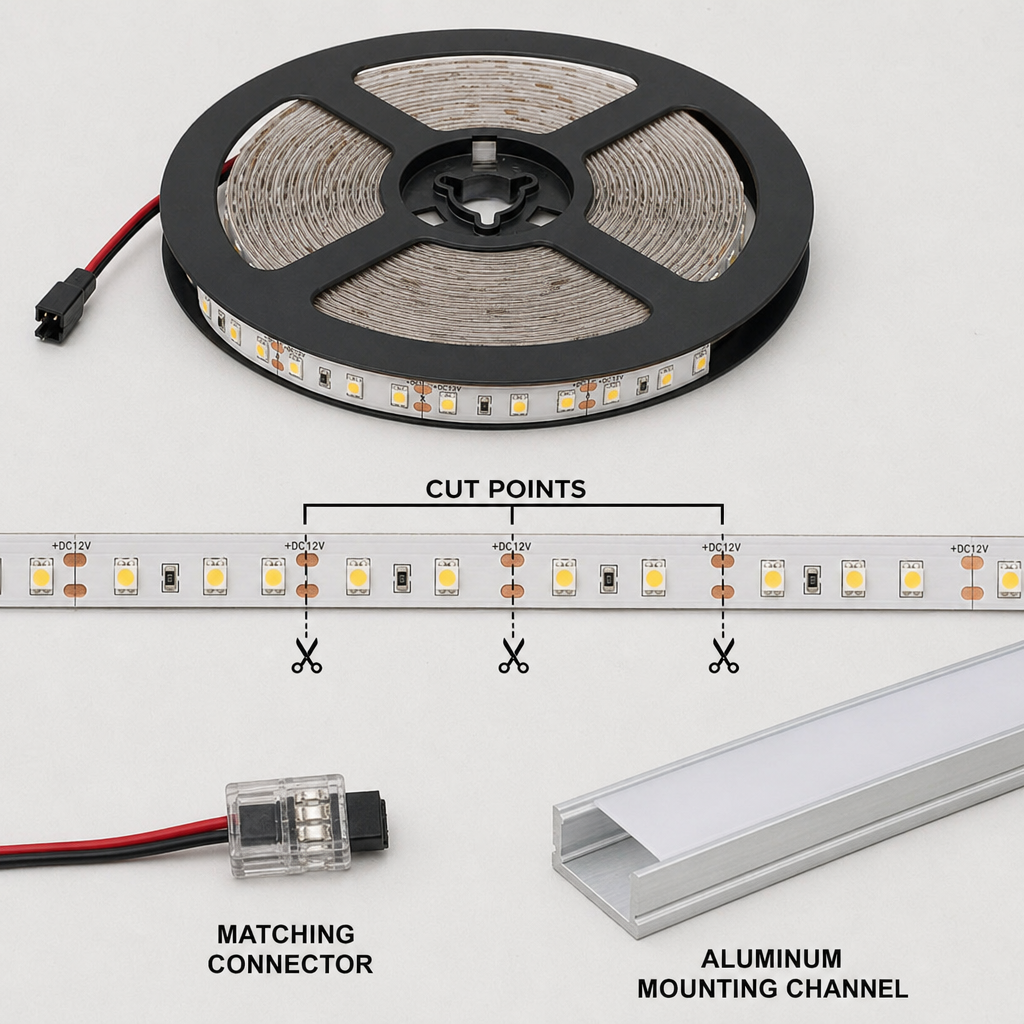
Include strip width, cut intervals, connector requirements, mounting method, and the installation environment in your request. Ask the supplier to confirm any required channel, thermal management, or sealing accessories. Request a marked drawing if the installation includes corners, short sections, gaps, or multiple power feeds.
Compare landed cost, not just reel cost
For your led lighting wholesale comparison, build one worksheet covering the complete delivered order. Keep product costs, delivery charges, and installation materials separate so you can see exactly where quotations differ. Use confirmed figures where available and clearly label any estimates.
A practical purchasing calculation is:
Landed strip cost per usable meter = total strip purchasing and delivery cost ÷ usable strip length.
For an illustrative calculation only, suppose strip material costs $800, delivery and other purchasing charges total $200, and the cutting plan yields 180 usable meters. The resulting cost is approximately $5.56 per usable meter. Those figures are hypothetical, not a supplier quotation or market price.
Then compare the complete installation budget separately. Add the quoted drivers, controls, channels, connectors, and other required materials rather than burying them in the strip figure. This preserves a fair strip comparison while showing what the project will actually require.
Before accepting a delivered price, ask:
Who arranges shipping, and where does the quoted delivery service end?
Which import, brokerage, insurance, or handling charges remain your responsibility?
Does the schedule distinguish production, dispatch, and delivery?
What happens if cartons arrive damaged or quantities are short?
Are split shipments permitted, and who pays the additional freight?
Have the supplier put the answers on the quotation or order acknowledgment. Avoid relying on an informal message that is disconnected from the approved order.
Verify documentation and approve a representative sample
For U.S. projects, verify certification claims against the exact model rather than accepting a logo in a catalog. UL Solutions distinguishes UL Listed products from UL Recognized Components, which are evaluated for use within a larger product under specified conditions. Its Product iQ database supports checking certification information and scope.
Request the model number, certification file information, technical sheet, and installation instructions together. Ask the supplier to identify what the certification covers and any conditions relevant to the proposed installation. Resolve project-specific approval questions with the installer or relevant authority before placing the bulk order.
Next, request a sample representative of the quoted production version. Evaluate it with the proposed driver, controller, connector, and mounting arrangement. A sample approval should record what you accepted, not simply state that the strip illuminated.
Use a short acceptance checklist:
Appearance: Compare the sample with the approved finish and nearby lighting.
Controls: Test switching, dimming, color adjustment, and startup behavior where applicable.
Fit: Confirm the strip, connectors, and end treatments fit the intended channel or mounting space.
Documentation: Check that labels and product codes match the quotation and technical sheet.
Repeatability: Ask how the supplier will identify the approved configuration in production and future orders.
Keep the approved sample, photographs, specification sheet, and correspondence together. Define which changes require fresh approval. This gives purchasing, installation, and receiving teams one reference instead of several different descriptions.
Send an RFQ that produces comparable answers
A useful request for quotation makes your requirements easy to understand and difficult to overlook. Send the same document to each supplier rather than starting several different conversations. Ask vendors to identify every deviation instead of silently substituting a nearby product.
Include these fields in your RFQ:
Application: Installation locati0n, intended use, and operating environment.
Product specification: Voltage, light output, color requirements, width, cut intervals, and controls.
Quantity: Total meters, required reel or cut lengths, and quantities per configuration.
Documentation: Technical sheets, applicable certification information, and installation instructions.
Commercial terms: Unit price, quantity breaks, MOQ, sample charges, payment terms, and quotation validity.
Delivery: Destination, required arrival date, packaging requirements, and permitted partial shipments.
After-sales process: Warranty exclusions, claim evidence, replacement procedure, and shipping responsibility.
When sourcing wholesale led lights for resale, add labeling, packaging, barcode, and replacement-stock requirements. Ask whether custom packaging has a separate minimum from the lighting itself. Keep first-order requirements distinct from future forecasts so an estimate is not mistaken for a purchase commitment.
Before payment, reconcile the final quotation against your approved sample and specification. Check quantities, product codes, included components, delivery terms, and agreed exceptions line by line. Choose the supplier whose written offer meets the requirements, not simply the one whose opening price was lowest.
Make the first order a controlled purchasing decision
The strongest LED Strip Lights Wholesale decision combines a defined specification, a representative sample, transparent delivered costs, and a minimum order that fits real demand. Start with comparable quotations, resolve exceptions, and retain an approved reference for receiving and reorders. That approach makes suppliers, prices and MOQ easier to evaluate—and gives your first bulk purchase a clear basis for acceptance.
Frequently Asked Questions About LED Strip Lights Wholesale
What is the minimum order quantity (MOQ) for LED strip lights when purchasing wholesale?
The MOQ varies by supplier and can depend on the specific product and customization requirements. Some suppliers may have no minimum order for professional accounts, while others may set minimums from a few meters to thousands, depending on the order specifications.
How do I choose the right supplier for my LED strip lights?
Evaluate suppliers based on their purchasing model, product variety, pricing, and customer service. Consider whether you need a professional account for repeat installations, commercial pricing for project purchases, or customized manufacturing based on specific product needs.
What factors influence the wholesale price of LED strip lights?
The wholesale price is influenced by specifications such as voltage, light output, color quality, reel length, and included accessories. Always compare similar specifications across suppliers to ensure that pricing reflects value accurately.
What should I include in my request for quotation (RFQ) to suppliers?
A comprehensive RFQ should include application details, product specifications (like voltage and color), required quantities, documentation needs, commercial terms (price and MOQ), and delivery requirements. Providing clear information helps suppliers give comparable quotes.
How can I verify the quality and compliance of the LED strip lights before placing a bulk order?
Always request samples that match your order specifications and check for relevant certifications. Verify that samples meet your appearance and functional requirements before finalizing your purchase to ensure they perform as expected.