Back To Blog
What is Product Sourcing? Discover Effective Product Sourcing Strategies
Successful product sourcing is the process of finding, evaluating, negotiating with, and managing suppliers so you can bring the right products to market at the right quality, cost, and pace. Whether you are building a retail assortment, launching a private-label item, or exploring global product sourcing, the best results come from a clear strategy rather than a quick supplier search. This guide explains how to source products with less guesswork, stronger supplier relationships, and better protection against costly mistakes.
What does effective product sourcing really mean?
Effective product sourcing means matching a business goal with a reliable supply path. It is not just finding the cheapest manufacturer or the first wholesaler with inventory; it is choosing suppliers, production models, terms, and quality controls that support your margins, brand promise, customer expectations, and growth plans.
In practice, product sourcing connects several decisions at once. You need to know what product you want, how much customization matters, what order quantities you can handle, where the item should be produced, how quality will be checked, and how goods will move from supplier to destination. A sourcing plan that ignores any of those pieces can look profitable on paper but fail when delays, defects, hidden costs, or poor communication appear.
Strong sourcing also creates options. A business that relies on one supplier, one market, or one vague agreement has little room to respond when demand changes. A business that uses sourcing best practices can compare quotes confidently, develop backup suppliers, and protect the customer experience even when conditions shift.
Start with a precise product sourcing brief
A clear sourcing brief is the foundation of every productive supplier conversation. Before asking for quotes, define the product in enough detail that different suppliers can respond to the same request. This helps you compare offers fairly and reduces the risk of misunderstandings later.
Your brief does not need to be overly technical at first, especially if you are still validating an idea. It should, however, describe the product’s intended use, target customer, required materials, preferred dimensions, packaging needs, expected price range, and any must-have performance requirements. If you already have samples, drawings, mood boards, competitor references, or compliance needs, include them in an organized way.
For custom product sourcing, the brief becomes even more important. Customization may involve materials, colors, sizing, branding, tooling, formulation, packaging, or bundled components. The more specific you are, the easier it becomes to identify suppliers that can actually produce what you need instead of suppliers that simply say yes to win the conversation.
A useful sourcing brief typically includes:
- Product description: What the product is, what problem it solves, and how customers will use it.
- Specifications: Size, weight, materials, finishes, color options, components, or technical requirements.
- Quality expectations: Acceptable tolerances, durability needs, sample requirements, and defect limits.
- Packaging requirements: Retail packaging, shipping cartons, labels, inserts, barcodes, or branding.
- Order expectations: Estimated first order, reorder frequency, seasonality, and growth potential.
- Target economics: Desired landed cost, expected retail price, margin needs, and budget limits.
- Timeline: Sample deadlines, production deadlines, launch date, and delivery requirements.
- Compliance considerations: Any safety, labeling, documentation, or market-specific requirements that apply.
This brief also helps internal alignment. If marketing wants premium packaging, operations needs stackable cartons, and finance needs a certain margin, those needs should surface before supplier sourcing begins. Resolving conflicts early is far cheaper than redesigning a product after production starts.
Common product sourcing models
Different sourcing strategies fit different business models. A new ecommerce seller, a regional retailer, and a brand developing a proprietary product may all need suppliers, but they do not need the same sourcing path. Understanding the main options helps you choose a model that fits your risk tolerance, budget, and level of control.
Wholesale sourcing
Wholesale sourcing means buying existing products from wholesalers, distributors, brands, or manufacturers at trade pricing and reselling them through your channels. It is often faster than developing a custom product because the item already exists, specifications are known, and production systems are in place.
The main advantage is speed. You can often review catalogs, request price lists, order samples, and test demand without building a product from scratch. This can be useful for retail product sourcing, marketplace selling, boutique assortments, and businesses that want to expand categories quickly.
The tradeoff is differentiation. If other retailers can buy the same item, your advantage may depend on merchandising, content, service, pricing, bundles, or channel access. Wholesale sourcing can still be highly profitable, but it requires careful assortment planning rather than simply adding whatever is available.
Manufacturer-direct sourcing
Manufacturer-direct sourcing connects you with the factory or production partner that makes the product. This model can improve cost visibility and give you more influence over specifications, packaging, and production planning. It is common for private label, custom product sourcing, and brands that want greater control over quality.
The challenge is that direct sourcing usually requires more diligence. You may need to evaluate production capabilities, minimum order quantities, sample processes, payment terms, inspection standards, and export experience. The supplier may be excellent at manufacturing but less polished in sales communication, so your request must be clear.
Manufacturer-direct sourcing is most effective when you have a defined product and enough volume to justify the work. If your product is still uncertain, start with samples, prototypes, or smaller test orders when possible before committing to a large production run.
Online sourcing
Online sourcing uses digital platforms, supplier directories, search engines, marketplaces, trade show databases, and professional networks to find suppliers. It is accessible and efficient, especially when you want to compare many possible partners quickly.
However, online sourcing requires discipline. Search results and marketplace listings can make suppliers look similar, even when their capabilities differ widely. Treat online discovery as the beginning of supplier sourcing, not the final decision. Verify business details, request documentation, compare samples, and evaluate communication before placing meaningful orders.
Online sourcing works best when you combine broad discovery with a structured qualification process. Create a shortlist, ask consistent questions, and track responses in a spreadsheet or sourcing system. This keeps enthusiasm from replacing evidence.
Working with a product sourcing company
A product sourcing company can help identify suppliers, request quotes, coordinate samples, support negotiations, and manage communication. This can be valuable if you lack supplier networks, need in-market support, are sourcing in unfamiliar categories, or do not have time to manage the process alone.
The right partner does not remove your responsibility for decision-making. You still need a clear brief, commercial goals, quality expectations, and approval checkpoints. A sourcing partner can improve execution, but the strategy should still reflect your brand, customers, and margins.
When evaluating a product sourcing company, ask how they find suppliers, how they avoid conflicts of interest, what categories they understand, how they handle quality control, and what information you will receive. Transparency matters because sourcing decisions affect your product, cash flow, and reputation.
How do you choose the right supplier sourcing strategy?
Choose the right supplier sourcing strategy by matching the product’s complexity, your desired control, available budget, timeline, and risk tolerance. Simple resale products may fit wholesale sourcing, while differentiated brand products may require direct manufacturing, custom development, or support from a product sourcing company.
The best strategy also depends on where you are in the business lifecycle. A startup testing demand may need speed, flexibility, and low order commitments. A growing brand may prioritize consistency, better margins, and supplier capacity. An established retailer may need dependable replenishment, compliance documentation, and multi-supplier coverage.
Use the following comparison to narrow the path:
|
Sourcing need |
Best-fit approach |
Why it works |
Watchouts |
|---|---|---|---|
|
Fast category expansion |
Wholesale sourcing |
Existing inventory and proven products can shorten launch time |
Less exclusivity and tighter pricing competition |
|
Private-label product |
Manufacturer-direct sourcing |
More control over packaging, specs, and cost structure |
Requires stronger quality and production management |
|
Unique design or formulation |
Custom product sourcing |
Supports differentiation and brand ownership |
Longer development cycles and more sampling |
|
Early demand testing |
Online sourcing plus small orders |
Broad supplier access and lower initial commitment |
Supplier claims still need verification |
|
Complex overseas project |
Product sourcing company support |
Adds local knowledge and process management |
Must confirm transparency, fees, and accountability |
|
Retail replenishment |
Multiple qualified suppliers |
Improves continuity and negotiating leverage |
Requires consistent standards across suppliers |
A strong sourcing strategy can also combine models. For example, a retailer might use wholesale sourcing for core assortment, direct suppliers for private label, and a product sourcing company for unfamiliar overseas categories. The goal is not to choose the most impressive model; it is to choose the model that supports the business decision in front of you.
Evaluate suppliers beyond price
Price matters, but it should never be the only factor in supplier selection. A low unit cost can disappear quickly if the supplier misses deadlines, ships inconsistent products, uses poor packaging, or cannot scale with demand. The more complete your evaluation, the fewer surprises you face after money changes hands.
Start by assessing fit. Does the supplier actually make or distribute the type of product you need? Do they understand your market? Can they support your order size without treating you as too small or pushing you into more volume than you can handle? Good supplier sourcing is about alignment, not just availability.
Then evaluate operational reliability. Ask about lead times, production capacity, reorder processes, quality checks, sample policies, payment terms, shipping support, and documentation. A supplier that answers clearly and consistently is easier to manage than one that avoids details or changes terms repeatedly.
Supplier evaluation checklist
Use a consistent checklist for every serious supplier so you can compare them objectively:
- Business legitimacy: Confirm company details, trading history where possible, and whether they are a manufacturer, distributor, agent, or trading company.
- Category experience: Review whether they have produced or supplied similar products, materials, or packaging types.
- Communication quality: Notice response time, clarity, willingness to answer questions, and ability to confirm details in writing.
- Sample quality: Compare samples against your brief, not just against the supplier’s own claims.
- Production consistency: Ask how they control quality across batches and how changes are communicated.
- Capacity and lead time: Confirm whether they can handle your expected order volume and reorder schedule.
- Commercial terms: Review pricing, minimum order quantities, payment timing, deposits, tooling fees, and quote validity.
- Compliance support: Request relevant documents, labeling support, or testing information when applicable.
- Packaging and logistics: Confirm carton specifications, packing methods, shipping terms, and export readiness.
- Problem resolution: Ask what happens if goods fail inspection, arrive damaged, or do not match approved samples.
This checklist is especially useful when comparing suppliers from different regions. It prevents you from overvaluing a low quote and undervaluing reliability. If one supplier is slightly more expensive but communicates better, provides stronger samples, and understands your standards, the total business value may be higher.
Build a landed cost view before you commit
Many sourcing mistakes happen because teams focus on unit cost instead of landed cost. Unit cost is the price of the product itself. Landed cost is the fuller cost of getting that product ready for sale, which may include packaging, inspections, freight, duties, taxes, warehousing, labeling, payment fees, damage allowances, and other handling expenses.
A product that looks attractive at the quote stage can become unprofitable once freight, storage, and defect risk are included. This is particularly important in global product sourcing, where distance, documentation, and shipping methods can change the economics significantly. Even domestic suppliers can create unexpected costs if packaging is inefficient or minimum orders tie up too much cash.
Build a simple landed cost worksheet before placing an order. It does not have to be perfect, but it should make assumptions visible. When you update the worksheet with real freight quotes, packaging details, and order quantities, you can decide whether the product still supports your target margin.
Include these cost categories:
- Product unit cost
- Setup, mold, tooling, or design fees
- Sample costs and sample shipping
- Product packaging and carton packaging
- Inspection or testing costs, if needed
- Freight from supplier to destination
- Duties, tariffs, customs brokerage, or import-related charges when applicable
- Domestic transportation, warehousing, and fulfillment handling
- Labels, barcodes, inserts, or compliance materials
- Expected defect, damage, or return allowance
- Financing cost or cash tied up in inventory
This exercise also improves negotiation. Instead of asking a supplier vaguely for a better price, you can identify specific levers: lower packaging volume, better carton quantities, adjusted materials, improved payment terms, or a price break at realistic reorder volumes.
Quality control is a sourcing strategy, not an afterthought
Quality control should be designed before production begins. Waiting until goods arrive to think about defects leaves you with fewer options and more expensive fixes. Effective product sourcing includes clear specifications, approved samples, inspection points, and written standards for what is acceptable.
The approved sample is one of the most important tools in the process. It creates a physical benchmark for materials, finish, packaging, size, color, function, and overall workmanship. If the bulk order does not match the approved sample, you have a clearer basis for discussion with the supplier.
Quality expectations should be practical and measurable. Instead of saying “premium finish,” describe the finish, material, color reference, acceptable variation, and visible defects that would cause rejection. If the product must fit with other components, survive shipping, or meet retail display standards, include those details in the brief and purchase documents.
Practical quality safeguards
- Request pre-production samples before approving full production, especially for custom items.
- Document specifications in writing so there is a shared reference beyond chat messages.
- Use photos and videos carefully to confirm progress, while recognizing they do not replace inspection for higher-risk orders.
- Set inspection criteria for appearance, function, packaging, labeling, quantity, and carton condition.
- Approve packaging before production because weak packaging can turn good products into damaged inventory.
- Keep a retained sample from approved production for future comparison.
- Track defects by type so repeat problems can be fixed at the source instead of absorbed as normal loss.
Quality control also protects supplier relationships. Clear standards reduce emotional disputes because both sides understand the target. When a problem occurs, documented expectations make it easier to decide whether the issue requires rework, replacement, discounting, or process changes for the next order.
Global product sourcing requires extra planning
Global product sourcing can open access to broader supplier networks, specialized manufacturing capabilities, and competitive cost structures. It can also introduce extra complexity around communication, lead times, logistics, documentation, currency, time zones, and product compliance. Success depends on planning for those differences instead of treating an overseas supplier like a local vendor with a longer shipping route.
Communication should be simple, specific, and confirmed in writing. Avoid relying on assumptions, slang, or unclear product descriptions. Use numbered requirements, annotated images, specification sheets, and recap emails after calls. When language or time zone differences exist, clarity becomes a cost-control tool.
Logistics planning is just as important. Production lead time is only one part of the schedule. You also need to account for sample revisions, packaging approval, inspection, freight booking, customs clearance, domestic transportation, and receiving. A launch calendar that ignores these steps can create stockouts before the product even reaches the shelf.
Some products also involve category-specific documentation, safety standards, labeling rules, or testing expectations. Do not assume the supplier knows every requirement for your sales market. Ask for documentation early, verify what applies to your product, and build enough time for corrections if packaging or labeling needs to change.
The phrase “global product sourcing gap shiplap panel” may sound unusually specific, but it illustrates a real sourcing issue: niche building or décor products often require exact material, profile, finish, installation, packaging, and regional compliance details. A small gap in specifications can lead to a product that looks similar in photos but performs differently in use. The more specialized the product, the more detailed your brief and sample review must be.
Negotiation works best when it creates a better deal for both sides
Negotiation is not only about pushing for a lower price. In product sourcing, the strongest negotiations improve the overall deal structure: cost, quality, payment timing, packaging, lead time, order quantity, exclusivity, warranty handling, and long-term supply stability. A supplier who feels forced into an unrealistic price may cut corners, delay your order, or prioritize other customers.
Prepare before negotiating. Know your target landed cost, expected order quantity, must-have specifications, and optional features. Separate what you need from what would merely be nice to have. This lets you trade intelligently instead of making demands that weaken the final product.
Useful negotiation levers include:
- Order volume: Ask for price breaks at realistic quantity tiers rather than pretending your first order will be massive.
- Packaging efficiency: Reducing carton size or improving pack configuration can lower freight and storage costs.
- Payment terms: A better deposit or balance schedule can improve cash flow without changing product quality.
- Material alternatives: Suppliers may suggest cost-effective materials if you define performance needs clearly.
- Production scheduling: Flexible timing may help a supplier offer better terms during slower periods.
- Long-term planning: Forecasts and reorder intent can support better pricing once trust is established.
- Bundled products: Combining related items may improve production efficiency or shipping economics.
Always confirm negotiated terms in writing. A friendly conversation is not enough when production, payment, and delivery are involved. Written purchase orders, invoices, specifications, and approval records help prevent disputes and keep both sides accountable.
Retail product sourcing should begin with the customer
Retail product sourcing works best when it starts with the shopper, not the catalog. The question is not simply “What can we buy?” but “What belongs in this assortment, at this price point, for this customer, in this channel?” A product that sells well in one retail context may fail in another because the audience, packaging, merchandising, or price expectation is different.
Think about how the product will be discovered and evaluated. In a physical store, packaging, shelf presence, size, and replenishment matter. In ecommerce, photography, descriptions, reviews, shipping durability, and return risk may matter more. For marketplaces, search demand, competition, listing quality, and fulfillment requirements can strongly influence performance.
Retail sourcing should also consider assortment architecture. Some products attract attention, some drive margin, some support repeat purchases, and some complete a category. If every item is sourced only because it has a low cost, the assortment may feel random. Better retail product sourcing balances customer demand, brand fit, operational simplicity, and margin contribution.
Sourcing best practices for long-term success
The strongest sourcing systems become repeatable. Each project teaches you something about suppliers, costs, timelines, quality, and customer demand. Instead of starting from zero every time, build a process that captures what worked and what needs improvement.
Document your supplier communications, quotes, samples, inspection results, order issues, and reorder performance. This creates an internal knowledge base that helps future decisions. If a supplier performed well on sampling but struggled with bulk production, that history should be visible before the next purchase order.
Key sourcing best practices
- Use a written brief before requesting quotes. Clear requirements create better responses and fewer misunderstandings.
- Compare suppliers on total value. Price matters, but reliability, quality, communication, and capacity matter too.
- Request and review samples carefully. Samples reveal details that spreadsheets and product photos cannot.
- Calculate landed cost early. Profitability depends on the full cost of getting goods ready for sale.
- Start with manageable order quantities. Avoid overcommitting before demand and supplier performance are proven.
- Keep backup suppliers in development. Redundancy protects you from disruptions and gives you negotiating confidence.
- Confirm every key term in writing. Specifications, pricing, quantities, timing, payment, and packaging should be documented.
- Review performance after each order. Treat sourcing as a learning system, not a one-time transaction.
These practices are useful whether you are using online sourcing, wholesale sourcing, or a more complex international supply chain. The details may change by category, but the discipline remains the same.
Common sourcing mistakes to avoid
Many product sourcing problems are preventable. They happen because a business moves too quickly, trusts assumptions, or focuses on the most visible cost while ignoring the operational details that determine success.
One common mistake is accepting vague quotes. A quote should clarify what is included, what specifications it is based on, how long it is valid, what quantity it assumes, and what terms apply. If two suppliers quote different packaging, materials, or shipping terms, the cheaper quote may not be cheaper at all.
Another mistake is skipping samples or treating a good sample as a guarantee of bulk quality. Samples are necessary, but they are only one checkpoint. Bulk production should still be monitored through specifications, inspections, and clear acceptance standards.
Businesses also get into trouble when they source products without understanding demand. A low minimum order quantity can still be too high if the product is unproven, and a large order can drain cash even if the margin looks strong. Match purchasing commitments to realistic sales expectations.
Avoid these high-risk habits:
- Choosing a supplier solely because they offer the lowest price
- Placing large orders before reviewing samples
- Failing to define packaging and labeling requirements
- Ignoring freight, duties, storage, and return costs
- Assuming every supplier understands your market’s compliance expectations
- Relying on verbal promises instead of written confirmations
- Making last-minute product changes without updating specifications
- Depending on one supplier with no backup plan
- Forgetting to review supplier performance after delivery
The goal is not to eliminate every risk. That is unrealistic. The goal is to identify the risks early enough to manage them before they become expensive problems.
Build a repeatable product sourcing process
A repeatable process turns sourcing from a stressful search into a business capability. It gives your team a shared way to move from idea to supplier decision, while still allowing flexibility for different categories and product types.
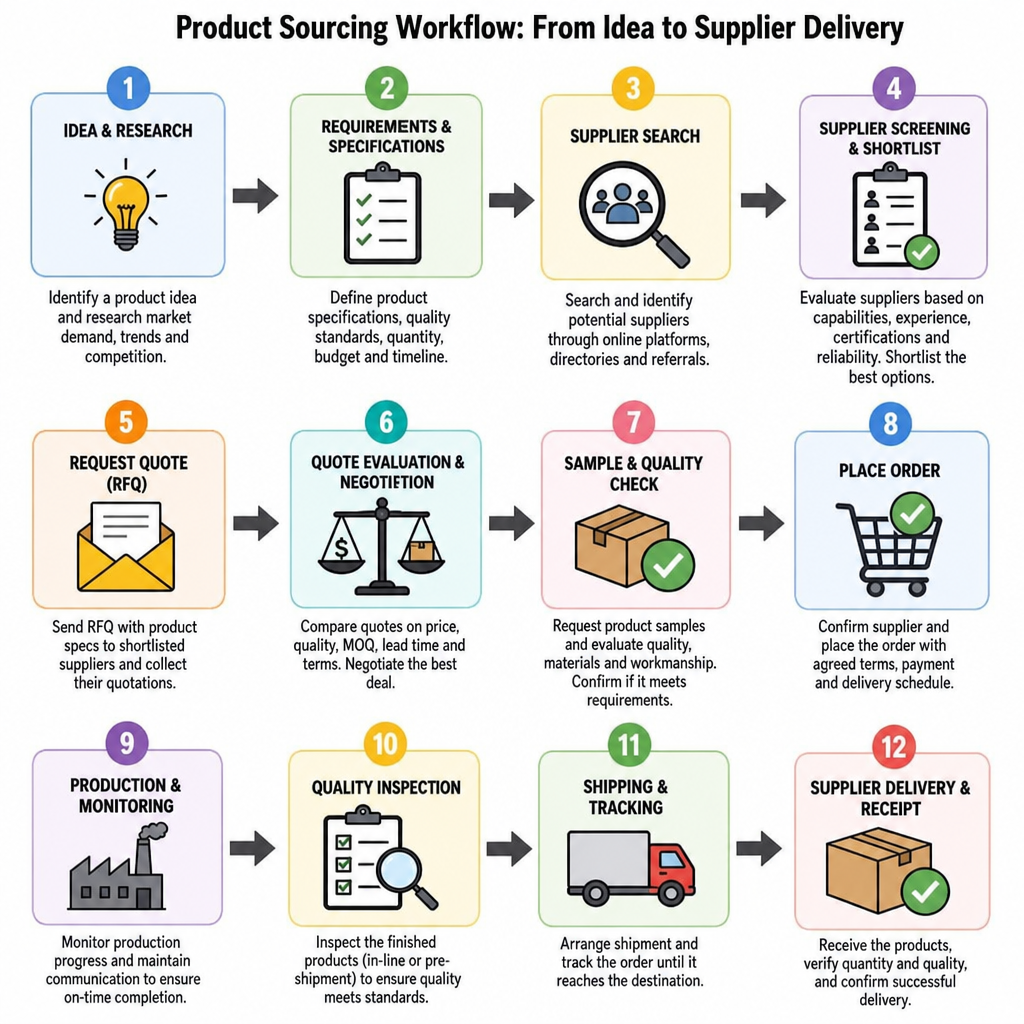
A practical process can follow these steps:
- Define the product and business goal. Clarify the customer, use case, target price, margin needs, and launch timing.
- Create a sourcing brief. Document specifications, packaging, quality standards, order expectations, and compliance needs.
- Research supplier options. Use wholesale sourcing, online sourcing, referrals, trade resources, direct outreach, or a product sourcing company as appropriate.
- Shortlist qualified suppliers. Compare capability, communication, pricing, minimums, documentation, and category experience.
- Request comparable quotes. Give each supplier the same information so pricing and terms can be evaluated fairly.
- Order and evaluate samples. Review product quality, packaging, function, finish, and consistency against your brief.
- Calculate landed cost. Include all costs needed to get the item ready for sale, not just the unit price.
- Negotiate terms and confirm details. Agree on pricing, payment, lead time, packaging, inspections, and issue resolution.
- Place a controlled first order. Keep risk manageable while you validate supplier performance and customer demand.
- Inspect, receive, and review. Check goods against standards, track issues, and decide whether to reorder, improve, or move on.
This process can be scaled up or down. A simple wholesale reorder may move quickly through the steps. A custom product may require several sample rounds and deeper quality planning. What matters is that the process creates visibility before decisions become expensive.
Turning product sourcing into a competitive advantage
Product sourcing becomes a competitive advantage when it supports better products, stronger margins, reliable availability, and a customer experience your competitors cannot easily copy. That requires more than searching for suppliers. It requires clear briefs, disciplined evaluation, realistic costing, quality control, and relationships built on shared expectations.
For businesses learning how to source products, the most important shift is to slow down at the beginning so the rest of the process can move with fewer surprises. Define what you need, compare suppliers carefully, calculate the true cost, and document every important decision. Over time, those habits create a sourcing system that is faster, smarter, and more resilient.
Whether you are exploring retail product sourcing, custom product sourcing, wholesale sourcing, or global product sourcing, success comes from treating sourcing as a strategic function. The right supplier can help you bring better products to market, but the right process is what helps you choose that supplier with confidence.
Frequently Asked Questions About elated to product sourcing:
What is product sourcing and why is it important?
Product sourcing is the process of finding and negotiating with suppliers to procure products for sale. It is important because effective sourcing ensures businesses acquire the right products at the right cost, quality, and timing, ultimately impacting profitability and customer satisfaction.
What are the different product sourcing models?
There are several sourcing models, including wholesale sourcing (buying existing products), manufacturer-direct sourcing (working directly with factories), online sourcing (using digital platforms to find suppliers), and partnering with product sourcing companies (outsourcing the sourcing process).
How do I create a sourcing brief?
A sourcing brief should include detailed specifications of the product, quality expectations, packaging requirements, order quantities, target pricing, timelines, and any compliance considerations. This document helps ensure all suppliers provide comparable quotes and meet the same standards.
What factors should I consider when choosing a supplier?
When choosing a supplier, consider their business legitimacy, experience with similar products, communication quality, production capacity, lead times, pricing, and compliance capabilities. It is crucial to evaluate suppliers based on total value rather than just the lowest price.
How can I ensure quality control during the sourcing process?
To ensure quality control, establish clear specifications and quality expectations, request pre-production samples, implement inspection processes during production, and maintain communication with the supplier. Documenting everything helps create accountability and minimizes disputes over quality issues.