Back To Blog
Amazon FBA Sourcing: Effective Strategies & Tips
Amazon FBA sourcing is the process of finding products, suppliers, and purchase terms that allow you to sell profitably through Fulfillment by Amazon.
A strong sourcing strategy does more than locate cheap inventory; it helps you choose products customers already want, verify supplier reliability, manage risk, and build a repeatable path from product research to replenishment.
This guide explains practical ways to approach fba product sourcing, including wholesale, online sourcing, branded FBA, supplier evaluation, and international options such as sourcing from Vietnam for Amazon FBA.
What does effective sourcing for FBA actually involve?
Effective sourcing for FBA means identifying products that can be bought at the right cost, meet Amazon’s requirements, reach customers in good condition, and leave enough margin after fees, shipping, storage, returns, and operating costs. It is not just “finding a product”; it is a decision process that connects Amazon product research, supplier qualification, compliance checks, pricing strategy, and inventory planning.
Many new sellers start by asking, “Where does Amazon get their products?” Amazon’s marketplace includes inventory sold by Amazon itself, third-party sellers, brands, distributors, wholesalers, private label companies, and retail or online arbitrage sellers.
FBA sellers can use several of those same supply paths, but the right model depends on budget, risk tolerance, category knowledge, and how much control the seller wants over branding and listings.
A practical Amazon FBA sourcing system usually includes:
- Demand research: Confirming that customers already search for and buy similar products.
- Competition review: Understanding who sells the product, how strong their listings are, and whether the niche is crowded.
- Cost modeling: Estimating landed cost, Amazon fees, packaging, prep, freight, returns, and advertising needs.
- Supplier validation: Checking whether suppliers are legitimate, responsive, consistent, and able to provide required documentation.
- Compliance review: Making sure the item is allowed on Amazon and suitable for the intended marketplace.
- Replenishment planning: Choosing products that can be reordered reliably without constant supplier chaos.
The best sourcing strategies are repeatable. Instead of chasing every trend, experienced sellers build a clear set of filters and apply them consistently.
The main sourcing models sellers use
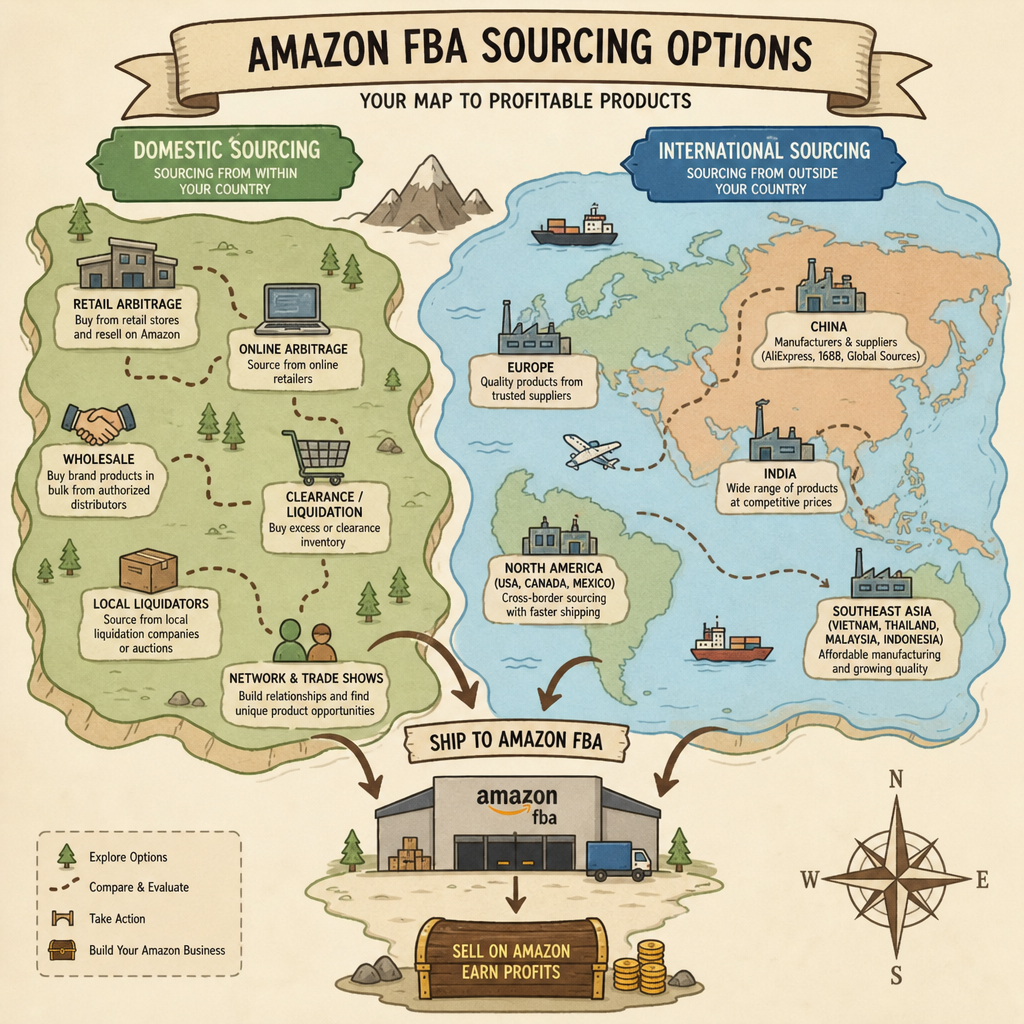
There is no single best method for sourcing products to sell on Amazon. Each model has different strengths, limitations, capital requirements, and operational demands. Understanding the differences helps you avoid choosing a model simply because it sounds popular.
Wholesale sourcing
Amazon wholesale sourcing involves buying established products in bulk from brands, distributors, or authorized wholesalers, then reselling them on Amazon. This approach can be attractive because the product already has market demand, existing brand recognition, and sometimes an active listing.
Amazon FBA wholesale sourcing works best when you can secure legitimate supplier relationships, buy at a cost that supports profit, and avoid listings where competition has already driven margins too low.
Sellers often need resale certificates, business documentation, and professional communication to work with serious suppliers. The challenge is not only finding suppliers for Amazon FBA, but finding suppliers who will approve marketplace sellers and offer terms that still make sense after Amazon costs.
Wholesale can be less creative than private label, but it rewards discipline. You need to analyze catalogs, calculate margins carefully, and watch stock levels. A product that looks profitable at first can become weak if multiple sellers enter the listing, the brand changes policies, or storage costs rise because inventory moves too slowly.
Private label and branded FBA
Branded FBA usually refers to selling products under your own brand, often through private label sourcing. Instead of reselling another company’s product, you work with a manufacturer or supplier to create, customize, package, or position a product under your brand name.
This model gives you more control over listing content, packaging, brand positioning, and customer experience. It also requires more upfront work. You must choose a product concept, define specifications, request samples, manage production, build a listing, and often invest in launch and advertising. Because you are responsible for the brand promise, quality control matters from the first sample to every reorder.
Private label can be a stronger long-term asset than simple resale, but it is not automatically safer. If the product has weak demand, poor differentiation, compliance issues, or inconsistent manufacturing, the brand will struggle.
Strong Amazon product research and supplier vetting are essential before placing a meaningful order.
Online sourcing and arbitrage-style buying
Online sourcing for Amazon FBA means finding products through ecommerce websites, clearance pages, brand sites, marketplaces, or online retailers, then reselling them when the numbers work. Some sellers use this as a lower-barrier way to learn Amazon sourcing before committing to larger wholesale or private label orders.
The main advantage is flexibility. You can test product categories, learn fee calculations, and understand how quickly inventory moves. The main limitation is consistency. Deals may disappear, purchase limits may apply, invoices may not satisfy Amazon’s documentation requests, and replenishment can be difficult.
Online sourcing is strongest when treated as a learning and cash-flow strategy rather than the only long-term plan. Sellers who document winning products, categories, brands, and supplier patterns can use those insights to approach wholesale suppliers or build more stable sourcing relationships later.
Direct manufacturing and international sourcing
Direct manufacturing can reduce per-unit costs and allow product customization, but it also adds complexity. Sellers must think about minimum order quantities, production timelines, samples, quality inspections, packaging, freight, customs, and cash tied up before sales begin.
Many sellers first think of China for manufacturing, but other regions may be worth exploring depending on the product. Sourcing from Vietnam for Amazon FBA, for example, may be relevant for categories such as home goods, textiles, furniture-related items, accessories, or certain crafted and manufactured products. The right country depends on material availability, factory capability, quality expectations, lead times, logistics, and supplier fit.
International sourcing works best when sellers slow down at the beginning. A cheap quote is not enough. You need clear specifications, written expectations, product samples, and a plan for inspection before goods move toward Amazon.
How to source products to sell on Amazon without guessing
Learning how to source products to sell on Amazon starts with a simple principle: research demand before you fall in love with a product. Good sourcing is not based on personal preference alone. It is based on evidence that customers want the item, the market has room for your offer, and the numbers can work after all costs.
A useful product research process keeps you from making emotional decisions. It also helps you compare very different opportunities in a consistent way. Whether you are building an amazon fba sourcing list, reviewing a wholesale catalog, or contacting an amazon fba sourcing agent, the same core questions apply.
Start with customer demand
Look for products that solve a clear need, fit a defined use case, or belong to a category with consistent buyer interest. Demand can show up through search volume, sales activity, review patterns, related product suggestions, and competitor performance. The goal is not to copy the biggest seller; it is to understand what customers already buy and where existing offers leave room for improvement.
Avoid relying on one signal. A product may have high search interest but intense competition. Another may have fewer searches but stronger margins and easier differentiation. The best opportunities usually balance demand, manageable competition, and realistic operating requirements.
Review the competitive landscape
Competition is not automatically bad. A category with no competition may also have no demand. The key is to understand whether you can compete in a way that is credible and profitable.
Look at listing quality, review counts, pricing patterns, product variations, brand strength, and customer complaints. Reviews can reveal what buyers like and what they wish were better. If multiple listings mention weak packaging, confusing instructions, poor sizing, or missing accessories, those comments may point toward a better product offer.
For wholesale sellers, competition analysis also includes checking how many sellers are already on a listing and whether the brand itself sells there. For branded FBA sellers, it includes deciding whether your product can stand out through design, bundle structure, material choice, packaging, or a more focused audience.
Calculate landed cost and true margin
A product’s purchase price is only one part of sourcing for FBA. True margin depends on landed cost and Amazon selling economics. Landed cost may include the product, packaging, supplier fees, domestic shipping, international freight, customs-related costs, inspection, prep, labeling, and delivery to Amazon or a prep center.
You also need to consider Amazon referral fees, FBA fulfillment fees, storage, returns, discounts, advertising, and possible price changes. A product with a high gross margin on paper may become weak once you include launch costs or slow turnover. This is why experienced sellers calculate several scenarios before buying: expected price, lower price, higher shipping cost, slower sales, and increased advertising needs.
A simple sourcing checklist can help:
- Confirm the product is allowed in the category and does not require approvals you cannot obtain.
- Estimate demand using several indicators, not one tool or one competitor.
- Check competition for seller count, listing quality, review strength, and price stability.
- Calculate total landed cost before comparing suppliers.
- Estimate Amazon fees and operating costs to understand realistic net margin.
- Request supplier documentation when needed, especially for wholesale and restricted categories.
- Order samples or small test quantities when the model allows it.
- Plan replenishment timing before the first order sells out.
Building a reliable supplier pipeline
A reliable supplier pipeline gives you more than one possible source for inventory. It reduces panic buying, helps you compare pricing and terms, and protects your Amazon business from depending too heavily on a single contact.
Suppliers for Amazon FBA can include manufacturers, distributors, wholesalers, brand owners, liquidation sources, online retailers, trade show contacts, and sourcing partners. Each has a different role. Manufacturers may be best for private label.
Distributors may be best for wholesale catalogs. Brand owners may offer direct authorization. Online retailers may support opportunistic sourcing, but may not always provide documentation Amazon accepts if proof of supply is requested.
What to look for in a supplier
A good supplier is not just the one with the lowest unit cost. The supplier should be legitimate, responsive, consistent, and able to meet your requirements. For Amazon sellers, that often includes accurate invoices, product consistency, packaging standards, barcode support, and clear communication about lead times.
Watch how suppliers communicate before you place an order. Do they answer specific questions? Do they understand your product specifications? Are payment terms, production timing, and shipping responsibilities clear? Vague answers early in the conversation often become bigger problems later.
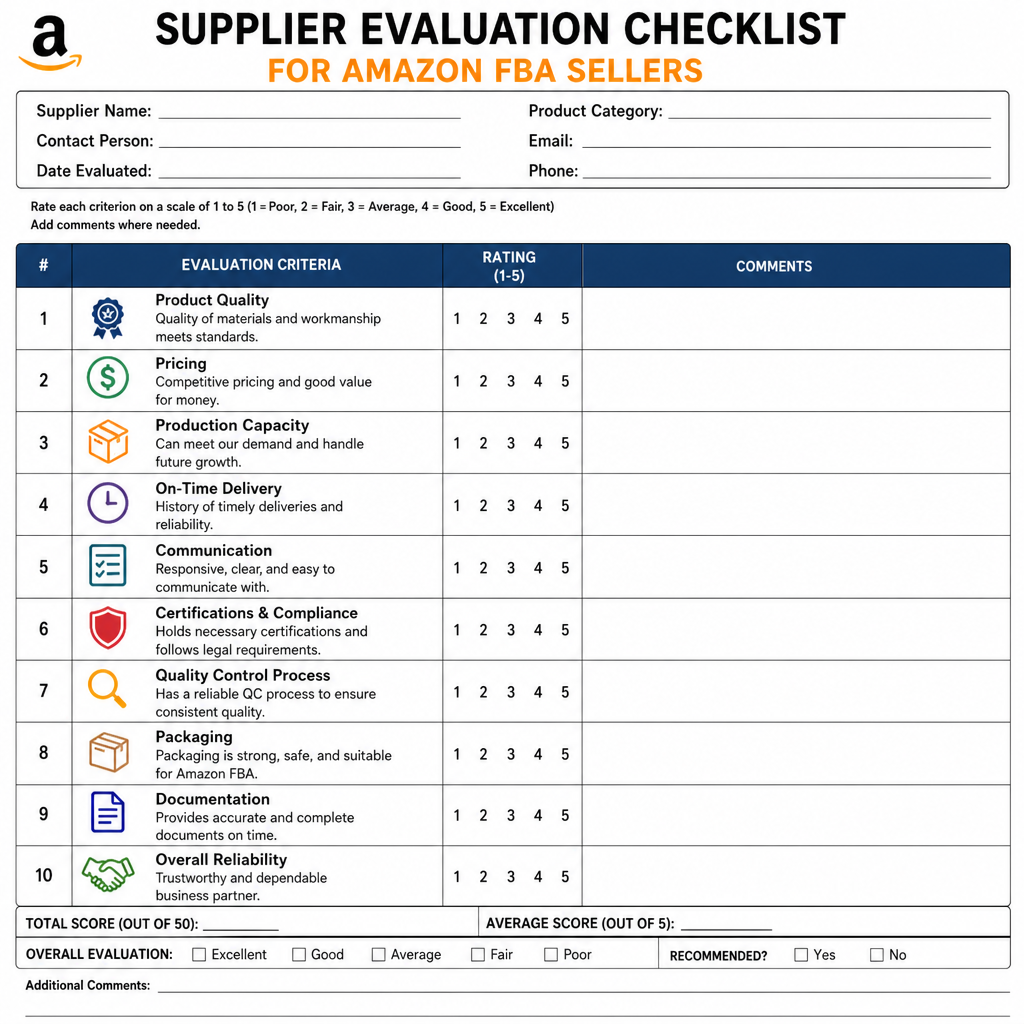
Useful supplier evaluation criteria include:
- Business legitimacy: Can the supplier provide company details, invoices, and references where appropriate?
- Product fit: Do they already make or distribute the type of item you need?
- Quality control: Can they explain materials, tolerances, packaging, and defect handling?
- Amazon readiness: Do they understand labeling, carton requirements, or shipment prep expectations if relevant?
- Communication speed: Do they respond clearly and professionally?
- Reorder reliability: Can they support consistent replenishment, not just one good sample?
- Documentation: Can they provide paperwork needed for your category, supplier records, or brand authorization?
Working with an Amazon FBA sourcing agent
An amazon fba sourcing agent can help identify suppliers, request quotes, coordinate samples, negotiate terms, arrange inspections, or support communication with factories. This can be especially useful when sourcing internationally or when language, time zones, and factory vetting create friction.
A sourcing agent should not replace your own judgment. You still need to define product requirements, understand your target margin, review samples, and approve suppliers. The agent’s role is to support the process, not make the business decision for you.
Before working with an agent, clarify how they are paid, whether they represent you or the supplier, what services are included, how they verify factories, and how quality issues are handled. Transparency matters. If an agent is vague about relationships or costs, proceed carefully.
Choosing products that fit the FBA model
Not every product that sells online is a good FBA product. FBA works best when the item fits Amazon’s fulfillment environment, has manageable dimensions, avoids excessive fragility, and can be stored and shipped without unusual risk. Larger, heavier, delicate, seasonal, or regulated products can still work, but they require more planning.
A strong Amazon FBA sourcing list should include more than product names. It should capture the reason each product is interesting, the estimated selling price, expected landed cost, competition notes, supplier options, risk flags, and next action. This turns sourcing from random browsing into a business development process.
Product traits that often make sourcing easier
Some product traits can make sourcing and operations more manageable. These traits do not guarantee success, but they reduce common friction points:
Clear use case: The customer immediately understands what the product does.
Manageable size and weight: Storage, shipping, and fulfillment costs are easier to control.
Low complexity: Fewer moving parts can reduce defects and returns.
Differentiation potential: Packaging, bundle contents, design, or instructions can improve the offer.
Repeatable supply: Suppliers can produce or provide the item consistently.
Stable demand: The product is not dependent on a short-lived trend unless you intentionally pursue trend-based selling.
Compliance clarity: Requirements are understandable before purchase.
The best sourcing decisions usually come from matching product traits to your resources. A seller with limited capital may prefer smaller test orders or online sourcing. A seller with category expertise may choose branded FBA in a niche they understand. A seller with strong supplier relationships may focus on amazon wholesale sourcing and replenishable products.
Red flags to investigate before buying
Some products deserve extra caution. These are not always bad opportunities, but they require deeper review.
Be careful with products that involve safety claims, children’s use, food contact, cosmetics, supplements, electronics, batteries, medical language, trademarked designs, patented features, or popular characters. Also investigate products with high return rates, unclear sizing, frequent breakage, or strong seasonality.
If a supplier says a product is “Amazon ready,” verify what that actually means. It may only mean they can ship cartons, not that the product meets category rules, labeling expectations, or marketplace compliance requirements.
Practical Amazon sourcing tips for better decisions
Good Amazon sourcing tips are often simple, but they require consistency. The goal is to reduce avoidable mistakes before money is committed.
Keep sourcing and purchasing separate
Sourcing is research. Purchasing is commitment. Treat them as separate stages so you do not place orders before the opportunity has been properly reviewed.
During sourcing, gather options, compare suppliers, request quotes, and test assumptions. During purchasing, confirm specifications, payment terms, shipping responsibilities, inspection plans, and documentation. This separation creates a pause that protects you from impulse decisions.
Build a repeatable scorecard
A scorecard helps compare different products and suppliers objectively. You can assign simple ratings for demand, margin, competition, supplier reliability, complexity, compliance risk, and reorder potential. The exact scoring system matters less than using it consistently.
For example, a product with excellent demand but high compliance risk may not fit a beginner. A product with moderate demand, healthy margins, and simple logistics may be a better first choice. Sourcing is not about finding a perfect product; it is about finding a product that fits your current capabilities.
Test before scaling when possible
Testing can mean different things depending on the model. For online sourcing, it may mean buying a small quantity. For wholesale, it may mean starting with a limited order if supplier terms allow. For private label, it may mean reviewing multiple samples, validating the listing opportunity, and starting with a conservative production run.
Testing helps reveal hidden issues: packaging damage, unexpected returns, slow sell-through, pricing pressure, or supplier inconsistency. Scaling should happen after the product proves it can perform under real marketplace conditions.
Document every supplier conversation
Good records protect your business. Save quotes, invoices, spec sheets, sample notes, payment terms, shipping details, and compliance documents. If you work with multiple suppliers, documentation also helps you compare performance over time.
This habit becomes especially important as your catalog grows. Without organized records, reorder decisions become confusing, supplier accountability weakens, and cost changes are harder to spot.
Wholesale, branded, and online sourcing compared
Choosing a sourcing model becomes easier when you compare them side by side. The best model is the one that matches your capital, skills, and appetite for operational complexity.
|
Sourcing model |
Best for |
Main advantage |
Main challenge |
|---|---|---|---|
|
Online sourcing for Amazon FBA |
Learning, testing, opportunistic buying |
Lower barrier to start and flexible deal hunting |
Harder to replenish consistently |
|
Amazon FBA wholesale sourcing |
Sellers who want established products |
Existing demand and faster catalog building |
Supplier approval and margin pressure |
|
Branded FBA/private label |
Sellers building a long-term brand asset |
Control over listing, packaging, and positioning |
Requires product development and launch effort |
|
Direct international sourcing |
Sellers ready for larger operational planning |
Customization and potential cost control |
Quality, logistics, lead times, and compliance complexity |
|
Sourcing agent support |
Sellers needing supplier search or coordination help |
Saves time and can reduce communication friction |
Requires careful agent vetting and clear expectations |
This comparison is not a ranking. Many sellers combine models over time. A seller might start with online sourcing, move into wholesale, then develop a private label product after learning a category. Another seller may focus entirely on wholesale because they prefer repeatable catalog analysis over product development.
International sourcing and Vietnam considerations
Sourcing internationally can open access to manufacturers, materials, and product styles that may not be available domestically at the same cost or scale. It can also introduce more moving parts, so the process needs structure.
When considering sourcing from Vietnam for Amazon FBA, focus first on product-supplier fit. Vietnam may be a strong option for some categories and less suitable for others. Rather than choosing a country first, define the product specifications, then evaluate which supplier base can meet them reliably.
Important questions include:
- Can the supplier produce the exact product quality and packaging you need?
- What minimum order quantity is required, and does it fit your budget?
- How long are sampling, production, inspection, and shipping timelines?
- Who handles export, freight coordination, and delivery to the destination?
- What quality checks happen before goods leave the factory?
- Can the supplier support reorder consistency?
- Are there product-specific rules, labels, or tests to address before shipment?
International sourcing requires patience. A polished sample does not always guarantee mass production quality, so written specifications and inspection plans matter. For first orders, avoid unnecessary complexity. Simple packaging, clear product requirements, and conservative order sizes can make the process easier to manage.
Creating an Amazon FBA sourcing list that works
An amazon fba sourcing list should be more than a spreadsheet of interesting products. It should help you decide what to research next, what to reject, and what to buy. A well-built list becomes a working pipeline for sourcing for FBA.
Useful columns may include:
Product name or concept
Category and subcategory
Target customer or use case
Estimated selling price range
Estimated landed cost
Amazon fee estimate
Expected margin range
Competitor notes
Review or complaint patterns
Supplier names and contact details
Minimum order quantity
Sample status
Compliance concerns
Replenishment potential
Decision status: research, contact supplier, sample, reject, test, reorder
Keep rejection reasons in the list. They prevent you from revisiting the same weak ideas repeatedly. Over time, your rejected products become a valuable training set because they show patterns: categories with poor margins, suppliers with unrealistic terms, or products with too much risk.
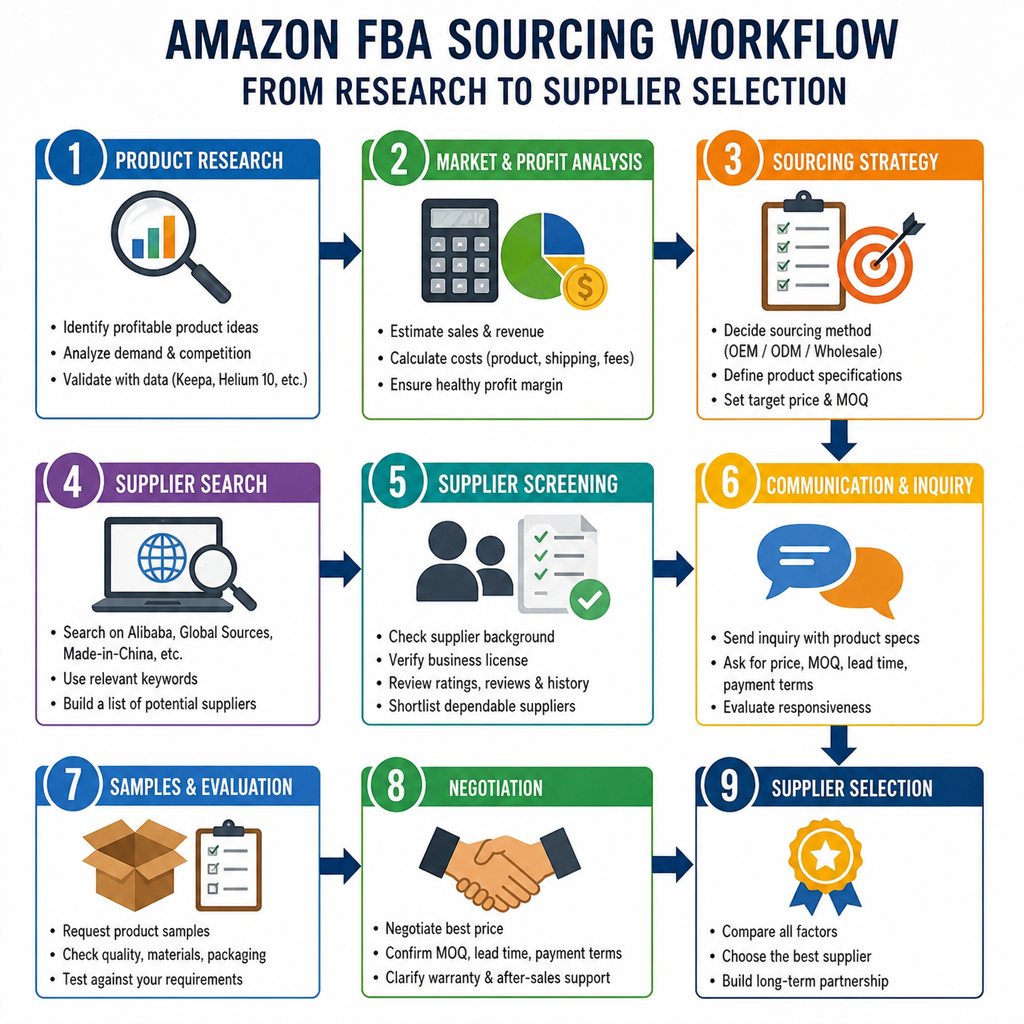
A step-by-step sourcing workflow
A clear workflow helps you move from idea to inventory without skipping important checks. You can adapt the sequence to wholesale, private label, or online sourcing, but the logic remains similar.
Choose a category focus. Start with a category you can understand, analyze, and monitor. Random sourcing across every category makes comparison difficult.
Research customer demand. Identify products with visible buying activity and a clear reason customers want them.
Study competing offers. Look at listing quality, pricing, reviews, variations, and seller strength.
Estimate total economics. Include product cost, shipping, prep, Amazon fees, storage, returns, and launch or advertising needs.
Find supplier options. Contact wholesalers, distributors, manufacturers, brand owners, or sourcing partners depending on your model.
Validate supplier credibility. Review documentation, communication quality, production capability, and consistency.
Request samples or test quantities. Inspect product quality, packaging, and customer experience before scaling.
Confirm compliance and listing requirements. Check category restrictions, labeling, claims, and documentation needs.
Place a controlled first order. Avoid overcommitting before real performance is visible.
Track results and improve. Monitor sell-through, margin, returns, customer feedback, and supplier performance.
This process may feel slower than simply buying inventory, but it is usually faster than recovering from a bad order. The purpose is to make mistakes smaller, cheaper, and easier to learn from.
Common sourcing mistakes to avoid
Many sourcing problems are predictable. Avoiding them can improve your chances of building a stable FBA operation.
One common mistake is focusing only on unit cost. A low price can hide poor quality, expensive shipping, weak packaging, or high return risk. Another mistake is copying a product because it appears popular without understanding why it sells or whether the market is already saturated.
Sellers also get into trouble when they ignore documentation. In wholesale, invoices and authorization may matter. In private label, product specifications, packaging details, and compliance records matter. In international sourcing, inspection reports and shipping documents can become critical.
Another mistake is assuming that a supplier’s sample represents every future unit. Samples should be evaluated carefully, but production standards should also be documented. If quality expectations are not written down, it becomes harder to resolve disputes.
Finally, many sellers buy too much too soon. Inventory feels like progress, but unsold inventory ties up cash. Controlled testing, reorder planning, and disciplined forecasting help protect the business.
Turning sourcing into a repeatable advantage
Amazon FBA sourcing becomes more powerful when it is treated as an operating system, not a one-time hunt. The sellers who improve over time usually keep records, compare opportunities objectively, build supplier relationships, and learn from every order.
Start with a sourcing model that fits your current resources. Use Amazon product research to understand demand. Build an Amazon FBA sourcing list with real decision data.
Vet suppliers carefully, whether you are pursuing amazon sourcing, amazon wholesale sourcing, branded FBA, or direct manufacturing. If you use an Amazon FBA sourcing agent, stay involved in the decisions and keep ownership of the product strategy.
The most effective approach is patient, evidence-based, and practical. Find products customers already want, source them from suppliers you can trust, calculate the true economics, and improve the process with each order.
That is how sourcing products to sell on Amazon becomes less of a guessing game and more of a repeatable business skill.
Frequently Asked Questions About Amazon FBA sourcing
What is Amazon FBA sourcing?
Amazon FBA sourcing is the process of finding suitable products and suppliers to sell on Amazon through Fulfillment by Amazon (FBA). It involves identifying profitable products, verifying supplier reliability, and managing inventory efficiently.
How do I choose the right products to sell on Amazon?
To choose the right products, start by conducting market research to understand customer demand, analyze competition, and calculate the total landed cost. Look for products with a clear use case, manageable competition, and good profit margins.
What are the different sourcing models for Amazon FBA?
Common sourcing models include wholesale sourcing (buying established products in bulk), private label (selling products under your brand), online sourcing (finding products from e-commerce sites), and direct manufacturing (sourcing products directly from factories).
How can I ensure the reliability of my suppliers?
To ensure reliability, thoroughly evaluate potential suppliers by checking their legitimacy, responsiveness, consistency, and ability to meet your specific requirements. Request documentation and samples, and establish clear communication regarding terms and expectations.
What are some common mistakes to avoid in Amazon FBA sourcing?
Common mistakes include focusing solely on unit costs, neglecting to validate supplier documentation, copying popular products without research, assuming samples represent all future units, and overcommitting on inventory too quickly. Always conduct thorough research and testing before making large purchases.