Back To Blog
Top Portable Chargers & Power Banks for Resale
The best portable chargers and power banks for resale are those you can match to a clear customer need, verify through reliable documentation, and sell at a sustainable margin. Rather than choosing inventory by capacity or wholesale price alone, evaluate charging compatibility, supplier accountability, and the full cost of each sale.
This article offers a category-based buying framework—not an unsupported ranking of individual models—to help you build a focused assortment.
Which portable chargers are best for resale?
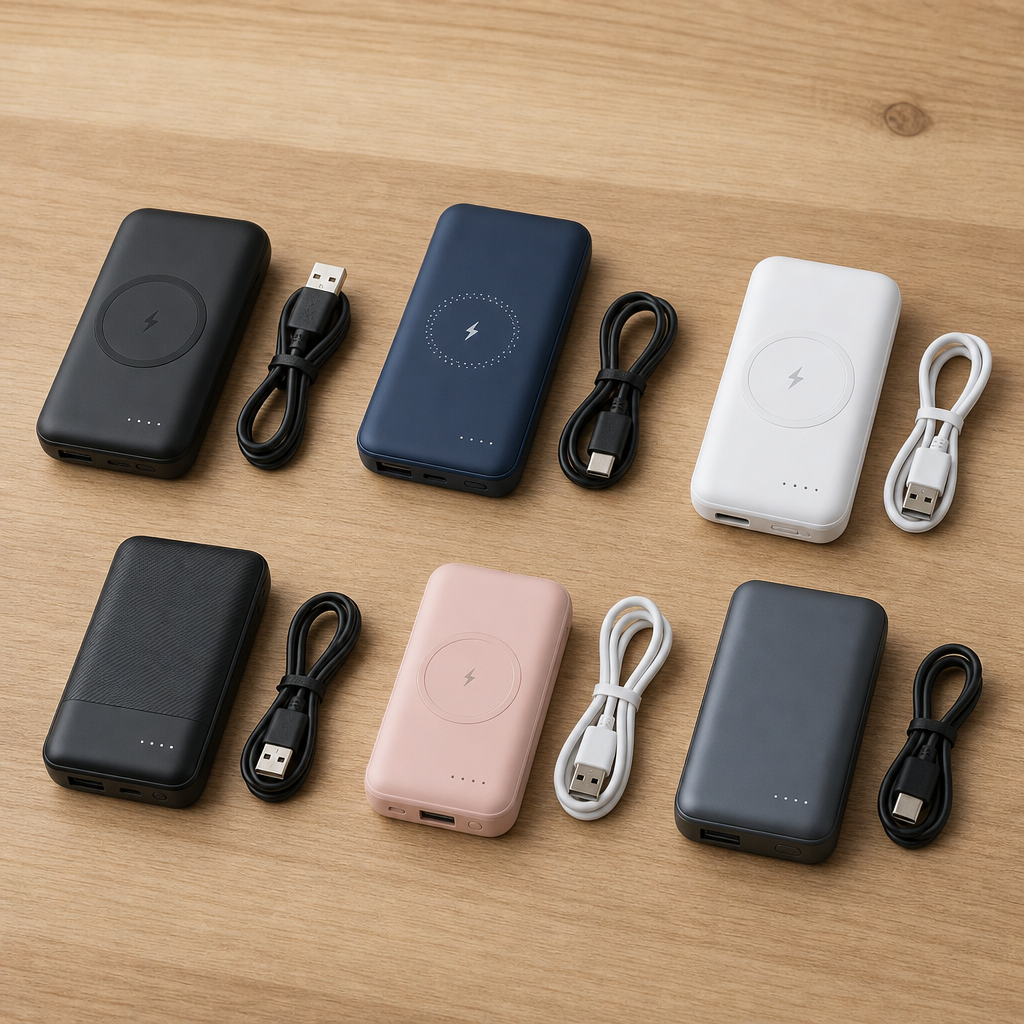
Start by considering compact USB-C models for everyday phone charging, higher-capacity options for customers seeking more backup energy, and specialized wireless or laptop-capable models where your audience justifies them.
Treat these as buying categories, not automatic recommendations: every shortlisted product still needs its specifications, sourcing, and safety documentation checked. USB-C alone does not establish USB Power Delivery capability, so inspect the actual charging specifications before positioning a product as fast-charging.
Use this assortment framework when requesting supplier quotes:
|
Product category |
Intended customer |
What to verify before ordering |
|---|---|---|
|
Compact everyday charger |
Shoppers prioritizing pocketability |
Dimensions, weight, connector type, and output |
|
Higher-capacity power bank |
Customers seeking extended backup |
Rated energy, usable output information, and recharge requirements |
|
Wireless or magnetic model |
Buyers seeking cable-free convenience |
Certified charging standard and supported devices |
|
Laptop-capable USB-C model |
Customers charging compatible computers |
Supported power profiles, sustained output, and cable requirements |
Begin with a narrow selection that your staff can explain confidently. Add another category only when it answers a different buying need rather than duplicating an existing listing. This keeps your initial purchasing decision focused and gives each product a clear role.
Read the specifications behind the packaging
Treat the headline capacity as a starting point, not a complete performance promise. The advertised milliamp-hour figure typically describes the internal battery's charge capacity; voltage conversion and other losses affect what reaches a connected device. Avoid estimating full phone recharges by simply dividing the power bank's advertised mAh by the phone battery's mAh.
Ask suppliers to distinguish battery capacity from rated output capacity and to explain the conditions behind any recharge-count claim. Request the relevant specification sheet rather than copying a marketplace headline. If the supplier cannot substantiate a claim, leave it out of your listing.
Separate connector type from charging capability
A USB-C connector does not, by itself, mean a charger supports USB Power Delivery. Check the documented input and output specifications, supported charging protocols, and cable requirements for the particular model. For laptop positioning, match those details against the intended computer's requirements rather than relying on a generic “high power” description.
Request port-by-port specifications, including what happens when multiple outputs are used together. Also ask which adapter and cable were used for the advertised recharge time. These questions give you concrete details to verify during sampling and explain at the point of sale.
Source wholesale portable chargers with traceability
When comparing wholesale portable chargers, make supplier accountability part of your buying criteria. Ask who manufactured the goods, which exact model you will receive, and how batches can be identified after delivery. Keep invoices, specifications, and correspondence together so you have a usable record for each purchase.
Before approving a supplier, request:
Product identification: Exact model numbers, packaging photographs, and batch or serial-number details.
Transport documentation: The applicable lithium battery UN 38.3 test summary, matched to the battery design being supplied. PHMSA provides guidance on obtaining and understanding these summaries.
Support terms: Written procedures for defective units, warranty claims, shortages, and product substitutions.
Certification evidence: Details you can verify against the relevant certification body's records, where certification is claimed.
Commercial terms: Minimum order quantities, lead times, payment terms, and responsibility for shipping arrangements.
USB-IF maintains a search database for products certified to carry its logo. The Wireless Power Consortium likewise lists certified wireless charging products in its product databases. Use those resources to check applicable claims rather than accepting a logo on a supplier image as sufficient evidence.
Make safety checks part of purchasing
Check the Consumer Product Safety Commission's recall and safety-warning database before purchasing, listing, or replenishing a model. Search using the brand and exact model, then review any serial-number or production details in the notice.
Power bank recalls can involve specific products rather than an entire brand; for example, the June 12, 2025 Anker recall identified PowerCore 10000 model A1263.
Require matching product identification on the sample, carton, invoice, and relevant documentation. If anything differs, pause the order and ask for clarification. A recognizable brand name should not replace model-level checks.
Plan fulfillment before accepting stock. Lithium battery transport has specific requirements, and a UN 38.3 test summary is not a substitute for determining the applicable shipping arrangements. Consult PHMSA guidance and your carrier about the shipment you intend to make, including any returns process.
How do you assess portable charger deals for profit?
Assess portable charger deals using the contribution remaining after all attributable costs, not the gap between the supplier's price and your intended selling price. Build the calculation before negotiating order quantity. Otherwise, you are choosing a purchase commitment without knowing what each completed sale needs to earn.
Use a worksheet with these lines:
Purchase cost: The quoted unit price and any packaging or labeling charges.
Inbound costs: Freight, applicable import charges, and receiving expenses.
Selling costs: Marketplace fees, payment processing, and planned advertising.
Fulfillment costs: Storage, packing materials, handling, and outbound shipping.
After-sale allowance: Your budget for returns, replacements, and customer support.
Calculate expected selling price minus those costs to estimate contribution per unit. Keep that figure separate from overall business profit, which must also account for overhead. Use your actual quotes and fee schedules rather than borrowed margin assumptions.
Compare suppliers on the same basis. A lower unit quote deserves further scrutiny if it comes with unclear replacement terms, missing documentation, or an order quantity beyond your budget. Request smaller trial-order pricing before deciding whether a volume discount is worthwhile.
Test samples before expanding the range
Create a repeatable sample review based on the manufacturer's instructions and your intended product claims. Check the exact model and accessories received, then document how it behaves with the devices you plan to name in your listing. Treat this as a purchasing check, not a replacement for professional safety testing or certification.
Include the following in your review:
Confirm that packaging, labels, instructions, and specifications agree.
Check each advertised port and supported connection with appropriate equipment.
Review multi-device charging against the supplier's stated limitations.
Inspect included cables, connectors, buttons, and displays for usability.
Record the adapter and conditions used when assessing recharge claims.
Ask the supplier to explain discrepancies before authorizing a larger order.
Apply the same review criteria across competing samples. Keep dated notes and photographs so your decision does not depend on memory. When placing a repeat order, require confirmation that the supplied model and specifications remain unchanged.
Sell the use case with clear product listings
Write listings around the buyer's intended use, then support the recommendation with verified details. Instead of calling every product the “best portable power” solution, explain who should consider it and what they must check for compatibility. Keep unsupported recharge counts, universal compatibility promises, and unverified charging-speed claims out of the copy.
For each Power Bank listing, include capacity, rated energy where available, dimensions, weight, input and output specifications, included accessories, and warranty terms. State whether a charging cable or wall adapter must be purchased separately. Give shoppers enough information to distinguish your products without decoding supplier jargon.
For travel-oriented portable power banks, describe restrictions carefully. FAA guidance says power banks belong in carry-on baggage, not checked bags; capacity limits and airline-specific restrictions also apply. Tell customers to check their airline rather than promising that a product is universally “airline approved.”
Build a focused, defensible assortment
Choose inventory you can verify, explain, and support—not simply the largest capacity at the lowest quoted price. Start with a manageable range, confirm your costs, review samples, and retain purchasing records. Expand when your own sales and support experience gives you a reason to add another product.
Frequently Asked Questions About Portable Chargers and Power Banks for Resale
What should I look for when choosing portable chargers for resale?
When selecting portable chargers, consider the charging compatibility, capacity, safety certifications, supplier accountability, and customer needs. It’s important to evaluate the specifications and performance claims to ensure you provide quality products.
Are higher-capacity power banks better for resale?
Not necessarily. While higher-capacity power banks can appeal to customers seeking extended backup, it’s essential to align your inventory with your target audience’s needs. The effectiveness and features of each model should meet customer expectations based on their usage scenarios.
How can I ensure the quality and safety of the portable chargers I sell?
Request detailed specifications, safety certifications, and transport documentation from suppliers. Always check for any product recalls or safety warnings from the Consumer Product Safety Commission before listing models for resale.
What are the potential costs involved in selling portable chargers?
Consider purchase costs, inbound shipping, selling fees (like marketplace or payment processing), fulfillment costs (storage and shipping), and allowances for returns or defective products. Calculating these can help ensure profitability from your sales.
How do I write effective product listings for portable chargers?
Focus on the buyer's intended use and provide verified specifications, including capacity, dimensions, and compatibility details. Avoid making unsupported claims about performance and ensure your listings are clear and informative to help customers make informed choices.