Back To Blog
Portable Espresso Machine Wholesale: Sourcing Guide
Sourcing portable espresso machines wholesale means choosing a product that fits your customers, verifying the supplier, and calculating the cost of getting saleable inventory into your business.
This guide covers product selection, supplier screening, sample testing, documentation, and purchasing terms.
Use it to build a buying process that prioritizes repeatable quality over an attractive unit price.
Which portable espresso machine should you source?
Source a portable espresso machine according to how your customers will heat water, prepare coffee, and use the device. Start by separating manually operated brewers from powered models, then verify whether each powered model actually heats water.
For example, Wacaco states that its manual Nanopresso needs externally heated water, while OutIn describes heating and extraction functions for its battery-powered Nano. Those are different customer propositions, not interchangeable features.
Build your shortlist around a realistic setting. A camper with a kettle may accept manual pumping; a traveler without convenient hot water may prioritize integrated heating. Treat these as buyer profiles to validate, not assumptions about every customer.
Also decide which coffee format belongs in your range:
Ground coffee: Ask buyers whether they value preparation flexibility enough to carry coffee, measure doses, and clean the basket.
Capsules: Identify the exact capsule system and test compatible products rather than accepting a broad “pod compatible” claim.
Dual-format brewing: Confirm which adapters are included and whether switching formats is straightforward.
Check the exact package configuration. Wacaco, for example, lists certain Nanopresso baskets and its capsule adapter as separately sold accessories. Never assume that a product photograph represents everything included in the wholesale carton. (wacaco.com)
Turn customer needs into a purchasing brief
Before contacting espresso machine suppliers, write a one-page brief that describes the product you intend to sell. Specify the customer, sales channel, intended use, required accessories, and acceptable purchasing commitment. Keep essential requirements separate from preferences so an appealing color or logo option does not distract from a missing function.
Your brief should establish:
Operating method: Manual pumping, powered extraction, or heating plus extraction.
Coffee format: Grounds, a named capsule system, or both.
Complete kit: Machine, adapters, cup, cable, case, and instructions, as applicable.
Support expectations: Replacement parts, troubleshooting materials, and a defined claims process.
Commercial boundaries: Target landed cost, initial inventory budget, and acceptable reorder terms.
Describe portability in practical terms. Ask for the packed dimensions and weight of the complete travel kit, not just the bare brewer. If customers must carry a charger, grinder, or separate hot-water source, account for that in your merchandising plan.
Avoid positioning a personal travel brewer as equipment for continuous café service unless the manufacturer explicitly supports that use and you have verified its suitability.
How do you evaluate espresso machine suppliers?
Evaluate espresso machine suppliers by verifying who they are, what they control, and whether they can consistently supply the agreed product. Request business identification, model-specific documentation, samples, and written commercial terms before committing to a production order. A supplier should be able to connect its quotation, sample, specifications, and supporting records to the same identifiable model.
Ask each candidate to explain its role. Are you buying from the manufacturer, an export trading business, an authorized brand wholesaler, or a regional distributor? Rather than treating one model as automatically superior, compare who will handle customization, inspection, replacement stock, and technical questions.
For coffee machine distributors selling branded products, request confirmation of authorization for your intended territory and sales channel. Clarify who backs warranty claims and whether you may use supplied photography and product descriptions.
For private-label sourcing, ask who owns the design, tooling, packaging files, and any paid customization. Get written confirmation of whether the supplier may substitute components or change the product without approval.
Watch how suppliers respond to specific questions. If a contact repeatedly substitutes a brochure for a requested test report, leaves the contracting entity unclear, or avoids identifying the supplied model, pause the evaluation. Do not let a discount replace missing answers.
Compare specifications using the same conditions
Send every shortlisted supplier the same specification worksheet. Require an answer, a supporting document, or an explicit “not available” for each field. This makes omissions visible and keeps a polished sales presentation from dominating the comparison.
|
Area |
Information to request |
What to verify |
|---|---|---|
|
Heating |
Starting temperature, water volume, heating endpoint |
Whether the claim matches intended use |
|
Battery |
Rated energy, charging requirements, test conditions |
Heating cycles separately from extraction-only cycles |
|
Brewing |
Coffee dose, water input, beverage output |
Whether results are repeatable |
|
Compatibility |
Named capsule systems and included adapters |
Fit and operation with your selected products |
|
Maintenance |
Cleaning method and replaceable components |
Whether customers can follow the process |
|
Packaging |
Unit and carton dimensions, contents, weight |
Freight estimates and receiving checks |
Battery claims especially need context. OutIn publishes different output figures for room-temperature water and already-hot water, illustrating why an unqualified “cups per charge” figure is inadequate for comparison. Request the underlying conditions and reproduce the relevant scenario during testing.
Treat advertised pressure as a specification to investigate, not your acceptance decision. Ask suppliers how it is measured, then judge the sample against your agreed brewing procedure and finished-drink expectations.
What should you test before placing a wholesale order?
Test the complete customer experience: unpacking, setup, brewing, cleaning, charging where applicable, and repacking. Use the same coffee, water quantity, starting temperature, and preparation method when comparing samples. Record observations against predetermined acceptance criteria rather than relying on one impressive demonstration.
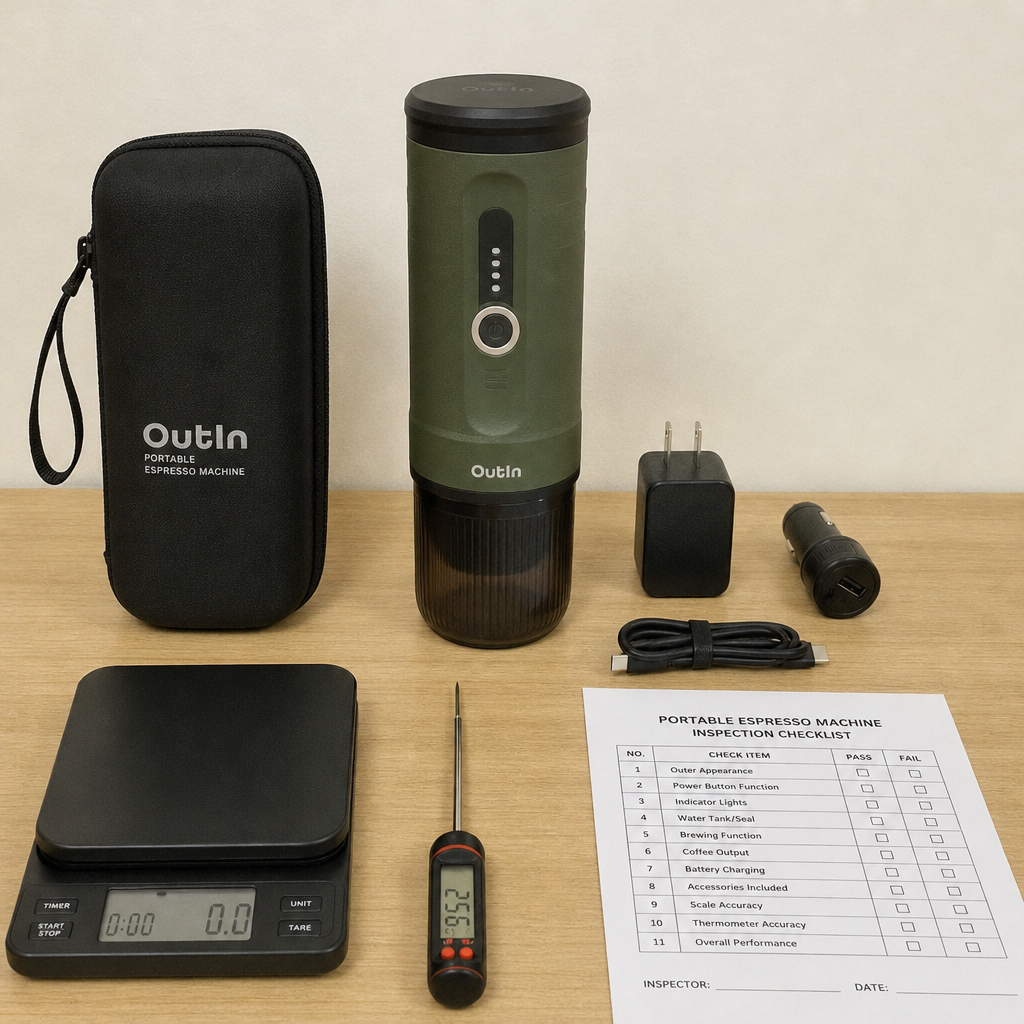
Use a written sample protocol:
Check identity and contents. Match the model, markings, accessories, instructions, and packaging against the quotation.
Follow the instructions literally. Have someone unfamiliar with the product attempt setup without coaching. Note unclear assembly steps or controls.
Run controlled brewing trials. Record coffee dose, water input, drink output, preparation time, and subjective taste observations.
Observe normal handling. Check assembly fit, stability, seal seating, and any leakage during manufacturer-approved operation.
Evaluate powered functions. Test heating and extraction separately where supported, using the specified charging equipment and operating limits.
Clean and reassemble. Assess access to components, drying requirements, and the clarity of maintenance instructions.
Repeat across samples. Look for differences between units rather than judging the order from one handpicked sample.
Do not improvise pressure, electrical, battery-abuse, or other hazardous tests. Commission a qualified laboratory for safety evaluations outside ordinary intended use.
Keep an approved reference sample and attach its specification revision to the purchase agreement. Require production inspection against the agreed criteria; sample approval should not become permission for undocumented changes.
Verify documentation for the destination market
Plan documentation review before paying for inventory. Ask a qualified compliance specialist to identify the requirements for the exact product, destination, power configuration, and intended use. Make that review a purchasing gate, rather than assuming a familiar logo or generic certificate settles every question.
For food-contact components, request material identification and supporting evidence for the intended conditions of use. FDA guidance explains that regulatory status depends on the components and their use, and notes that buyers may request a manufacturer's letter of guaranty. Use that framework to ask specific questions about the water chamber, seals, basket, and beverage pathway.
For models containing lithium batteries, request the applicable UN 38.3 test summary and have your logistics provider review the shipment configuration. PHMSA explains that lithium batteries must undergo the relevant design tests and provides guidance on test-summary requirements. Do not treat an unrelated battery document as evidence for the supplied configuration.
Check that documents identify the correct model, manufacturer, and relevant components. Ask the issuing laboratory or certification body to confirm questionable records. Keep the approved documentation with the product revision so later substitutions trigger a fresh review.
Calculate landed cost and selling contribution
Compare quotations on landed cost, not factory price alone. The International Trade Administration defines landed cost as the product price plus freight, insurance, tariffs, taxes, and other applicable fees. Obtain current shipment estimates and have a customs broker confirm classification and applicable charges for your actual product and origin.
For your internal buying worksheet, calculate:
Estimated landed cost per saleable unit = total acquisition and inbound costs ÷ expected saleable units.
Show the assumptions behind both numbers. Separate supplier charges, packaging, inspection, freight, insurance, brokerage, duties, and inbound delivery. Avoid double-counting charges already included in a delivered quotation.
Then build a separate selling contribution estimate:
Net sales revenue − landed product cost − variable selling, fulfillment, and support costs.
Use your own channel fees, fulfillment quotes, promotional plans, and reasonable return scenarios. Model a slower-selling case as well as your preferred outcome; do not make the purchase work only under optimistic assumptions.
When comparing coffee maker wholesale offers, ask suppliers to quote the same quantity, kit contents, packaging, delivery basis, and payment schedule. A lower unit price is not a useful saving if the quotation excludes accessories or services your offer requires.
Put order terms and after-sales support in writing
A wholesale portable espresso machine purchase should connect the approved product to clear commercial obligations. Include model identification, specifications, kit contents, packaging artwork, quantity, inspection rights, payment milestones, and the agreed remedy for nonconforming goods. Define what constitutes acceptance rather than leaving “good quality” open to interpretation.
Specify the agreed Incoterm, its version, and the named place or port. Incoterms allocate defined delivery responsibilities, costs, and risks, but they do not settle every contractual issue, including payment timing, ownership transfer, or remedies for nonconforming goods. Address those separately in the purchase agreement.
Make the support arrangement equally concrete. Ask who approves claims, what evidence is required, who pays shipping, and whether the remedy is repair, replacement, credit, or refund. Establish how replacement seals, baskets, adapters, and other serviceable parts can be ordered.
Before approving private-label packaging, review the instructions and troubleshooting content alongside the sample. Require accurate descriptions of included accessories, coffee compatibility, charging requirements, and cleaning limitations. Leave unsupported claims off the box, even if they appear in a supplier's marketing materials.
Start with a pilot and scale on evidence
Use an initial order to validate the entire supply relationship, not just demand for portable coffee machines. Track receiving discrepancies, inspection findings, customer questions, returns, and the supplier's response to problems. Set your reorder decision criteria before sales begin so early enthusiasm does not override unresolved issues.
Keep the first assortment focused. One well-understood coffee machine with a complete accessory kit gives your team a clearer testing and support task than several nearly identical variants. Add options when customer feedback provides a reason, not merely because the catalog offers them.
Reliable sourcing is a sequence of decisions: define the use case, verify the supplier, approve the sample, review documentation, and agree on total costs and remedies. Build your shortlist around those checkpoints. The strongest purchasing decision is the one you can explain with records, reproduce through inspection, and support after the sale.
Frequently Asked Questions About Portable Espresso Machines Wholesale
What factors should I consider when selecting a portable espresso machine to source?
Consider the intended use by your customers, whether the machine is manually operated or powered, the coffee formats (ground coffee, capsules, or dual-format brewing), and the packaging and accessories included with the product.
How do I verify the reliability of espresso machine suppliers?
Request business identification, model-specific documentation, samples for testing, and written commercial terms. Compare who will handle customization, inspection, and warranty claims, and ensure they can consistently supply the agreed product.
What documentation is required for importing portable espresso machines?
Documentation may include compliance certificates, material identification for food-contact components, safety evaluations for electrical devices, and any necessary shipping and customs documentation, especially for models containing lithium batteries.
How can I calculate the total landed cost of my inventory?
The total landed cost includes the product price, freight, insurance, tariffs, taxes, and other applicable fees. It's calculated by summing all acquisition costs and dividing by the expected number of saleable units.
What should I include in my purchasing agreement with suppliers?
Your purchasing agreement should specify model identification, product specifications, kit contents, agreed payment terms, inspection rights, and the remedies for nonconforming goods. Clearly define all commercial obligations and after-sales support arrangements.