Back To Blog
Top 15 Smart Home Products to Sell for 2027
Smart home products worth evaluating for a 2027 store include connected lighting, security devices, climate controls, and practical automation sensors. This selection focuses on products with clear household uses and gives sellers a positioning angle, sourcing priorities, and potential purchase barriers for each.
Treat it as a merchandising shortlist—not a prediction of guaranteed bestsellers or future sales.
What makes a smart home product worth selling in 2027?
A worthwhile product should solve an understandable problem, fit the buyer’s existing setup, and leave room for profit after fulfillment, returns, and support. Favor smart living solutions that you can demonstrate through a simple routine: controlling a lamp, checking the doorstep, or scheduling room temperatures. Build your selection around those outcomes rather than futuristic promises.
Compatibility deserves particular attention. Matter provides a shared connectivity standard, but platform support varies by device type and feature; Google explicitly notes that not all Matter devices are fully supported in its ecosystem. Verify the exact model and advertised functions instead of treating a compatibility logo as a universal guarantee.
For your buying plan, evaluate smart home trends through three practical filters:
Customer fit: Choose a defined audience, such as renters, pet owners, or homeowners upgrading existing equipment.
Setup burden: Estimate how much installation guidance, troubleshooting, and accessory explanation each product needs.
Supplier accountability: Request clear warranty terms, return procedures, and written software-support information before ordering inventory.
Which smart home products should you consider selling?
The following 15 categories are candidates for a focused smart home assortment. Choose products that match your customers and support capabilities rather than stocking every category. The selling angles below are merchandising suggestions; confirm all features against the specific model you source.
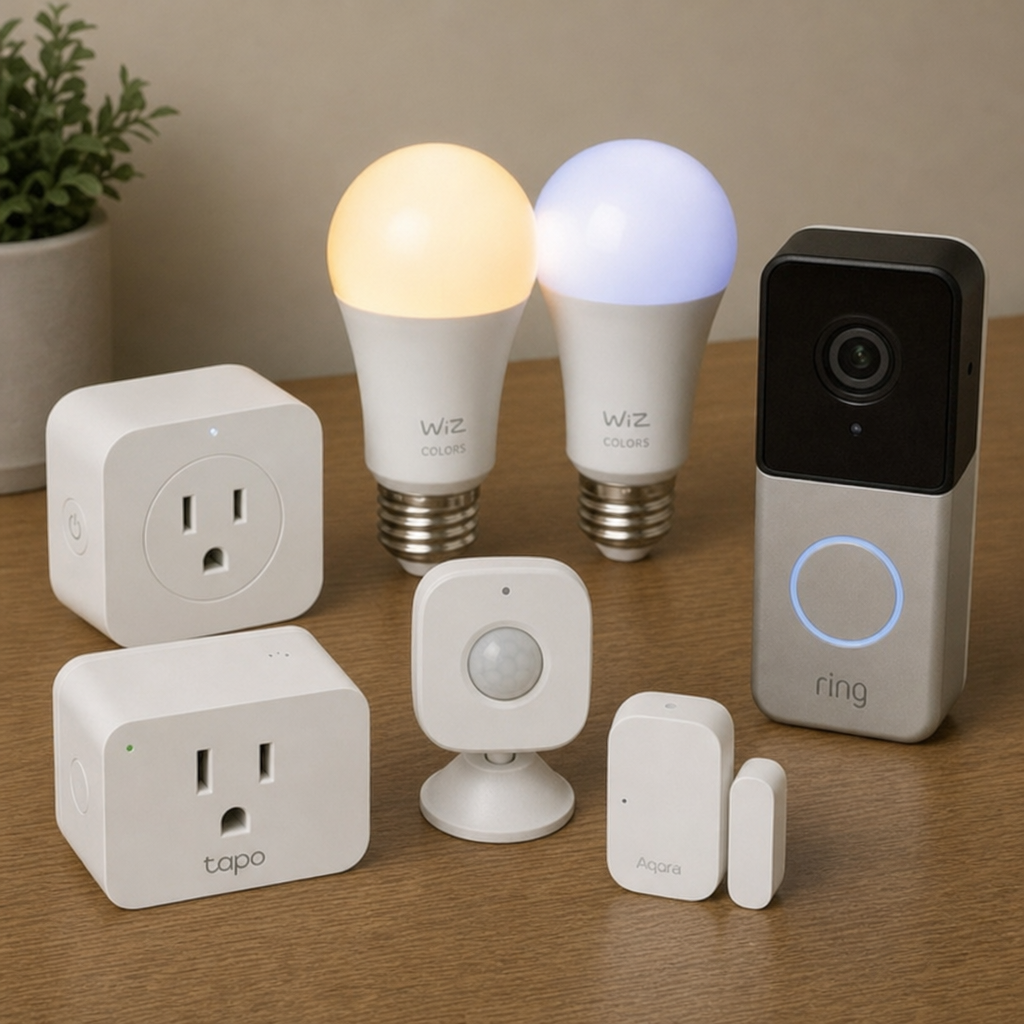
1. Smart Plugs With Energy Monitoring
Energy-monitoring plugs combine connected outlet control with electricity-use information; products such as Tapo’s P110M illustrate this combination.
Position them around a specific use, such as controlling a compatible table lamp or reviewing a device’s consumption. Publish electrical ratings and manufacturer restrictions prominently. Avoid suggesting that a plug makes every appliance suitable for unattended operation.
2. Color-Changing Smart Bulbs
Smart bulbs offer an easy visual demonstration: the same room can switch between functional lighting and colorful ambience. Multicolor models with connected controls are already available, including Tapo’s L535E.
Merchandise by room and purpose rather than color count alone. Show socket type, brightness, dimming compatibility, and connection requirements so shoppers can assess fit before purchasing.
3. Smart Light Switches
Connected switches deserve consideration alongside bulbs, particularly for shoppers planning a lighting upgrade. Matter-compatible switch models are available in existing product ranges.
Make installation requirements central to the listing: ask suppliers about neutral wires, supported loads, and single-pole versus multi-locati0n wiring. Offer a pre-purchase checklist rather than implying that every switch fits every home.
4. Smart Thermostats
Smart thermostats provide a concrete comfort-and-control proposition. ENERGY STAR certification requires features including scheduling, HVAC-use information, and basic thermostat operation without service-provider connectivity.
Build listings around system compatibility and daily routines, not guaranteed savings. Ask suppliers for a compatibility checker and clear wiring guidance; do not present a thermostat as suitable for every heating or cooling system.
5. Video Doorbells
Video doorbells combine doorstep viewing with visitor communication; available models offer features such as two-way audio, motion alerts, and local or cloud storage. These capabilities differ by model and operating mode.
Explain battery versus wired installation and separate included functions from subscriptions. Show what the camera can see from a realistic mounting position, not just an ideal promotional angle.
6. Indoor Security Cameras
Indoor cameras are another category to evaluate for buyers seeking visibility inside their homes. Existing ranges include indoor and indoor/outdoor models, so avoid treating those labels as interchangeable.
Compare privacy controls, recording options, placement requirements, and account access before sourcing. Frame demonstrations around an authorized household use, and make any ongoing storage charges easy to find.
7. Smart Door Locks
Door locks are an established connected-device category supported within Matter, although available controls depend on the platform and product.
Position them around the access features your chosen model actually provides. Require buyers to check door dimensions and hardware compatibility.
Explain backup entry and battery procedures clearly, and avoid claims that any lock makes a property burglar-proof.
8. Door and Window Contact Sensors
Contact sensors belong in a starter assortment because they give sellers a focused automation category to explain. Google lists contact sensors among its supported Matter device types, while manufacturers also offer ecosystem-specific models. (developers.home.google.com) Show a compatible opening-triggered routine in your demonstration. State hub requirements, mounting limitations, and whether the advertised notification needs another service or device.
9. Presence Sensors
Presence sensors offer a more advanced merchandising option for tech-savvy homes. Radar-based products such as Aqara’s FP2 support room-based presence detection and zone positioning.
Demonstrate the exact behavior you have tested rather than promising flawless detection everywhere. Provide placement and calibration guidance, and distinguish the product’s supported automations from functions that depend on a separate platform.
10. Water-Leak Sensors
Water-leak sensors are innovative home gadgets with a straightforward purpose: detecting water where it should not be. Aqara’s sensor range includes dedicated leak-detection devices.
Consider multi-sensor bundles organized around placement points, such as appliance areas. Explain alert delivery and hub requirements. Never describe a sensor alone as an automatic shutoff system; verify any separately required valve-control equipment.
11. Temperature and Humidity Sensors
Temperature and humidity sensors can anchor a room-monitoring collection; both are recognized sensor types within Google’s Matter support documentation.
Give shoppers examples of what to monitor, then specify which readings, history, and automations the selected model provides. Compare display availability and power requirements.
Avoid implying that a monitoring device actively regulates conditions without compatible control equipment.
12. Smart Curtain Controllers
Smart curtain controllers offer a useful retrofit angle for a home-comfort assortment. Aqara’s range includes scheduled curtain control and different hardware formats.
Make compatibility the centerpiece: provide a measurement guide and request photos when fit is uncertain. Demonstrate scheduling and manual operation where supported. State whether paired curtains need additional hardware rather than leaving shoppers to discover it after delivery.
13. Robot Vacuums and Mop Combos
Robot vacuum and mop combinations are established products, with options that include mapping and auto-empty docks.
Evaluate them through realistic cleaning demonstrations rather than suction figures alone. Ask suppliers about replacement brushes, bags, filters, floor restrictions, and maintenance. Build the listing around the exact cleaning tasks tested, and avoid implying that automation eliminates all manual floor care.
14. Smart Air Purifiers
Smart air purifiers combine filtration with connected convenience. IKEA’s range, for example, offers app-based fan adjustment, timers, and air-quality status when connected through supported equipment.
Prioritize room suitability, filter availability, and replacement costs in your selection. Explain which controls require a hub. Keep positioning focused on documented filtration and control functions rather than unsupported medical or wellness promises.
15. Smart Irrigation Controllers
Weather-based irrigation controllers adjust watering schedules using local weather and landscape conditions. WaterSense-labeled models undergo independent certification against EPA efficiency and performance criteria.
Consider this category for customers with compatible irrigation systems, not every household. Publish zone limits, installation requirements, and weather-service dependencies. Discuss water-management benefits without promising identical savings across different yards, climates, and watering habits.
Build a focused assortment before expanding
Treat future smart homes as a planning theme, not a reason to overbuy untested inventory. Start with a small group of complementary products and build demonstrations around one household routine. For example, test a compatible lighting-and-sensor bundle before offering it as a complete solution.
Before listing any item, complete this checklist:
Test onboarding: Record setup steps, reset procedures, and the accessories needed to reproduce your demonstration.
Calculate landed margin: Include shipping, marketplace fees, returns, replacement stock, and expected support work.
Disclose ongoing costs: Identify subscriptions, consumables, batteries, storage, and optional services.
Verify support: Obtain a written update policy. The FTC warns that software-support duration can be difficult for buyers to find.
The strongest smart home products to sell are those you can explain, demonstrate, and support honestly. Use these 15 categories to build a shortlist, validate supplier claims, and test customer response before expanding your 2027 range.