Back To Blog
Best Portable Electronics for Camping and Outdoor Activities
The best portable electronics for camping and outdoor activities are the ones that solve a clear problem without creating extra packing or charging work.
Start with reliable lighting, navigation, and backup power, then add comfort-focused camping gadgets if your trip leaves room for them.
This article helps you choose useful categories, compare practical features, and build a kit that fits your campsite rather than your shopping cart.
What portable electronics do you actually need for camping?
For most camping trips, prioritize a headlamp, a navigation setup, and enough backup power to keep essential devices working.
Add communication equipment according to the remoteness of your route, and treat entertainment devices as optional. The National Park Service includes navigation and illumination among its Ten Essentials and recommends carrying a physical map and extra battery power.
Think in terms of tasks before products. Who needs light after sunset? Which device holds your route? What happens if that device stops working?
Use these suggested starting points to narrow your camping gear list:
|
Trip style |
Prioritize |
Consider adding |
Usually leave behind |
|---|---|---|---|
|
Overnight backpacking |
Headlamp, navigation, compact power bank |
Communication device suited to the route |
Large speakers and power stations |
|
Family car camping |
Individual lights, shared lantern, charging setup |
Fan or small speaker where appropriate |
Duplicate gadgets with overlapping jobs |
|
Extended off-grid base camp |
Planned power supply, lighting, navigation |
Compatible solar panel and power station |
Appliances without a realistic energy budget |
|
Day hiking or paddling |
Navigation, emergency light, protected backup power |
Communication equipment appropriate to conditions |
Bulky comfort electronics |
These are starting points, not universal packing lists. Check destination guidance and conditions before deciding what belongs in your bag; the National Park Service specifically recommends planning for your activity and checking the park’s website.
Portable chargers deserve a place near the top
A portable charger is worth considering before entertainment-focused camping accessories. National Park Service camping guidance warns that a phone may have no signal or a dead battery, so plan for both power and communication limitations.
Match the charger to your devices
Compare capacity, output, connections, and carrying weight rather than choosing by one headline number. For example, Anker’s product documentation lists battery capacity separately from USB-C output, showing why those specifications deserve separate attention. Confirm that the charger supports your actual devices and cables.
Before buying, check:
Charging compatibility: Match the charger’s supported output to your phone, camera, or other equipment.
Port arrangement: Decide whether you need to charge several devices together or can rotate them.
Input requirements: Check what wall charger and cable you need to recharge the bank itself.
Small-device support: If you carry earbuds or similar electronics, check the instructions; some power banks provide a dedicated low-power charging mode.
Avoid promising yourself a fixed number of phone charges based only on the label. REI notes that battery packs supplement your power supply but do not guarantee a full device recharge. Test your complete setup at home instead.
Keep the charging setup simple
Pack the cables you have actually tested, not a handful of mystery leads from a drawer. Where practical, choose future camping electronics that share a charging connection. Keep an essential spare cable separate from the main charging pouch so one misplaced item does not interrupt your whole setup.
Headlamps first, lanterns second
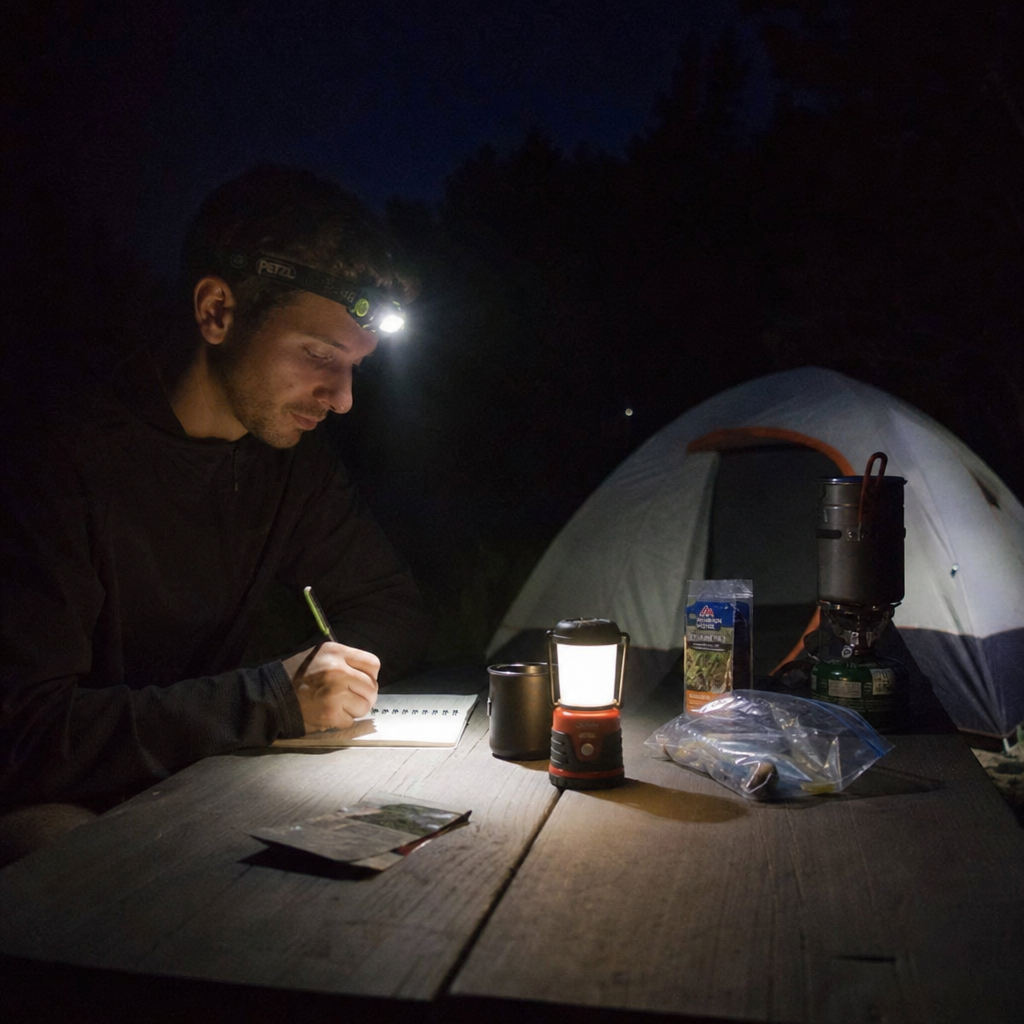
A headlamp should generally come before a decorative campsite light. The National Park Service recommends headlamps because they leave your hands free and advises carrying extra batteries. That makes personal lighting a practical foundation for cooking, organizing gear, and moving around after dark.
Do not shop by maximum brightness alone. Petzl explains that brightness and burn time are linked, so compare runtime at the setting you expect to use—not just the brightest mode advertised on the box. A comfortable everyday setting deserves more attention than a boost mode you rarely need.
For shared camp lighting, consider a lantern with adjustable brightness and a stable base or hanging point. Before departure, try it over your camp table and inside your shelter to judge whether the light feels useful or glaring. Keep personal headlamps accessible even when the group has a lantern, rather than making everyone depend on one shared light.
Navigation and communication need separate plans
Treat finding your way and contacting help as two different jobs. For navigation, the National Park Service recommends knowing how to use your map, compass, or GPS before heading out and bringing a physical map as backup. Download any digital maps you intend to use before departure.
Practice with your chosen navigation setup somewhere familiar. Find your locati0n, identify a junction, and work through the steps you would take after a wrong turn. The Appalachian Trail Conservancy cautions against relying exclusively on phones and apps and recommends carrying a map and compass—and knowing how to use them together.
For remote trips, investigate a satellite communicator or personal locator beacon rather than assuming ordinary cellular service will be available. NOAA identifies personal locator beacons as emergency signaling equipment for wilderness activities and emphasizes planning reliable communication. Choose according to the communication job you need, not simply the device’s size.
If you choose a subscription-based messenger, verify its service requirements and test it before leaving. Garmin’s inReach guidance calls for checking subscription status and testing outdoors with a clear view of the sky. Learn the controls beforehand, and make sure your companions know where the device is carried.
Also leave your itinerary with someone who is not joining the trip. Electronics should support that plan, not replace it. The National Park Service recommends naming an emergency contact and sharing your travel itinerary before camping.
When are solar panels and power stations worth carrying?
Solar panels are worth considering when your trip’s energy needs exceed the batteries you can reasonably carry and you expect sufficient direct sunlight. Power stations make more sense for vehicle-supported trips with larger charging needs than for a lightweight overnight hike. REI distinguishes handheld power banks from larger power stations and emphasizes matching portable power to travel style and energy demand.
Solar charging needs a realistic campsite plan
Before packing a panel, picture where it will sit during the day. A shaded forest campsite and a sunny open base camp offer very different charging opportunities. REI notes that clouds, terrain, shade, and panel orientation all affect solar performance; rated output reflects ideal conditions.
Check panel compatibility with your intended battery or power station before purchase. Then rehearse the setup at home: unpack it, connect it, identify the charging indicator, and confirm that you understand the instructions. Make solar part of your power plan rather than assuming an unopened panel will solve every charging problem.
Size a power station around actual equipment
List the devices you intend to run before comparing power stations. Goal Zero recommends looking at device wattage consumption when deciding what to power, and its range separates storage capacity from output options. Check both rather than assuming a physically larger unit automatically suits your equipment.
For each appliance, record its stated power requirements, intended daily use, and required connection. Then consult the power station manufacturer’s compatibility guidance and runtime information. If your list contains only a phone and a small light, reconsider whether you need a station at all.
Portable speakers belong in the optional category
Portable speakers can fit some social camping plans, but the setting should decide whether you use one. The National Park Service encourages protecting natural soundscapes, observing campground quiet hours, and minimizing electronic noise. Joshua Tree’s guidance goes further by encouraging visitors to leave portable speakers at home.
If music is appropriate at your destination, prioritize simple controls, manageable size, and clear manufacturer guidance on outdoor use. Decide where and when you would listen before adding a speaker to your packing list. Avoid buying extra volume you have no considerate place to use.
Check local rules rather than assuming quiet hours are the only restriction. For personal listening at camp, headphones are the more considerate option recommended in REI’s camping checklist. On shared trails, consider leaving entertainment switched off and enjoying the surroundings instead.
Choose comfort gadgets around a specific job
Once your essential setup is covered, optional outdoor gadgets deserve a simple test: what exactly will this improve? A rechargeable fan, dedicated camera, or e-reader may fit your plans, but none needs to come automatically. Give each one a specific purpose before accepting the packing and charging work.
Consider these possible uses:
Rechargeable fan: If you expect to use one while resting at camp, test its noise, placement, and runtime at your preferred setting before packing it.
Dedicated camera: Bring it when photography is a central activity, with a clear plan for batteries, storage, and carrying access.
E-reader: Consider one if quiet reading is part of the trip, and load your books before departure.
Electronic activity accessories: For items such as a bike computer or GPS watch, decide which information you actually need and practice using the relevant functions beforehand.
A useful buying rule is to explain the gadget’s job in one sentence. If that sentence simply repeats something another packed device already does adequately, leave it off the list for now.
Build and test one complete electronics kit
Do a rehearsal with the exact camping gadgets, cables, and charging equipment you plan to carry. This is your chance to catch awkward controls or a missing connector while the fix is easy. Pack everything afterward so the tested setup becomes the departing setup.
Use this pre-trip checklist:
Charge and inspect: Check every device’s charge level and review its manufacturer’s handling instructions.
Verify connections: Connect each device to its intended charger and confirm that charging starts.
Prepare navigation: Load your maps, check your route, and pack the physical backup recommended by the National Park Service.
Rehearse communication: Test your messenger using its approved procedure, and share your itinerary with your emergency contact.
Separate priorities: Keep essential lighting and communication power ahead of entertainment charging in your plan.
Make equipment accessible: Pack your headlamp where you can reach it before sunset, not beneath your sleeping gear.
Finally, remove anything without a clear purpose. A smaller kit that you understand is the goal—not a bag full of features you have never tried.
Pack for the experience, not the gadget collection
Start with your route, campsite, and essential tasks, then choose electronics to support them. My suggested priority is personal lighting, prepared navigation, and a tested charging setup, followed by communication equipment appropriate to your plans. Add comfort and entertainment only when they earn their space.
Before your next trip, review what you already own and test it together. The most useful camping accessories may already be in your drawer; what matters is knowing how they fit into a reliable, manageable kit.
Frequently Asked Questions About Portable Electronics for Camping and Outdoor Activities
What are the essential portable electronics I should bring for camping?
For camping, it's crucial to have a reliable headlamp, a navigation setup (like a GPS or physical map), and a portable charger to keep your devices powered. Additional items like communication devices and entertainment gadgets can be added based on your needs.
How do I choose the right portable charger for my devices?
When selecting a portable charger, consider its capacity, output connections, and compatibility with your devices. Ensure it matches the charging requirements of your phone, camera, or any other electronics you plan to bring.
Are solar panels worth bringing on a camping trip?
Solar panels can be beneficial if your energy needs exceed what you can carry and if you're camping in an area with plenty of sunlight. They are most effective for vehicle-supported trips where you can use larger power stations.
How can I test my camping electronics before the trip?
It's a good idea to rehearse using all your camping gadgets before your trip. Charge them, verify their connections, and confirm that you can navigate and communicate effectively with your devices. This practice will help catch any issues ahead of time.
What should I do if I lose cell signal while camping?
Always plan for limited or no cell service. Carry a physical map and compass as backups for navigation and consider bringing a satellite communicator or personal locator beacon for emergency situations, especially in remote areas.