Back To Blog
Best Home Products to Sell on Amazon in 2027
The best home products to sell on Amazon in 2027 are worth researching in practical categories such as organization, cleaning, soft furnishings, bathroom storage, and everyday household accessories.
Drawer dividers, compact under-sink organizers, microfiber cloth sets, cushion covers, shower caddies, and cable management kits give sellers specific problems to solve without necessarily requiring complicated electronics or oversized inventory.
However, this is a forward-looking product shortlist , researched on October 20, 2026, rather than a confirmed ranking of 2027 best sellers; next year's sales results do not exist yet.
The opportunity is to identify products you can improve, validate their demand, and sell at a price that covers every meaningful expense.
Imagine two nearly identical storage baskets: one arrives bent, has confusing measurements, and fits poorly, while the other stacks securely, includes clear dimensions, and solves a recognizable storage problem.
The second seller has built a reason to buy that goes beyond a cheaper price. This guide focuses primarily on Amazon.com in the United States , with product recommendations presented as editorial judgments rather than verified sales forecasts.
You will find twelve ideas, practical ways to differentiate them, sourcing considerations, and a financial framework to help you choose products with a defensible business case.
Why Home Products Deserve a Place on Your 2027 Shortlist
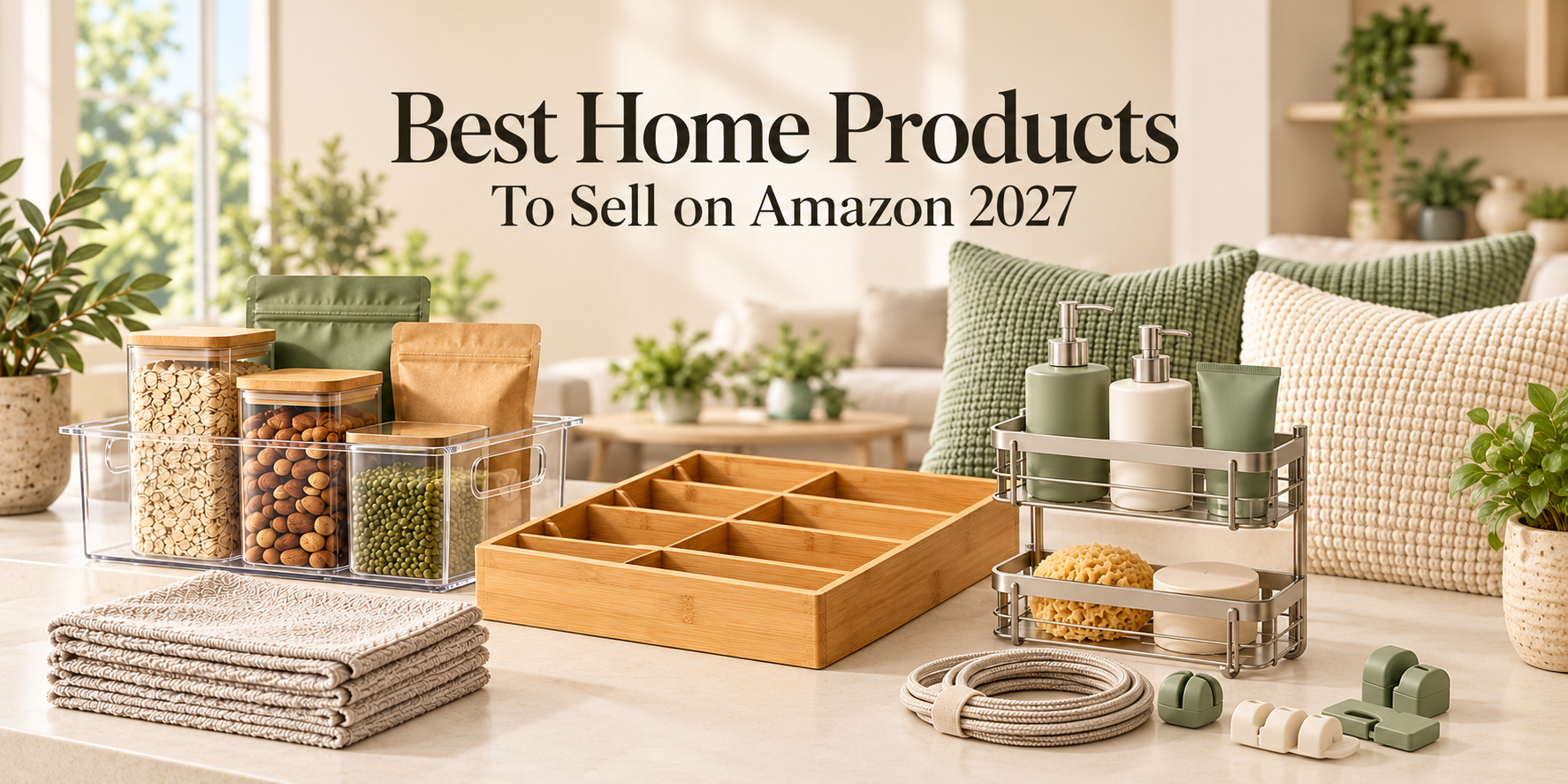
Home products offer a useful starting point because their benefits can often be demonstrated through ordinary situations: a cluttered drawer, a crowded bathroom counter, a sofa that needs refreshing, or charging cables that keep falling behind a desk.
That makes it easier to connect product development with a clear customer need, although competition and profitability still require careful research.
Amazon's own product guidance, updated September 29, 2026, identifies Home & Kitchen among categories that can sell well and recommends researching demand regularly because trends change.
The same guidance describes small, lightweight, durable products as potentially suitable for beginners, which supports a sensible selection principle: start with products you can ship reliably and explain clearly.
Sell on Amazon For 2027 planning, the stronger approach is to look for a repeatable household problem and then ask whether existing products leave customers dissatisfied.
A storage accessory might need better dimensions, a cleaning cloth might need stronger stitching, or a decorative textile might need more accurate color photography.
These improvements are less glamorous than predicting the next viral gadget, but they are concrete enough to test before placing a large order.
Think of your product as a helpful household tool with a specific job; the more precisely you define that job, the easier it becomes to evaluate its design, listing, packaging, and eventual customer feedback.
Comparing 12 Home Product Ideas for Amazon
The following comparison is a research shortlist, not a live Amazon sales leaderboard, and the price bands are illustrative positioning targets rather than verified marketplace averages.
They show how different products might fit a business model, but actual selling prices must be checked against current listings, pack quantities, material quality, and promotional activity.
A cloth set priced at $19 could be attractive or unrealistic depending on its size, construction, quantity, and competitive alternatives. Likewise, a $30 organizer may look profitable until its packaging pushes fulfillment costs above your original estimate.
Use the table to identify two or three candidates that match your sourcing experience and available capital, then replace every assumption with evidence.
The most useful comparison is often between complete offers rather than isolated objects: what does the customer receive, how well does it work, and what does it cost you to deliver that experience?
You should also consider whether an improvement can be protected through consistent manufacturing, distinctive design, or a recognizable brand experience.
If competitors can reproduce the entire offer immediately from a stock supplier catalog, your advantage may be fragile. A promising product therefore needs a combination of practical usefulness, manageable costs, dependable quality, and a reason customers would select your listing over established alternatives.
| Product idea | Illustrative retail target | Differentiation opportunity | Main issue to investigate |
|---|---|---|---|
| Adjustable drawer organizers | $18–$30 | Better fit and secure dividers | Slipping or inaccurate dimensions |
| Under-sink organizers | $23–$40 | Plumbing clearance and stable construction | Bulk and awkward installation |
| Pantry organizers | $20–$35 | Useful sizes and secure stacking | Shipping volume |
| Refrigerator bins | $20–$35 | Narrow configurations and comfortable handles | Cracking and fit |
| Microfiber cloth sets | $15–$25 | Task-specific textures and clear labeling | Lint and commodity pricing |
| Reusable lint removers | $15–$25 | Surface-specific performance | Fabric damage |
| Cushion covers | $18–$30 | Distinctive texture and dependable sizing | Color mismatch |
| Washable table linens | $18–$35 | Coordinated sets and easy care | Shrinkage and stains |
| Shower caddies | $20–$35 | Drainage and durable construction | Adhesive or coating failure |
| Bathroom countertop organizers | $20–$35 | Easy cleaning and efficient layouts | Fit and bulky packaging |
| Cable management kits | $15–$25 | Complete kits for defined desk setups | Adhesive failure |
| Bedside storage organizers | $18–$30 | Secure attachment and practical pockets | Sagging or incompatibility |
Best Home Products to Sell on Amazon in 2027
Choosing among these products starts with identifying the customer you want to serve, because “people who own homes” is too broad to guide a useful offer. An apartment renter with limited cabinet space has different needs from a family organizing a large pantry, even when both shoppers search for storage products.
You can narrow your offer around a room, a task, a household type, or a physical constraint, such as shallow drawers or narrow bathroom counters. That focus gives you a practical way to select dimensions, materials, colors, packaging, and photographs without adding features that increase cost but contribute little value.
Consider a basic cable kit: a random collection of clips competes mainly on quantity and price, while a thoughtfully configured kit for a two-monitor home office has a clearer purpose. The same reasoning applies throughout this list, from cleaning accessories to decorative textiles. Before treating any recommendation as a launch candidate, write a simple sentence describing the customer, the problem, and your proposed improvement.
If you struggle to complete that sentence without vague phrases such as “premium quality” or “better lifestyle,” continue your research. The products below become stronger opportunities when you can explain their value through a specific, observable benefit and verify that customers care enough about that benefit to purchase.
1. Drawer Organizers and Under-Sink Storage
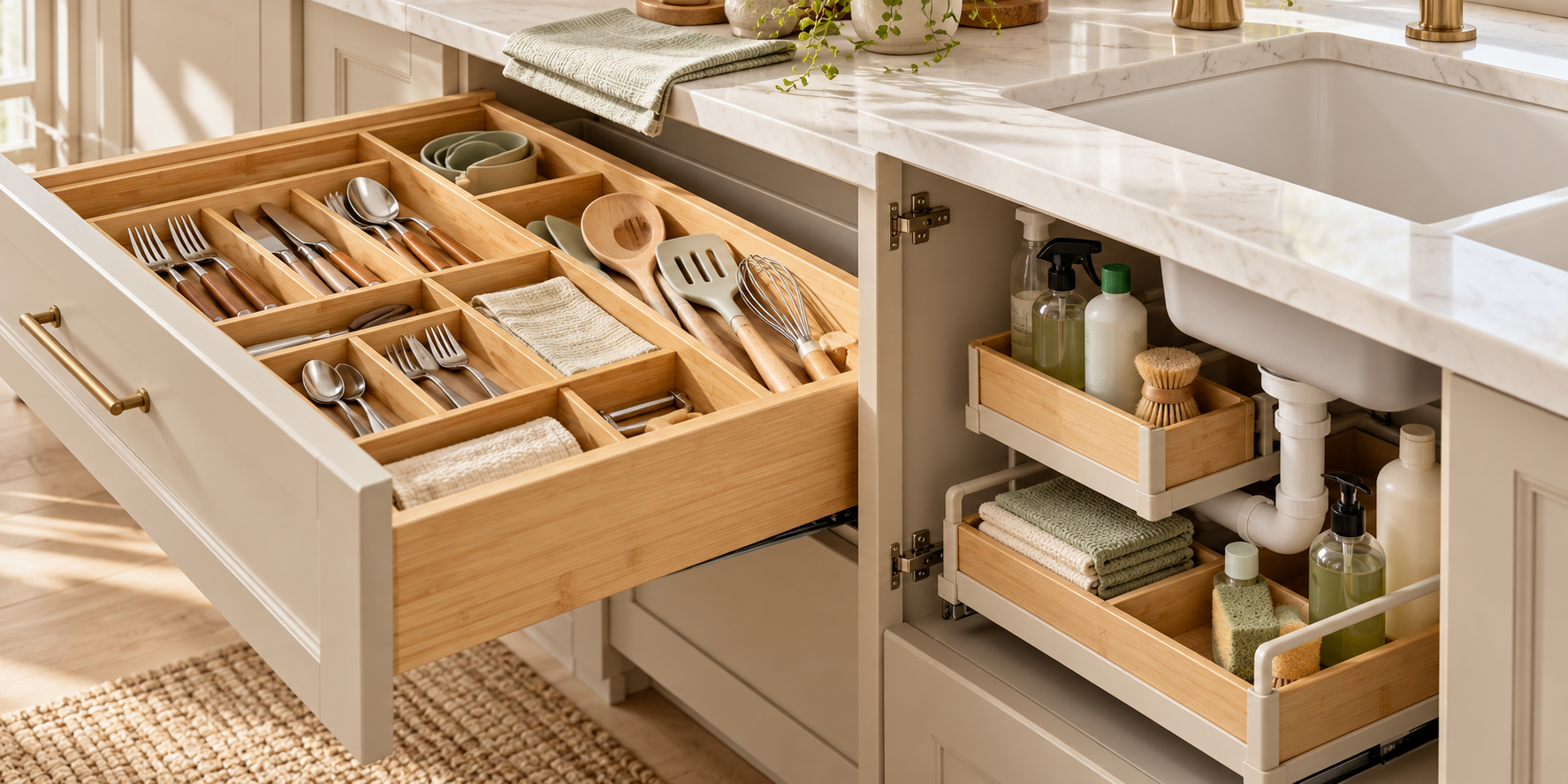
Drawer organizers and under-sink storage are useful candidates because they address visible problems that product photography can explain quickly, but fit and construction determine whether the promise survives real use.
For drawer organizers, consider adjustable dividers, modular trays, or coordinated compartments designed around a defined drawer size and task. A kitchen utensil system needs different proportions from a bathroom grooming organizer, so avoid assuming that one layout serves every room equally well.
Check whether dividers stay in place, whether contact surfaces leave marks, and whether the usable interior dimensions match the listing. Under-sink products require even more attention because pipes, cabinet hinges, disposal units, and cleaning bottles can obstruct an otherwise attractive design.
A compact organizer with an offset shelf or useful clearance may solve a better problem than a larger generic rack, provided the structure remains stable during normal handling. Ask suppliers for assembled and packaged measurements, then test samples in realistic spaces instead of relying entirely on renderings.
Your listing should show installation requirements, clearance points, and a simple measurement guide that helps shoppers decide before ordering. A strong starting offer might focus on narrow bathroom cabinets or shallow kitchen drawers, giving customers a clear reason to choose it while giving you a manageable set of specifications to inspect.
2. Pantry Organizers and Refrigerator Bins
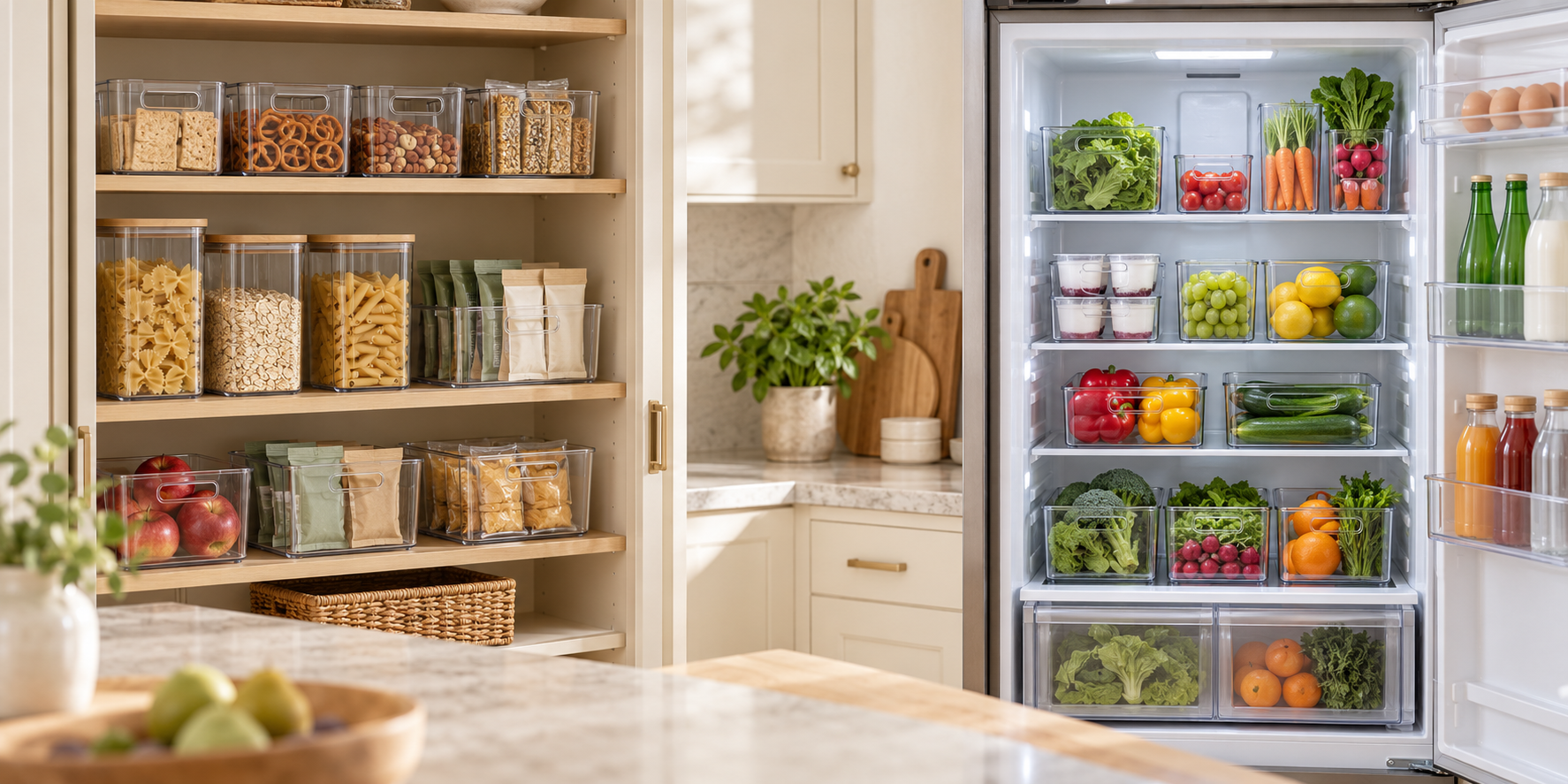
Pantry organizers and refrigerator bins deserve investigation when you can offer a configuration that makes everyday storage easier without creating excessive shipping costs. The first design question is whether the product is a general organizer or is intended for direct food contact, because that distinction affects material selection, documentation, and the claims you can support.
A bin for packaged snacks does not have the same intended use as a container holding cut fruit, and supplier descriptions should not blur those applications. For pantry systems, look for useful combinations of narrow and wide pieces, comfortable handles, and stacking features that remain dependable under the intended load.
Refrigerator bins need careful attention to shelf depth, drawer clearance, low-temperature handling, and whether users can remove them without disturbing everything around them. Test samples for cracking, sharp edges, difficult cleaning, and the strength of handles rather than judging them only by transparency or appearance.
Packaging also matters: a nested set may ship efficiently, while another arrangement traps large amounts of empty space inside the carton. Show customers exactly what common items fit, and make the dimensions easy to understand through photographs and diagrams. The strongest offer is likely to be a well-proportioned system for a particular storage task, supported by accurate information and dependable materials, rather than an oversized assortment assembled mainly to advertise a high piece count.
3. Microfiber Cleaning Cloths and Reusable Lint Removers
Microfiber cleaning cloths and reusable lint removers offer relatively compact product formats, but a low purchase cost alone does not establish an attractive business. Cleaning cloths compete on properties customers notice during use, including absorption, lint release, streaking, edge durability, and how well the fabric performs after repeated washing. Instead of creating a large pack of nearly identical cloths, consider a purpose-built set with distinct textures or colors for glass, kitchen surfaces, and general dusting.
Explain those differences clearly and verify them through practical testing, because decorative labeling cannot compensate for poor performance. Reusable lint removers require a similarly specific approach: a tool that works on upholstery may behave differently on knitted clothing, delicate fabric, or a loosely woven blanket.
Test the intended surfaces and describe limitations accurately so customers understand where the product belongs. Useful improvements might include an easier-to-empty collection chamber, a more comfortable grip, or a design that stores neatly beside household cleaning supplies. Avoid broad performance or environmental promises that you cannot substantiate with evidence relevant to the finished product.
For sourcing, compare samples across multiple suppliers and repeat the same cleaning tasks under similar conditions, then record what happens after washing or continued use. A smaller, clearly explained cleaning system can offer more convincing value than a large generic bundle if it helps customers complete a familiar chore with less frustration.
4. Cushion Covers and Washable Table Linens
Cushion covers and washable table linens allow sellers to build recognizable collections through texture, color, and coordinated design, although their appeal depends heavily on accurate presentation. A customer buying a cushion cover usually wants more than a functional fabric envelope; they want an item that works with their room, feels appropriate, and looks close to the photographs when it arrives.
Etsy’s spring and summer 2026 trend reporting describes interest in expressive, personal interiors, which provides a directional design signal rather than proof of Amazon demand or a confirmed 2027 trend. etsy.com Translate that signal into testable options, such as textured neutrals, restrained patterns, or coordinated dining textiles, and then validate those options within your target marketplace.
For cushion covers, inspect zipper construction, seam strength, finished dimensions, and consistency between units; show clearly whether inserts are included. For table linens, test laundering, shrinkage, color transfer, and how easily the material returns to a presentable condition after normal use.
Photograph samples under consistent lighting and include close-up images that help customers understand the weave or surface texture. A restrained initial assortment can make quality control and stock planning easier than launching many colors at once. Build the collection around an identifiable style and dependable specifications so customers can understand both its appearance and its practical value before purchasing.
5. Shower Caddies and Bathroom Countertop Organizers
Shower caddies and bathroom countertop organizers can offer a strong visual selling proposition because customers can immediately see the difference between crowded surfaces and an orderly arrangement. However, the bathroom is an unforgiving environment for weak coatings, poor drainage, unstable shelves, and unreliable mounting systems.
For shower caddies, examine how water leaves the tray, whether bottle bases sit securely, and whether edges or hooks create awkward contact points. If the product uses adhesive mounting, test the intended surface types and follow a documented installation method instead of relying on a supplier’s broad load-capacity claim.
Wall texture, moisture, preparation, and installation conditions can all affect how the finished system performs, so your instructions and photography should make compatibility understandable. Countertop organizers need a different balance of stability, useful compartment sizes, and surfaces that are easy to wipe clean.
A narrow organizer designed for a small vanity may have a clearer customer than a bulky rotating unit presented as suitable for every bathroom. Check whether tall bottles make the product unstable, whether removable components are practical, and whether the packaging protects corners and fittings. The goal is to deliver a product that remains convenient after weeks of daily use, supported by honest measurements and instructions that help buyers select the right configuration.
6. Cable Management Kits and Bedside Storage
Cable management kits and bedside storage organizers are worth evaluating as products that solve small but persistent annoyances around desks, sofas, and beds. A useful cable kit might combine reusable straps, sleeves, and clips selected for a particular setup rather than simply adding more pieces to the package.
Think through a complete task, such as organizing a home-office desk with two monitors, a laptop charger, and a power strip, then decide which components actually help. Adhesive parts need testing on intended surfaces, and instructions should explain preparation and limitations without promising universal performance.
Bedside storage requires a different assessment because mattress thickness, bed-frame shape, attachment method, and pocket layout affect compatibility. A pocket that looks spacious in a photograph may sag when loaded with a book and tablet, while a poorly positioned attachment flap can slip during ordinary use.
Test realistic contents, repeated access, and the strength of seams or fasteners before choosing the final specification. Photography should make attachment methods obvious and show the size of the items each compartment can hold. These categories are especially suited to a focused offer because the customer problem is easy to describe in everyday language. The opportunity lies in making the product fit a defined situation reliably, with a complete set of useful parts and enough guidance to prevent avoidable disappointment.
How to Validate Demand Before Ordering Inventory
Start your Amazon product research with customer needs and marketplace evidence, then use supplier quotations to determine whether the opportunity can support a business. Amazon’s Product Opportunity Explorer provides information on search behavior, purchasing, competition, reviews, and returns, allowing sellers to investigate niches and identify areas of unmet demand.
On Amazon’s tool page, founder Josh Gilliam describes one benefit as: “Getting insights from Opportunity Explorer into why customers are purchasing has been incredibly helpful.” That is a seller testimonial rather than an independent forecast, but it captures the value of understanding purchase motivation before choosing inventory.
Sell on Amazon Examine competing offers across relevant searches and record their prices, pack sizes, dimensions, materials, presentation, and recurring complaints. Look for patterns across several listings rather than treating one negative review as proof of a market gap. A repeated complaint about narrow compartments may justify testing a different layout, whereas a rare complaint about packaging may require a simpler operational fix.
Compare demand across time where data is available, since a holiday spike and steady household demand suggest different purchasing plans. Finish with a written hypothesis: who needs the product, what existing offers fail to provide, and how your version addresses that problem. Approve inventory only when customer evidence, sample performance, and financial calculations support the same decision.
How to Source Home Products From China
Sourcing home products from China works best when you approach suppliers with a clear specification rather than a photograph and a request for the lowest price. Define the product’s dimensions, materials, finish, construction, colors, included components, packaging, and intended use, then ask suppliers to quote against the same requirements.
For textiles, include fabric composition, finished measurements, stitching details, and care expectations; for organizers, include wall thickness where relevant, assembly requirements, and the loads or conditions you intend to test. Request samples from more than one supplier so you can compare actual performance and communication rather than selecting only from catalog images.
A marketplace listing or factory claim should be treated as a starting point for verification, especially when the product requires technical documentation or specific material properties. Keep an approved sample and a written inspection checklist so production expectations remain concrete after payment.
Packaging deserves its own review because damage, missing parts, and inflated carton size can undermine an otherwise sound product. If you work with a sourcing partner, define their responsibilities for supplier checks, sample coordination, inspection, consolidation, and shipment preparation before the order proceeds. Calculate the cost of delivering consistent finished goods, including foreseeable inspection and rework, because an inexpensive unit becomes costly when quality problems arrive with the shipment.
How to Calculate Profit Before Launching
A promising product needs a unit economics calculation that includes the expenses between the supplier’s quotation and the customer’s completed order. Amazon’s current US pricing page lists a 15% referral fee for Home and Kitchen, with a $0.30 minimum, and a $39.99 monthly Professional selling plan, while other services can add costs; these are current reference points and should be checked again when planning a 2027 launch.
Sell on Amazon The example below uses an assumed $29.99 selling price and hypothetical expenses to demonstrate the calculation, rather than quoting a fulfillment fee for a real product. Its $6.49 contribution is the amount remaining before fixed overhead and taxes under those assumptions, so it should not be presented as guaranteed net profit.
Replace each figure with your supplier quote, packaged measurements, fulfillment estimate, and advertising expectations. Separate freight, import-related costs, inbound preparation, and inventory charges carefully so expenses are counted once and nothing material disappears between spreadsheets. Then stress-test the result by increasing advertising costs, reducing the selling price, or allowing for slower sales.
A product that only works under your most optimistic assumptions leaves little room for ordinary problems. Your launch decision should also consider cash timing, since paying for a reorder before receiving proceeds from the first shipment can strain a business that appears profitable per unit.
| Illustrative item | Amount per unit |
|---|---|
| Selling price | $29.99 |
| Product and retail packaging | −$6.00 |
| Freight, import-related costs, and inbound preparation | −$2.00 |
| Referral fee at 15%, rounded | −$4.50 |
| Assumed FBA fulfillment expense | −$4.50 |
| Advertising allowance | −$5.00 |
| Storage and returns allowance | −$1.50 |
| Contribution before fixed overhead and taxes | $6.49 |
Conclusion
The best home products to sell on Amazon in 2027 will be the products that combine validated customer demand with a useful improvement, dependable supply, and enough margin to withstand real operating costs.
Drawer organizers, cleaning accessories, compact storage systems, cushion covers, table linens, bathroom organizers, and cable management kits provide practical starting points because their customer problems can be described and tested clearly. Their inclusion here does not establish future sales rankings, and the strongest choice for your business may be a narrow version of one product rather than an entire category.
Begin with a manageable shortlist, study competing offers, and request samples against written specifications before committing to a production order. Make the purchasing decision only after the samples demonstrate the benefit you plan to advertise and the financial model survives less favorable assumptions.
Your first launch should also teach you something useful about customer fit, packaging, return reasons, and replenishment, so keep the assortment focused enough to interpret those results. A successful home-product business can grow from a small improvement applied consistently: a divider that stays secure, a cover that matches its dimensions, or a caddy that drains properly. Build around a household problem you understand, then make the finished product, listing, and delivery experience support the same promise.
Frequently Asked Questions About Home Products for Beginner Amazon Sellers
The questions below address the decisions that usually turn a product idea into an actual launch: choosing a manageable first item, assessing profit, setting a budget, selecting fulfillment, and building differentiation. These decisions should be considered together because changing one can alter the others significantly.
A large storage product may look attractive at the sourcing stage but require a different fulfillment approach, while a compact textile product may need more investment in photography and variation management than you first expected. Similarly, a lower minimum order can reduce initial inventory spending while increasing the purchase cost per unit, which may change your advertising budget and achievable margin.
Use the answers as a framework for comparing options rather than as universal rules for every seller. Your target marketplace, business experience, available capital, and supplier relationships will influence the final choice.
Before purchasing stock, gather enough evidence to explain why customers would buy the product, how you will deliver it reliably, and what remains after selling expenses. Write those assumptions down and revisit them after the first sales arrive. That habit makes it easier to distinguish a product that needs a small adjustment from one whose underlying economics or customer fit require a more substantial change.
What Are the Best Home Products for Beginner Amazon Sellers?
For beginners, compact, durable home accessories with straightforward specifications are often sensible products to investigate, including cushion covers, microfiber cloth sets, drawer organizers, and simple cable management kits. These examples can make sample inspection and product explanation more manageable, but each still needs evidence of customer demand and a realistic cost structure.
The right starting item is one you can evaluate confidently: you should know what good construction looks like, which dimensions matter, and how customers will use it. If you cannot tell whether a sample performs acceptably, spend more time learning the category before placing an order.
Avoid launching a broad assortment simply because the supplier offers a low price on multiple designs, since every variation adds purchasing and inventory decisions. A narrow range allows you to concentrate on accurate photography, clear measurements, packaging quality, and a reliable replenishment process.
Consider your personal advantages as well: access to textile factories may make cushion covers easier to develop, while experience with molded products may help you evaluate organizers more effectively.
Your first product should fit your ability to inspect and improve it as much as your budget. Choose a specific household problem, establish what a successful solution must do, and order only when the sample, customer research, and financial calculation support that standard.
Which Home Products Offer the Best Profit Potential?
The home products with the best profit potential are those whose perceived value can support a selling price comfortably above the full cost of sourcing, fulfillment, advertising, returns, and ongoing operations.
No category guarantees that result, and the cheapest factory quotation can be misleading when the product occupies a large carton or needs expensive customer acquisition. Compact textile sets, specialized organizer kits, and well-designed cleaning accessories are worth comparing because sellers may be able to differentiate them through construction, configuration, or presentation. However, those advantages need to matter to customers rather than existing only in the seller’s description.
A better zipper can improve a cushion cover, but the financial benefit depends on whether it reduces problems or supports a credible offer at the intended price. Evaluate at least a conservative, expected, and optimistic scenario for each shortlisted item, using the same expense categories so comparisons remain fair.
Include inventory-related costs and the consequences of slow sales, not just the expenses attached to a successful order. Also consider whether the product can be replenished consistently without introducing defects or unexpected price increases. The strongest profit opportunity is usually the product where customer value, manufacturing reliability, shipping efficiency, and realistic acquisition costs work together, leaving a margin that survives ordinary fluctuations.
How Much Money Do You Need to Start Selling Home Products?
Your Amazon home-product startup budget depends on the product, minimum order quantity, customization, shipment size, required testing, and how you plan to acquire customers.
A compact item purchased in a small run can require a very different commitment from a custom organizer with new tooling and bulky packaging. Build the budget from the actual steps involved: samples, product development, inventory, packaging, inspection, transport, inbound preparation, photography, selling expenses, and advertising. Keep a separate reserve for unexpected problems and replenishment rather than spending the entire amount on the first production order.
For illustration, a $6,000 planning budget could allocate $2,000 to goods, $1,000 to logistics and preparation, $1,000 to samples and creative work, $1,000 to launch activity, and $1,000 to contingency. Those amounts are hypothetical and may be unsuitable for a particular product, especially where testing, tooling, or import-related charges add significant expense.
Replace them with quotations before deciding that your available capital is sufficient. Cash timing matters too, because the next order may need funding while much of the first shipment remains unsold. Start with an assortment small enough to monitor closely and large enough to test the business case meaningfully, then increase purchasing only when sales, returns, and replenishment performance justify the commitment.
Should You Use Amazon FBA for Home Products?
Amazon FBA can be suitable for home products when the packaged item’s dimensions, weight, selling price, and expected sales support the associated costs. It can also suit sellers who prefer to outsource much of the physical order-fulfillment work, but the decision should begin with the finished package rather than the unpackaged sample.
A lightweight organizer may still occupy substantial space, and protective packaging for a fragile item can change its economics considerably. Compare FBA with merchant fulfillment using realistic storage, handling, transport, and service costs for each option. Ask how quickly the product is likely to sell, how much inventory you plan to hold, and what happens if demand is slower than expected.
A compact cushion-cover set and a bulky bathroom rack may require different answers even if their selling prices are similar. Use Amazon’s current calculation tools and fee information when evaluating the actual item, and refresh the estimate before a 2027 shipment. Packaging changes deserve another calculation because small dimensional differences can affect your assumptions.
The best fulfillment method is the one that delivers the required customer experience at a sustainable total cost while matching your operational capacity. Make the choice product by product instead of treating one method as automatically appropriate for an entire home-products catalog.
How Can You Make Home Products Stand Out on Amazon?
To differentiate home products on Amazon , start with a recurring customer frustration and make an improvement buyers can understand without a long explanation. That could mean dividers that stay in place, cushion covers with consistent finished measurements, bathroom trays that are easier to clean, or a cable kit containing the right components for a clearly defined setup. Read reviews across competing products and distinguish repeated, practical complaints from isolated preferences.
Then translate the chosen improvement into a measurable specification so the supplier knows exactly what must change. Your listing should demonstrate the benefit through accurate photography, dimensions, component details, and realistic use examples rather than relying on broad claims such as “ultimate” or “luxury.” Packaging and instructions can strengthen the offer when they help customers receive an undamaged item and use it correctly from the start.
A coherent collection can also support recognition, provided the additional products serve a related need and maintain consistent quality. Avoid adding unnecessary pieces simply to advertise a larger bundle, because customers still judge how well the main product works. Sustainable differentiation comes from delivering the promised improvement repeatedly, then using customer feedback to refine the design, presentation, and service experience. Give shoppers a specific reason to choose the product and make sure the item they receive fulfills that reason.