Back To Blog
Wholesale Water Flossers from China: Sourcing Guide
Sourcing water flossers wholesale from China means selecting a suitable product, verifying the supplier, checking compliance, and agreeing on quality standards before placing a bulk order.
For retailers, distributors, and private-label brands, the goal should be a repeatable supply arrangement—not simply the lowest factory quote.
This guide explains how to compare suppliers, evaluate samples, calculate costs, and prepare a first order with fewer avoidable risks.
How do you source water flossers wholesale from China?
Start with a written product brief, send the same requirements to shortlisted suppliers, and compare their responses on specifications, documentation, samples, and total cost. Before committing to production, confirm the requirements for your destination market and record acceptance criteria in the purchase agreement. Use a pilot order to evaluate the supplier before increasing your commitment.
Treat sourcing as a sequence of decisions rather than a race to negotiate:
Define the offer: Identify your customer, sales channel, preferred format, and intended selling position.
Shortlist suppliers: Check business identity, manufacturing arrangements, and model-specific documentation.
Evaluate samples: Compare performance and usability against a consistent checklist.
Confirm commercial terms: Agree on specifications, payment milestones, inspection, and defect remedies.
Review delivery results: Inspect incoming stock and track problems before reordering.
Decide your nonnegotiables before requesting prices. Otherwise, a cheaper quote can quietly change what you are buying.
Build a product brief around your customer
Before searching for wholesale portable water flossers, describe the experience you want customers to have. A travel-focused product brief might prioritize packed dimensions, a secure reservoir closure, and a protective case. A home-use brief might give greater weight to grip comfort, controls, reservoir access, and straightforward cleaning.
Avoid specifying features simply because they appear in competing listings. Instead, connect each requested feature to a use case and a method of verification.
|
Requirement |
What to ask the supplier |
What to check on samples |
|---|---|---|
|
Reservoir |
Usable capacity and removal method |
Filling, draining, cleaning access, and seal fit |
|
Operating modes |
Mode behavior and startup settings |
Clear differences and predictable controls |
|
Charging |
Input requirements and included accessories |
Connector fit and documented charging behavior |
|
Nozzles |
Included types and replacement availability |
Secure attachment and straightforward removal |
|
Packaging |
Contents, dimensions, and labeling options |
Product protection and accurate instructions |
Request measurable specifications where they matter, including the supplier’s test methods and tolerances. Treat pressure ranges, runtime, and waterproofing statements as claims to verify, not automatic evidence of quality.
If you already sell dental hygiene products, consider how replacement tips, support instructions, and packaging will fit your existing range. A product should make sense operationally as well as visually.
Find suppliers and establish who does the work
When researching portable water flossers wholesale in China, use marketplaces, manufacturer websites, trade-show exhibitor directories, or sourcing referrals as starting points. Apply the same verification process regardless of where the introduction comes from. A polished listing should not replace a review of the business behind it.
Ask whether the seller manufactures the model, contracts production elsewhere, or purchases finished units for resale. Do not automatically reject an intermediary; instead, establish who controls specifications, inspection, production changes, and corrective action.
Request a supplier information pack covering:
Registered business name, business license, production address, and contracting entity.
The exact model number, specification sheet, and available customization options.
Which production and testing activities happen at the named facility.
Minimum order quantities for standard stock, logo printing, custom colors, and packaging.
Sample arrangements, production scheduling, and replacement-part support.
Relevant reports identifying the tested product and the issuing organization.
Arrange a live facility walkthrough or an independent assessment when the commitment justifies it. Ask to see the proposed model and its production or testing process, rather than accepting a general showroom presentation.
Investigate any mismatch between the seller, contract, invoice, and payment beneficiary before paying. Ask for a documented explanation of legitimate differences rather than assuming names must always match.
Compare quotes on the same basis
To compare water flosser deals fairly, send every shortlisted supplier the same request for quotation. Specify the model requirements, order quantity, colors, accessories, packaging, destination, and requested shipping terms. Ask suppliers to identify exclusions explicitly.
Separate the base product cost from logo application, packaging setup, samples, testing, tooling, and other charges. Request price breaks at realistic order quantities, but do not let a volume discount dictate your first commitment.
For portable water flossers wholesale, distinguish the minimum order quantity for an existing model from the minimum for each customization. Ask whether a mixed-color order is possible and whether each color requires separate packaging production.
Keep a comparison sheet with columns for cost, specification gaps, missing evidence, and unresolved questions. A quote is not truly comparable until you understand what it includes.
Verify compliance before approving the order
For U.S. sales, begin by confirming the regulatory classification of the exact product and its intended claims. FDA lists oral irrigation units under product code EFS as Class I and 510(k)-exempt, subject to applicable limitations. Do not assume that every design or marketing claim fits that category; have a qualified regulatory adviser confirm the requirements for your model.
Next, distinguish registration from product authorization. FDA expressly states that establishment registration and device listing do not indicate approval, clearance, or authorization. A supplier’s “FDA certificate” should therefore never be treated as proof that a product is approved for sale.
For imported medical devices, FDA checks applicable requirements such as registration, listing, labeling, and any required premarket submission. Accurate manufacturer and product information matters because incomplete or inconsistent entry information can delay review. Confirm your own obligations as importer or private-label business rather than relying solely on the factory’s documents.
For rechargeable models containing lithium batteries, request the applicable UN 38.3 test summary and have your freight provider check the shipping requirements. PHMSA explains that lithium batteries must undergo the relevant design tests and identifies the information required in the summary. Match the battery documentation to the battery used in your product.
Build a document checklist with your adviser, testing laboratory, and logistics provider before paying a production deposit. Specify who obtains each document, who reviews it, and when approval is required. For other destinations, repeat this review under that market’s requirements instead of treating U.S. documentation as universally sufficient.
Test samples against a written acceptance plan
Order samples from your strongest candidates and evaluate them under the same conditions. Ask each supplier to identify the sample’s model, configuration, and production status. Record any differences between the sample and the proposed bulk order.
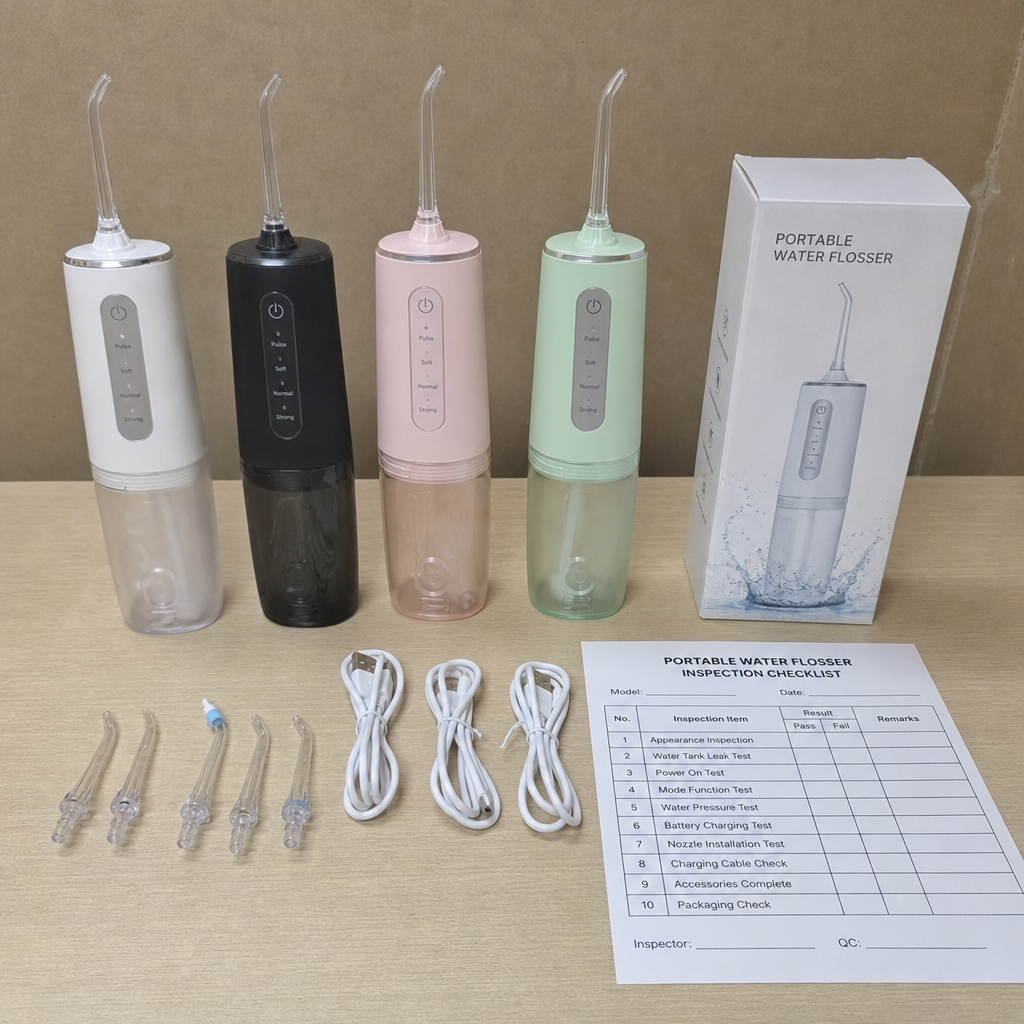
Your evaluation should cover more than appearance:
Handling: Check grip, button placement, nozzle attachment, and ease of filling.
Water containment: Observe the tank, seals, and connections during intended use and handling.
Operation: Compare startup behavior, mode selection, and consistency against the agreed specification.
Charging: Check supplied accessories and operation against the manufacturer’s instructions.
Maintenance: Assess access for emptying, drying, and cleaning.
Instructions: Confirm that setup, warnings, charging, and care directions match the model.
Do not substitute informal use tests for required laboratory testing. Ask an appropriate laboratory to assess safety or performance claims that need technical verification.
Keep an approved reference sample and attach its specification to the order. Require written permission before changes to components, materials, firmware, accessories, or packaging. That gives both sides a clearer basis for resolving discrepancies.
What does a wholesale order really cost?
The useful comparison is the landed cost of saleable stock, not the supplier’s unit price alone. Build your estimate from the goods, customization, quality checks, transport, import charges, and delivery to your warehouse. Then assess the margin remaining after fulfillment, selling costs, and an allowance for service issues.
Use this planning structure:
Estimated landed cost per saleable unit = total acquisition and inbound costs ÷ expected saleable units.
Keep assumptions visible. Include sample evaluation, packaging setup, inspection, freight, insurance, brokerage, duties, and applicable additional tariffs where relevant. Model a less favorable scenario for freight changes, delays, or rejected units rather than assuming everything goes perfectly.
Ask a customs broker to confirm the correct tariff classification and current charges for your model. CBP has issued classification rulings specifically addressing oral irrigation devices, including revoking earlier rulings, so do not simply copy a code from an old supplier invoice.
For water flossers wholesale in China, request the named shipping term, named place, and a written breakdown of included services. Ask your logistics provider to explain responsibility for export handling, international transport, customs clearance, and final delivery. Resolve ambiguity before comparing shipping quotes.
Put customization, payment, and quality terms in writing
For a first private-label order, consider an existing model with limited branding before commissioning extensive changes. Ask suppliers to quote each option separately so you can weigh the customer benefit against the added commitment. Reserve deeper customization for features your customers actually value.
Approve artwork on a complete packaging proof, including accessories, instructions, warnings, identifiers, and any product claims. Avoid copying a competitor’s appearance, photographs, or wording. Obtain appropriate intellectual-property advice if your proposed design raises questions.
Your purchase agreement should define:
The exact model, approved specifications, materials, accessories, and packaging.
Order quantities and agreed treatment of shortages or overproduction.
Production milestones and payment conditions.
Inspection scope, sampling approach, and defect acceptance criteria.
Remedies for nonconforming goods and responsibility for related costs.
Warranty handling, spare parts, and procedures for reporting recurring faults.
Negotiate payment milestones around identifiable deliverables, such as sample approval or inspection results. For significant commitments, have qualified counsel review enforceability and dispute-resolution terms. Do not leave important promises scattered across messages.
Inspect the first shipment and learn before scaling
Arrange an independent pre-shipment inspection against your approved specification and reference sample. Give the inspector explicit instructions about functional checks, accessories, labeling, packaging, and carton quantities. Agree in advance on what happens if the order fails inspection.
Ask the supplier to explain its routine production controls separately. A final inspection should be one checkpoint in your purchasing process, not the only discussion you have about quality. Retain reports, photographs, and approvals together with the purchase records.
When stock arrives, check shipment condition and reconcile quantities before releasing it for sale. Record batch identifiers where available, preserve representative samples, and make the customer-support instructions accessible to your team.
Use early results to guide the next order. Track problems by model and batch, distinguishing product faults from unclear instructions, missing accessories, or shipping damage. Share documented issues with the supplier and agree on corrective action before increasing volume.
Build a sourcing process you can repeat
Successful wholesale sourcing starts with a clear product brief and ends with evidence that delivered stock matches it. Prioritize verifiable documents, comparable quotations, approved samples, and enforceable purchasing terms over an attractive headline price.
Before contacting suppliers, prepare one specification sheet and one comparison checklist. Those two documents will help you ask better questions, identify gaps, and choose a supplier you can evaluate—not merely one you hope will deliver.
Frequently Asked Questions About Water Flossers Wholesale from China
What should I include in a product brief when sourcing water flossers?
When creating a product brief, include details about your target customer, intended usage (e.g., travel vs. home use), required features (like reservoir capacity and charging methods), and any measurable specifications that ensure product quality.
How can I verify a supplier’s credibility?
Check their registered business name, business license, production address, and previous client reviews. Conduct due diligence by requesting a live facility walkthrough or an independent assessment to ensure they control production and quality.
What regulatory requirements should I consider for water flossers in the U.S.?
Water flossers fall under FDA regulations as Class I devices. Confirm the classification, establishment registration, and any necessary premarket submissions. Having a qualified regulatory adviser review the requirements for your specific model is essential.
How do I compare quotes from different suppliers effectively?
Send all shortlisted suppliers the same request for quotation with specific requirements. Keep a comparison sheet with details on cost, terms, and specifications, and ensure you understand what is included in each quote for a fair assessment.
What is the process for testing samples before placing a bulk order?
Order samples from the top candidates and evaluate them based on a written acceptance plan. Check for performance, usability, and adherence to specifications. It's also important to have laboratory testing conducted on samples that require technical verification.