Back To Blog
Best Smart Ring Manufacturers in China
China-based smart ring suppliers worth evaluating include J-Style, Shenzhen Yawell, Linktop, LONGVON, and COLMI, each offering a different mix of products, development services, or distribution support.
Their published capabilities make them useful starting points—not interchangeable choices or independently verified performance winners.
This guide compares their potential fit and explains what to check before choosing a manufacturing partner.
Which smart ring manufacturers in China should you shortlist?
Start with J-Style and Yawell for established wearable OEM/ODM offerings, LONGVON for project-scoped hardware and software development, Linktop for its NexRing and broader health-device portfolio, and COLMI for branded distribution and qualified customization discussions.
These recommendations reflect each company's published positioning, not factory audits or hands-on product testing. The right choice depends on whether you need a finished product, a customized platform, or a development partner.
Use this comparison to decide where to begin discussions:
|
Company |
Published offering |
Main point to verify |
|---|---|---|
|
J-Style |
JCRing products, customization, SDK/API integration |
Exact model capabilities and software deliverables |
|
Yawell |
Smart ring OEM/ODM and multiple ring designs |
Hardware configuration and app customization scope |
|
Linktop |
NexRing products and telehealth devices |
Commercial partnership terms and model-specific evidence |
|
LONGVON |
Hardware, firmware, app, and integration development |
Development milestones, access rights, and project costs |
|
COLMI |
Branded wholesale, distribution, and potential OEM/ODM cooperation |
Whether your project qualifies for customization |
The table summarizes official company materials; confirm availability and terms directly before ordering samples.
Five suppliers worth evaluating
J-Style: An integrated option for wellness product development
J-Style, also identified as Youhong Medical, presents JCRing as part of a broader digital-health wearable business. Its published services include industrial and mechanical design, firmware and app customization, manufacturing, and SDK/API integration.
That combination makes it worth investigating when your plan involves both a physical ring and a connected wellness service.
For example, a wellness platform could ask J-Style to demonstrate how ring measurements reach an existing member dashboard. Request documentation and a working sample integration rather than accepting “API available” as a complete answer. Establish which metrics are accessible, how frequently they synchronize, and whether integration support continues after launch.
Also separate ordinary wellness functions from medical-sounding marketing. Ask for evidence tied to the exact model, algorithm version, intended use, and sales market before repeating any health claim in your own advertising.
Shenzhen Yawell: Multiple hardware directions to compare
Shenzhen Yawell Intelligent Technology describes itself as a smart wearable OEM/ODM manufacturer supporting customization across industrial design, hardware, firmware, and apps.
Its published ring catalog includes different enclosure materials and interaction features, including ceramic designs, touch controls, and selected wireless-charging models. This makes Yawell worth considering when you want to compare several product directions before committing to one.
Ask for a side-by-side specification sheet covering your shortlisted models. Compare the sensor package, charging method, app, dimensions, and supported functions—not just the exterior finish. Request that the final quotation identify the approved hardware and firmware configuration explicitly.
For a fashion-led launch, evaluate finish consistency and comfort alongside tracking performance. For a fitness-focused range, make app usability and repeatable measurements central to sample acceptance.
Linktop: Relevant to broader connected-health plans
Xiamen-based Linktop markets NexRing alongside telehealth equipment such as digital stethoscopes and health monitors. Its portfolio makes it a relevant company to investigate when a ring would sit within a wider connected-health offering rather than operate as an isolated accessory. NexRing's terms identify Xiamen Linktop Technology as the developer and owner of its services.
Do not assume that a consumer product listing establishes private-label availability. Ask Linktop directly about distribution, customization, integration access, branding permissions, and responsibility for customer support. Request a written scope before treating it as an OEM alternative to other suppliers.
If you are evaluating advertised ECG or respiratory functions, obtain model-specific technical and regulatory documentation. Have qualified specialists assess whether the evidence supports your intended claims before planning a health-focused launch.
LONGVON: A candidate for customized technology projects
LONGVON Technology in Shenzhen publishes services spanning hardware, sensor integration, firmware, mobile apps, manufacturing, and project-scoped SDK/cloud API access.
It distinguishes existing-platform OEM work from customized ODM and broader technology-development projects. The company also states that pilot quantities, development scope, and commercial terms require project review rather than following a fixed public price list.
Consider this route if your differentiation depends on integration or product behavior rather than a logo change. Ask the engineering team to map each requirement to a deliverable, acceptance test, responsible party, and milestone. Separate existing functionality from features that still need development.
Before funding custom work, clarify ownership and licensing for tooling, firmware, algorithms, app code, and documentation. Your agreement should explain what happens if development stops or you later change suppliers.
COLMI: A channel-oriented route into smart rings
COLMI offers wholesale and distribution discussions across smart rings and other wearables. Its official inquiry page says OEM/ODM cooperation may be available for suitable projects, with product availability, sample options, and minimum quantities depending on the proposed relationship. That makes it a sensible starting point for retailers and distributors, while custom-brand buyers should establish eligibility early.
Choose your commercial model before requesting pricing: selling COLMI-branded products is different from launching your own branded ring. Ask which branding, packaging, app, and product changes are actually available under your proposed agreement. Avoid assuming that wholesale access includes engineering customization.
Request warranty procedures and app-support responsibilities in writing. Build your retail promise around the support your agreement actually includes.
Which smart ring features matter most when comparing suppliers?
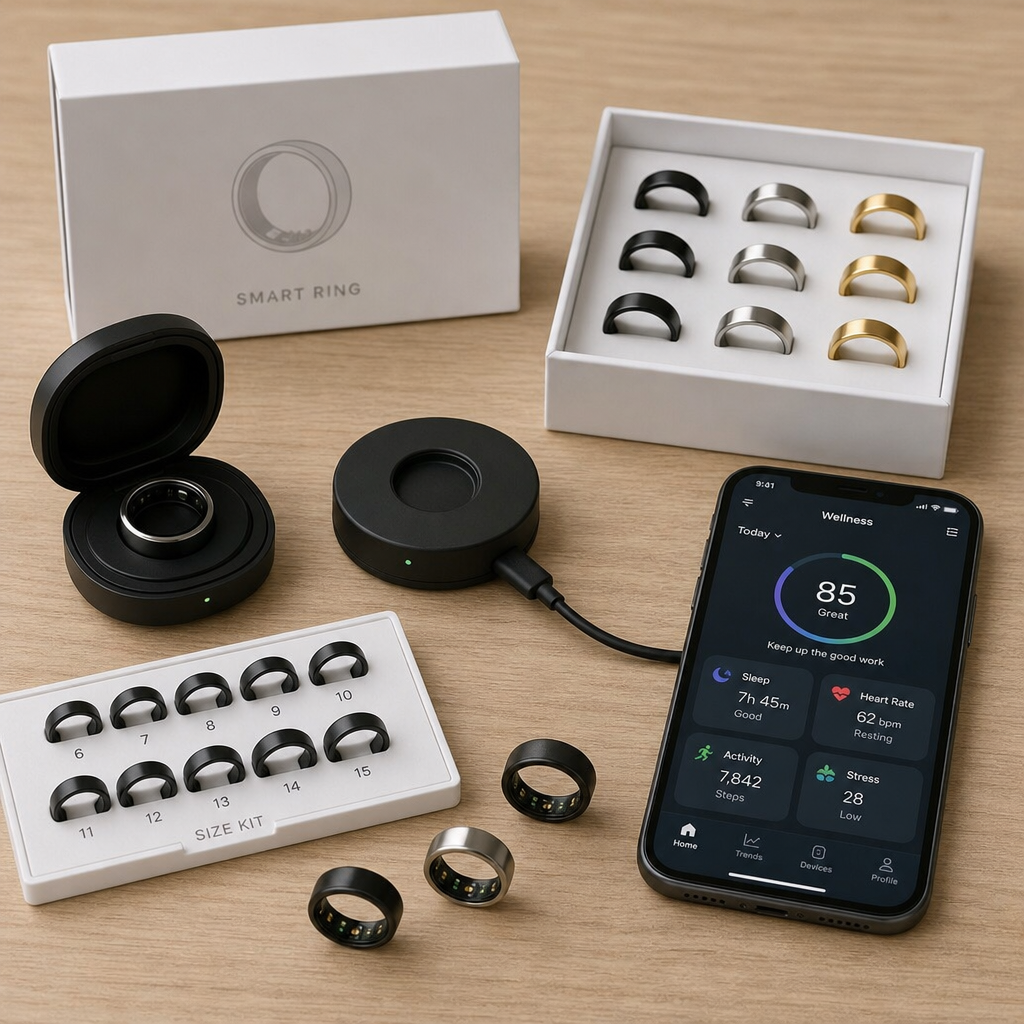
Prioritize the features that support your customer promise: comfortable wear, useful tracking, dependable charging, and an understandable app.
Published smart ring offerings cover combinations of sleep, heart rate, activity, temperature, and other wellness metrics, but availability differs by supplier and model. Compare the complete experience rather than counting features on a specification sheet.
Tracking evidence and clear limitations
For every important metric, request a validation summary describing the reference method, test conditions, participant group, and limitations. Ask whether the evidence applies to your exact production configuration. Treat a demonstration screen as a starting point, not proof of measurement quality.
Be particularly cautious about glucose claims. The FDA warns against rings that claim to measure blood glucose without piercing the skin and states that it has not authorized, cleared, or approved a smart ring intended to measure or estimate glucose independently. Do not position such a product as a replacement for an authorized glucose-monitoring device.
Fit, charging, and everyday usability
Include sizing kits in sample evaluation, not just finished rings. Ask testers to record comfort during typing, sleeping, exercise, and removal. Evaluate the supplied sizing process as part of the product rather than expecting customers to resolve fit problems themselves.
For battery testing, specify enabled features, synchronization frequency, and charging conditions. Request results for the sizes you intend to sell, then repeat your own checks. This gives you a defensible basis for customer-facing battery claims instead of relying on an unexplained maximum.
App quality and data access
Install the app before approving the hardware. Test onboarding, pairing, interrupted synchronization, account recovery, data export, and deletion. Ask the supplier to demonstrate any promised integrations on the exact software version supplied with your ring.
For smart ring brands building their own platforms, request SDK documentation during evaluation. Clarify whether access covers summarized metrics, raw signals, historical records, or only selected outputs. Put ongoing maintenance and support expectations into the contract.
Define the commercial model before comparing quotes
Ask each supplier to describe precisely what its OEM, ODM, or private-label proposal includes. Do not rely on those labels alone. Require an itemized scope covering hardware changes, branding, software, tooling, testing, packaging, and post-launch support.
Compare total project cost using the same assumptions:
Development: Engineering work, prototypes, tooling, app changes, and integration support.
Product assortment: Quantities by size, color, finish, charger, and packaging variant.
Launch preparation: Sizing kits, instructions, inspection, testing, and marketing assets.
Ongoing obligations: Cloud hosting, software maintenance, warranty replacements, and support.
Request separate figures for one-time charges and recurring costs. Ask whether minimum quantities apply to the entire order or to each size and finish. Have suppliers explain what changes in price or schedule if you revise the product after sample approval.
Finally, compare quotations against an identical specification. A lower unit price should prompt questions about what is included, excluded, or supported differently—not an automatic rejection or acceptance.
Validate the supplier before placing a production order
Use a staged process to turn a promising shortlist into a purchasing decision. The goal is to identify disagreements while changes are still manageable. Apply the same evaluation framework to every candidate.
Send one written brief. Define the customer, intended use, required metrics, app languages, integrations, branding, target markets, and launch constraints. Mark each requirement as essential or optional.
Confirm the contracting entity. Request company documentation and identify who handles assembly, firmware, algorithms, apps, cloud services, and warranty support. Make those responsibilities explicit in the agreement.
Evaluate comparable samples. Use one checklist across suppliers and retain approved samples. Record firmware versions and configurations so later production can be checked against them.
Review product documentation. Request reports and declarations for the exact model and destination market. Have qualified testing or regulatory specialists assess applicability rather than relying on logos in a catalog.
Run a pilot build. Agree on inspection criteria covering finish, sizing, charging, pairing, tracking continuity, packaging, and traceability. Define how failures trigger corrective action and retesting.
Set post-launch obligations. Document warranty handling, spare chargers, replacement stock, firmware updates, app support, and escalation procedures. Establish what happens if a component or software service changes.
Use smart ring reviews to build your test checklist, not as a substitute for these checks. Look for clearly described testing and the exact model reviewed. When comparing top smart rings, distinguish comments about a finished consumer product from evidence about the supplier's manufacturing or customization capabilities.
For example, translate “the app was confusing” into a practical onboarding test. Translate praise for comfort into a structured wear trial. This approach makes reviews useful without treating opinions as procurement proof.
Choose the strongest fit, not the longest feature list
The best smart ring manufacturers in China for your project are those that can substantiate the capabilities you need and accept clear delivery obligations.
Start with a focused shortlist, compare equivalent samples, and resolve software, quality, and support questions before production. If your ambition is to compete among the best smart wearables, treat smart ring technology as a complete hardware-and-service commitment—not merely an attractive piece of jewelry.
Frequently Asked Questions About Smart Ring Manufacturers and Their Product
What are the main features to look for in smart rings?
Smart rings often come with features like heart rate monitoring, sleep tracking, activity tracking, temperature measurement, and app integration. It's important to prioritize features based on your specific customer needs and use cases.
How do I choose the right smart ring manufacturer?
Consider factors such as the manufacturer's experience, product offerings, customization capabilities, quality assurance processes, and customer support. It's advisable to request samples and validate their claims before making a commitment.
Are smart rings safe to use for health monitoring?
While many smart rings are designed for health tracking, it's crucial to verify the accuracy and validity of their claims. Always look for regulatory compliance and user testimonials for the specific functionalities you plan to offer.
What is the typical lead time for manufacturing smart rings?
Lead time can vary significantly based on the manufacturer, order quantity, and complexity of customization. It's important to clarify timelines and any potential delays during the quoting phase.
Can I customize the branding and features of smart rings?
Many smart ring manufacturers offer OEM/ODM services that allow for branding and feature customization. However, the extent of customization may depend on each manufacturer's capabilities, so it's best to discuss your specific requirements directly.