Back To Blog
Wholesale Pet Cameras: Features, Suppliers & Costs
Buying wholesale pet cameras means comparing features, suppliers, and costs—not simply choosing the lowest unit price.
For retailers, distributors, and private-label sellers, this guide explains what to test, where to investigate sourcing options, and how to calculate a realistic purchasing budget.
Use it to build a shortlist and identify pet camera deals worth pursuing.
What should you look for in wholesale pet cameras?
Look for a camera that performs its core monitoring job reliably, has clearly disclosed app and subscription requirements, and comes with documented supplier support.
Evaluate the complete customer experience: installation, live viewing, alerts, account security, and returns.
The FTC specifically recommends evaluating connected devices’ functionality, data practices, and ongoing security support rather than treating security as an afterthought.
Start your buying brief with the customer’s purpose. A shopper checking the living room needs a different product from someone who wants to watch feeding sessions or dispense treats remotely.
Manufacturers offer distinct configurations, including rotating cameras, treat-dispensing units, and camera-equipped feeders; compare these as separate categories rather than interchangeable products.
For an initial assortment, consider organizing your shortlist around three roles:
Basic monitoring: Prioritize dependable live viewing, usable night footage, and straightforward setup. Avoid paying for extras your target customers are unlikely to use.
Interactive monitoring: Evaluate two-way audio, remote movement, and treat dispensing through hands-on demonstrations rather than specification sheets alone.
Mealtime monitoring: Check the camera angle, feeding controls, cleaning process, and access to recorded meal footage before positioning a feeder-camera combination.
Keep the first order focused. Prove that a product suits your customers before adding more finishes, bundles, or closely related models.
Features that deserve a hands-on test
Video quality, coverage, and night viewing
Supplier catalogs advertise resolutions, pan-and-tilt movement, and night vision, but those specifications describe capabilities rather than your customers’ actual viewing conditions.
For example, ZXY lists fixed, pan-and-tilt, treat-dispenser, and dual-lens configurations across its pet camera offering. Ask suppliers to demonstrate the exact configuration you intend to purchase.
Set a sample up in a realistic room. Watch an animal-sized moving object cross the frame, check corners and floor coverage, and repeat the test after dark. Save comparable clips from each sample so your team can review the same situations rather than relying on memory.
For rotating models, test manual movement and any advertised tracking separately. Check whether the camera returns to a useful position after movement. Decide what counts as acceptable coverage before comparing quotes.
Audio, alerts, and interactive functions
Two-way audio and remote interaction appear in branded pet-monitoring products, including PETKIT’s camera-equipped feeders.
However, feature availability and access to recordings can differ: PETKIT states that video playback on its camera-feeder range requires a subscription. Confirm the distinction between live functions and paid services for every model.
During testing, speak through the app from another locati0n and listen for understandable speech, feedback, and delay. Trigger any advertised sound or motion alerts deliberately. For treat dispensers, use approved treat types and inspect loading, dispensing, and cleaning procedures.
Ask the supplier to provide a feature matrix showing what works without payment, during a trial, and after a trial expires. Use that matrix to prepare accurate product descriptions.
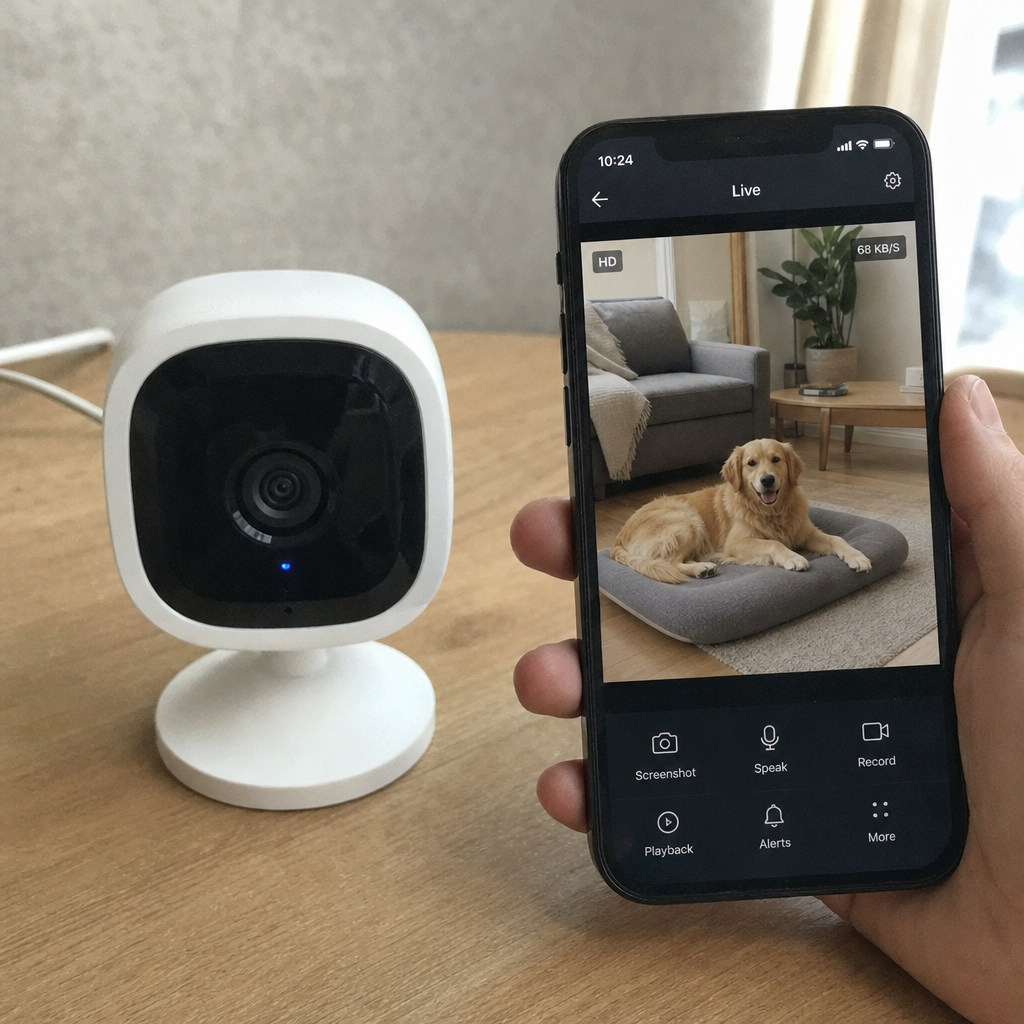
Connectivity and everyday usability
Do not assume all Wi-Fi networks are supported. Furbo’s setup documentation, for example, specifies a 2.4 GHz Wi-Fi connection and says its listed devices do not work with 5 GHz networks. That is a model-family example, not a universal specification for all pet cameras.
Have someone unfamiliar with the product complete installation using only the supplied instructions. Then test reconnection after a router restart, shared household access, password recovery, and factory reset. Record confusing steps and ask whether the supplier will revise the instructions before production.
Where can you find pet camera wholesale suppliers?
You can investigate authorized brand programs, specialist manufacturers, and business-to-business marketplaces.
Each route needs a different verification process: confirm resale permission with brands, production and software responsibilities with manufacturers, and the actual seller behind marketplace listings. PETKIT’s dealer program and Alibaba’s wholesale listings illustrate these distinct sourcing channels.
Authorized brands and distributors
For a branded assortment, begin with the brand’s official business contact rather than assuming a discounted retail source permits resale.
PETKIT publishes a B2B application, but its page states that dealer partnerships are currently available for physical retail channels only. Its contact page also lists a distributor-inquiry route; neither page guarantees approval or access to every product.
Ask which camera-equipped products are available for your territory and channel. Request written confirmation of warranty handling, permitted marketplaces, opening-order requirements, and replenishment terms. Keep that authorization with your purchasing records.
Manufacturers and private-label suppliers
If you want your own branding, investigate suppliers that explicitly offer customization. ZXY, for example, publishes options for housing appearance, retail packaging, app branding, and firmware settings, with different minimum quantities for different customization levels.
Treat those published terms as a starting point for verification, not an independently audited endorsement.
Separate cosmetic changes from software ownership. Ask whose account publishes the app, who fixes bugs, and what happens if the commercial relationship ends. Require a written description of ongoing service responsibilities before paying for custom packaging or development.
B2B marketplaces
Alibaba carries pet camera wholesale listings with different prices and minimum order quantities. Its category pages also mix camera types and camera-equipped feeders, so search results are not automatically like-for-like comparisons.
Verify the individual seller, model, configuration, and quantity behind each quotation.
Send shortlisted sellers the same request for quotation. Include your destination, intended sales channel, required features, packaging, order quantity, and delivery expectations. Comparable requests make it easier to spot missing items and unclear promises.
Suppliers & Costs: build a realistic purchasing budget
Treat wholesale cost as a stack of expenses rather than one advertised number. Supplier quotations may distinguish product configurations and customization quantities, while U.S. imports can also attract duties and processing fees. CBP notes that applicable fees depend on factors including entry type and transportation method.
For context, one specialist supplier, ZXY, publishes indicative FOB ranges of $12–$18 for an entry fixed camera and $24–$36 for a treat-dispenser model.
These are that supplier’s advertised examples, not market averages, landed prices, or confirmed quotes for your order. Obtain a dated quotation with the exact specification and named delivery terms.
Build your purchasing worksheet around these lines:
|
Cost item |
What to confirm |
|---|---|
|
Hardware |
Exact model, accessories, power adapter, and quantity tier |
|
Packaging |
Standard box versus branded artwork, inserts, and labels |
|
Setup |
Samples, tooling, app changes, and translation charges |
|
Logistics |
Freight, insurance, clearance, and final delivery responsibilities |
|
Import charges |
Applicable duties, taxes, and processing fees |
|
After-sales provision |
Replacement stock, return freight, and support arrangements |
|
Ongoing services |
Cloud, app, or other recurring fees and who pays them |
Budgeted landed cost per sellable unit = total procurement and inbound costs ÷ expected sellable units.
Keep selling expenses separate. Add your expected payment processing, marketplace fees, outbound fulfillment, marketing, and customer support when assessing commercial viability. Do not label the difference between purchase price and selling price as profit.
Before committing to a U.S. shipment, ask a customs broker to confirm classification, origin treatment, and applicable charges for the actual goods. Avoid budgeting from an old tariff screenshot or assuming that “shipping included” resolves every import expense. CBP maintains guidance on duties and import-related fees.
Security and support belong in the buying decision
Pet cameras can capture private household video and audio, so security deserves explicit purchasing criteria.
The FTC advises camera users to protect accounts, keep software updated, and consider privacy before enabling remote viewing. Its business guidance also recommends clear disclosures about functionality and the extent of future security support.
Ask suppliers for written answers covering account protection, access sharing, data collection, video retention, deletion, and software updates. Request a demonstration of removing a shared user and resetting a returned device. Where claims sound vague—such as “bank-level security”—ask for specific documentation instead of copying the phrase into your listing.
Use these questions as a procurement checklist:
Who operates the app and any cloud service?
What information is collected, and where is that explained to customers?
How are firmware updates delivered, and how long is support planned?
How can users revoke access or delete their accounts?
Who receives vulnerability reports and customer security complaints?
These requests follow the FTC’s emphasis on transparency, layered security, customer communication, and continued support. Keep the answers with the approved specification so future purchasing decisions do not depend on a sales conversation nobody documented.
How do you judge pet camera deals before ordering?
Judge pet camera deals against the same approved specification, delivery assumptions, and service requirements—not the discount percentage. Require a working sample, a complete quotation, and written acceptance criteria before placing a meaningful inventory order. Use the following sequence to turn supplier promises into checks your team can repeat.
Approve the sample. Record the model identifier, accessories, app version, packaging, and agreed functions. Keep photos and test notes as the reference for the order.
Confirm the commercial terms. Resolve minimum quantities, payment milestones, production timing, delivery responsibilities, and the process for approving changes.
Define inspection criteria. Specify checks for power, pairing, video, audio, included accessories, labeling, and visible damage. Agree how failures will be handled before shipment.
Place a controlled pilot. Choose a quantity your business can support and evaluate. Avoid letting a lower unit price alone dictate the size of your first commitment.
Review the results. Track setup questions, returns, replacement requests, and customer feedback. Use those observations to decide whether to reorder, revise instructions, or change products.
Also request a replenishment quote before scaling. Compare the repeat-order specification with your approved sample and ask whether any components, packaging, or software services may change. Make substitutions subject to written approval rather than leaving “equivalent product” undefined.
For private-label orders, retain approved artwork and a version-controlled specification. Assign one person to authorize changes so purchasing, marketing, and customer support work from the same product information.
Buy for the full customer experience
The strongest wholesale pet cameras shortlist should connect useful features with verifiable supplier commitments and a workable budget. Compare samples consistently, clarify paid services, document support responsibilities, and calculate costs beyond the hardware quote. Then scale only after a pilot gives your business enough evidence to make the next order confidently.
Frequently Asked Questions About Wholesale Pet Cameras
What should I look for when buying wholesale pet cameras?
When purchasing wholesale pet cameras, consider features like video quality, night vision, two-way audio, and ease of setup. It's essential to evaluate the customer experience, including app functionality, subscription requirements, and supplier support.
How do I find reliable wholesale pet camera suppliers?
You can find wholesale pet camera suppliers through authorized brand programs, specialist manufacturers, and B2B marketplaces like Alibaba. Verify resale permissions and assess the seller's reputation before committing to a purchase.
What are the typical costs associated with wholesale pet cameras?
Wholesale costs can vary widely based on features, customization, and order quantities. It’s essential to account for additional expenses like shipping, import duties, and after-sales support in your budget calculations.
How can I ensure the security of pet cameras?
To ensure security, ask suppliers about account protection, data collection practices, and software update policies. It's crucial to understand how customer privacy is maintained and what measures are in place to protect video and audio recordings.
What is the best way to test wholesale pet cameras before ordering?
Approve a sample of the camera before placing a bulk order. Confirm commercial terms and define inspection criteria for quality checks. Conduct a pilot order to evaluate the product's performance, including setup, usability, and customer feedback, before making a larger commitment.