Back To Blog
Smart Home Sensors Wholesale Types And Buying Guide
Buying smart home sensors wholesale means evaluating more than a unit price: you need the right sensor types, verified compatibility, and workable supplier terms.
This guide explains how to compare home automation sensors, assess samples, and plan a bulk order.
Use it to build a focused purchasing brief for retail stock, installation projects, or property portfolios.
Which smart home sensor types should you buy wholesale?
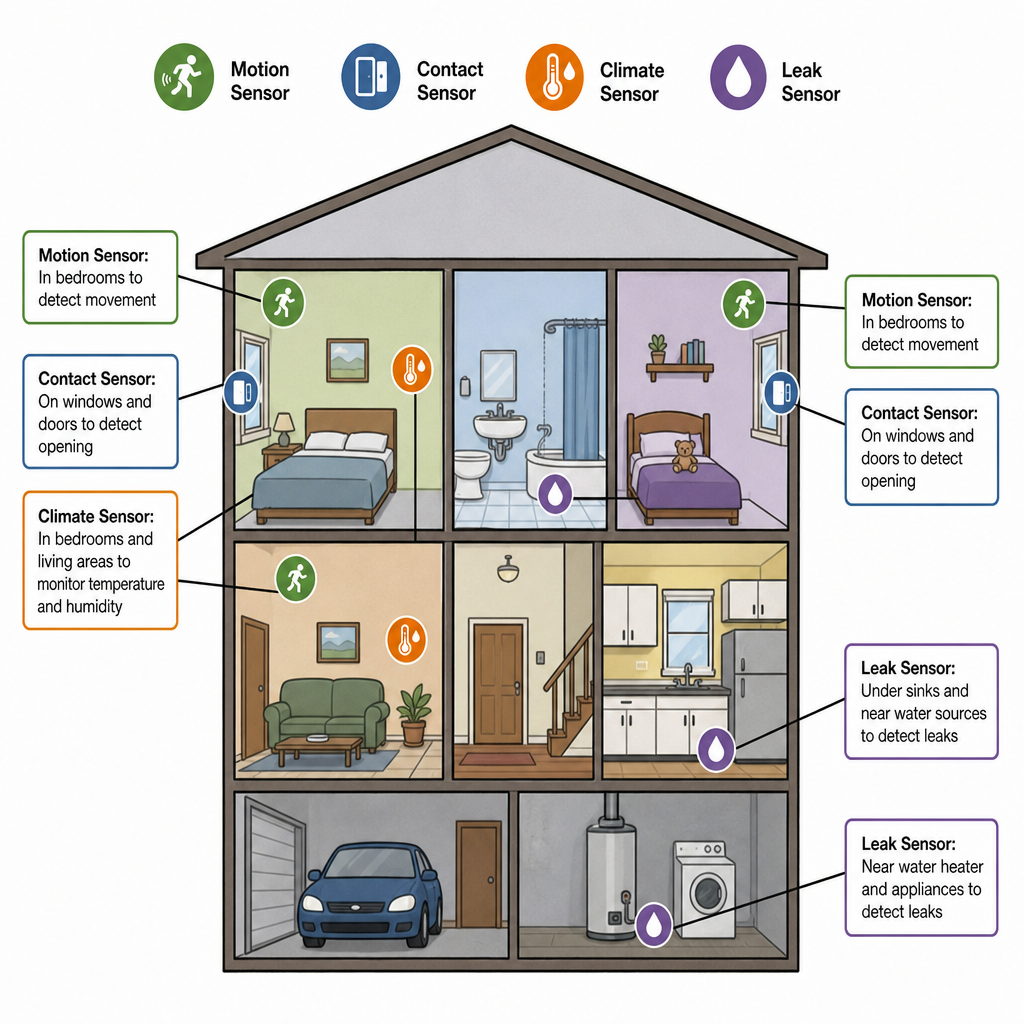
Start with the condition you need to detect: movement, an open door, changing temperature, water, or a specific air pollutant. These are distinct sensing tasks, even when a product combines several functions.
Manufacturer ranges illustrate why buyers should compare detection capabilities rather than treat every sensor as interchangeable.
Build your shortlist around customer needs, then check installation requirements and integration details. A hallway lighting project, for example, calls for different testing than environmental monitoring across rental properties.
Avoid buying a broad assortment before you have defined what each model must accomplish.
Motion and presence sensors
Motion sensors detect movement, while some presence sensors use millimeter-wave radar to detect much smaller movements associated with someone remaining in a room.
That distinction matters when comparing an entry-triggered lighting routine with one intended to keep lights on while someone reads or works. Detection behavior depends on the particular technology and model.
For wholesale evaluation, test walking entry, seated activity, vacancy detection, and the intended mounting position. Ask whether sensitivity, detection zones, and timeout settings are available in the customer's chosen platform.
Include power requirements in your comparison; radar presence models can require continuous wired power rather than replaceable batteries.
Door and window contact sensors
Contact sensors report whether an opening is open or closed. A common design uses a sensor and a separate magnet, with status determined by their relative position.
This makes physical alignment an important part of product evaluation, not just an installation detail.
Request the permitted installation gap and mounting instructions before approving samples. Try them on representative door frames, including awkward or recessed surfaces. For retail packaging, check that the instructions clearly explain which component goes where and how to confirm a successful installation.
Temperature, humidity, and water leak sensors
Temperature and humidity sensors provide environmental readings that compatible systems can use for monitoring or automation. Water leak sensors address a different task: detecting water near potential leak locations, such as sinks, washing machines, or water heaters.
Keep these categories separate in product descriptions so customers understand what each device actually measures.
For environmental models, request documented accuracy, operating limits, reporting behavior, and calibration options. For leak models, review placement instructions, alert delivery, and how users test and reset the device. If you plan to offer automatic shutoff, require proof that the complete sensor-and-valve combination supports your intended workflow.
Light and air quality sensors
Illuminance sensing can support lighting routines that respond to available light; some presence sensors include this capability alongside occupancy detection. Confirm whether the light reading is accessible in the intended ecosystem rather than assuming every integrated measurement is available to automations.
Air quality products require closer scrutiny of the measurement itself. A monitor may measure particulate matter, carbon dioxide, volatile organic compounds, or only selected environmental conditions.
Specify the pollutant you need to measure, and never market a general air quality monitor as a replacement for certified smoke or carbon monoxide alarms.
How do you choose compatible connectivity?
Choose connectivity by checking the entire system: sensor, network, controller, app, and required automation. Matter, Thread, Wi-Fi, Zigbee, and Z-Wave are not interchangeable labels. Matter uses network technologies including Thread, Wi-Fi, and Ethernet, while compatible bridges can connect supported devices using other protocols.
Use this comparison to structure supplier questions rather than declare one technology universally best:
|
Option |
What to establish before ordering |
|---|---|
|
Matter over Thread |
Confirm the Matter controller, Thread border router, supported sensor functions, and commissioning process. |
|
Matter over Wi-Fi |
Confirm the controller, network requirements, and functions exposed to the intended platform. |
|
Zigbee |
Identify the compatible hub and whether a Matter bridge is needed for your proposed setup. |
|
Z-Wave |
Verify the controller, certified model, and correct regional version. |
Matter's network and bridging documentation supports these distinctions; the Z-Wave Alliance catalog also allows searches by region and model. Use those records alongside the supplier's compatibility documentation.
Thread deserves a separate infrastructure check. Battery-powered Thread end devices do not relay traffic for other devices, while suitable powered routers extend the mesh. A border router connects that mesh to other IP networks, so do not assume a carton of battery sensors supplies its own network coverage.
Before committing, create a compatibility record for each SKU: exact model, firmware, controller, app, and functions tested. Verify certification claims against the relevant organization's records; Matter certification includes a certified product record in its Distributed Compliance Ledger.
Turn specifications into acceptance criteria
Ask suppliers to connect every important specification to a test you can repeat. Instead of accepting “fast response,” define the event, destination, and acceptable behavior for your project. Instead of accepting “long battery life,” request the stated test conditions and plan your own observation period.
Your sample scorecard should include:
Detection: Intended events, missed events, nuisance triggers, and recovery after an event.
Installation: Mounting options, included hardware, access to batteries, and clarity of instructions.
Reporting: Available readings, timestamps, alert settings, and low-battery or offline indications.
Recovery: Behavior after network loss, controller restart, power interruption, and factory reset.
Environment: Documented temperature and humidity limits, plus any claimed indoor or outdoor suitability.
Set priorities before scoring. A contact sensor for a simple lighting routine may not need the same reporting workflow as a leak sensor used by a property maintenance team. Record unacceptable failures separately from preferences so an attractive enclosure cannot outweigh a missed requirement.
Vet the supplier behind the product
Treat supplier evaluation as its own purchasing task. Request the legal business name, product documentation, sample availability, production lead time, and written warranty terms. Establish whether your contact is the manufacturer, an authorized distributor, or another reseller, and clarify who handles technical escalation.
For wholesale smart devices, put these commercial points in writing:
Minimum order quantity: Is it calculated per model, color, package design, or total purchase?
Price tiers: Which quantities qualify, and what accessories or services are excluded?
Defect handling: Who approves claims, pays freight, and supplies replacements or credits?
Product changes: Must you approve component, firmware, packaging, or model substitutions?
Traceability: Will cartons and devices identify the model and production batch?
Reorders: How will the supplier communicate discontinuation and replacement models?
If you want private-label smart home products, request separate approval samples for the device, packaging, instructions, and app experience. Do not authorize production from a logo mockup alone. Require written confirmation of who is responsible for applicable testing, labeling, and market-access documentation rather than assuming branding leaves those responsibilities unchanged.
Keep an approved reference sample and its documentation. Use it when checking later deliveries against the configuration you actually accepted.
What does a wholesale sensor order really cost?
Evaluate the complete purchasing and deployment budget, not just the quoted sensor price. Request separate figures for devices, required infrastructure, accessories, customization, freight, and any recurring services. Then add your own estimates for receiving, installation, training, maintenance, and returns.
A useful planning formula is:
Deployment budget = hardware + infrastructure + delivery and import costs + setup labor + planned support and maintenance.
Keep confirmed supplier charges separate from internal estimates. Ask your freight provider or customs adviser to establish shipment-specific costs rather than relying on a generic percentage. For ongoing services, document which functions remain available if a subscription ends.
Compare quotes using the same scope. One offer might include batteries, mounts, and retail packaging while another prices those separately. Request a line-item quotation and record exclusions beside each bid; otherwise, the lowest displayed price may not represent the lowest budget for your intended order.
Also check payment milestones, quote validity, cancellation terms, and the treatment of delayed or partial shipments. Agree on the delivery term and ask each party to identify its responsibilities. These details belong in the comparison before you authorize a deposit, not after production begins.
Make cybersecurity and support part of procurement
Evaluate the product's support lifecycle alongside its sensing features. NIST's consumer IoT baseline addresses cybersecurity outcomes across the whole product, making it a useful framework for discussing devices, supporting software, and associated services—not merely the sensor enclosure.
Ask suppliers to document update delivery, the security support period, vulnerability reporting, and instructions for secure use and maintenance. NIST's guidance includes communicating maintenance needs and what happens after security support ends. Request specific answers rather than accepting “secure connection” as a complete explanation.
For managed properties, test account transfer and removal as part of your sample review. Confirm that your team can reset a device, remove previous access, and commission it for the next user. Include these steps in handover documentation before scaling the installation.
Run a pilot before scaling the order
Use a small pilot to test the complete smart home solutions you intend to sell or install. Include representative rooms, mounting surfaces, controllers, and user workflows. Agree on pass-or-fail criteria before testing so the purchasing decision does not depend on a polished demonstration.
Document the setup. Record model numbers, firmware, apps, controllers, placement, and configuration.
Repeat normal events. Open and close contacts, enter and leave rooms, and test sensors according to their instructions.
Check the full workflow. Confirm the reading or event reaches the right app, notification recipient, or automation.
Test interruptions. Observe behavior during internet loss, network recovery, and controller restart.
Recommission a device. Follow the reset process and measure the effort required to restore service.
Review with the supplier. Resolve failures and document any settings or limitations before approving the order.
Use your results to narrow the assortment. If two models address the same need, retain both only when you can explain the meaningful difference to customers or installers. A focused range should have a clear purpose for every SKU.
Build an order that is ready for deployment
Organize the final purchase around complete use cases rather than disconnected devices. For a lighting bundle, specify the sensor, controller requirements, mounting materials, and tested routine. For environmental monitoring, specify the readings, intended placement, alert recipient, and handover process.
Prepare a deployment sheet for each approved model. Include its tested setup, required accessories, installation instructions, reset procedure, and support contact. Keep sales descriptions aligned with that sheet so your team does not promise functions that were never verified.
The strongest wholesale buying decision is one you can explain and repeat. Define the job, verify compatibility, test samples, and negotiate support before increasing volume. Start with a documented shortlist and a pilot order; scale only when the product and supplier both meet your acceptance criteria.
Frequently Asked Questions About Smart Home Sensors Wholesale
What types of smart home sensors are available for wholesale purchase?
Smart home sensors include motion sensors, door/window contact sensors, temperature and humidity sensors, water leak sensors, air quality sensors, and light sensors. Each type serves distinct functions and should be selected based on specific customer needs.
How do I evaluate the compatibility of smart home sensors with existing systems?
Assess the connectivity options, including Matter, Zigbee, Z-Wave, and Wi-Fi, to ensure the sensors integrate seamlessly with your smart home system. Document the required hardware and software components to confirm compatibility.
What should I consider before making a wholesale order?
Factors to consider include the minimum order quantities, price tiers, defect handling policies, installation requirements, and the supplier’s warranty terms. It's also essential to review product specifications and establish clear acceptance criteria.
How can I ensure the quality of smart home sensors before purchasing?
Conduct thorough evaluations through pilot testing, where you document setup, performance under normal and adverse conditions, and the full workflow. This helps identify any shortcomings and ensures the sensors meet your standards before ordering at scale.
What additional costs should I budget for when purchasing smart home sensors?
In addition to the sensor prices, consider costs for shipping, installation, maintenance, customization, and any necessary infrastructure upgrades. Create a comprehensive deployment budget to accurately capture the total investment required.