Back To Blog
Mini Projectors Wholesale Buying Guide for Retailers
Buying mini projectors wholesale means choosing inventory around verified performance, total cost, and dependable support—not simply finding the lowest unit price.
This buying guide helps retailers compare specifications, evaluate suppliers, test samples, and plan orders.
The goal is an assortment you can describe honestly, price sustainably, and reorder with confidence.
What should retailers look for when buying mini projectors wholesale?
Retailers should prioritize a clear customer use case, documented specifications, consistent sample performance, and written purchasing terms.
Evaluate the complete offer: projector, accessories, packaging, delivery, defect handling, and after-sales support. Set those requirements before comparing quotes so a lower price does not quietly remove something your customers need.
Start by deciding which shopping mission each product will serve:
Occasional movie nights: Prioritize straightforward setup and a picture you have tested under the viewing conditions you intend to advertise.
Travel and portable entertainment: Verify packed size, power requirements, included accessories, and battery operation where offered.
Presentations: Test small text, spreadsheet readability, and connections with representative laptops.
Gift purchases: Examine packaging, instructions, remote controls, and how easily a first-time user can get started.
Use these needs to build a focused opening range. Give every model a distinct reason to exist rather than stocking several nearly identical products with different cases. Define a customer-facing limitation for each one, too: what situation should prompt staff to recommend another model?
Read specifications before negotiating price
Request a complete specification sheet for the exact model and hardware version being quoted. Record any unclear language as a question for the supplier, not as a feature for your product page. Keep the answers alongside your sample results so purchasing and merchandising work from the same information.
Brightness and viewing conditions
Brightness requirements depend on the viewing environment, including ambient light. Epson distinguishes white brightness from color brightness and identifies the measurement standards used for its specifications. Ask suppliers which measurement method supports their figures rather than treating every advertised lumen number as directly comparable.
For your own comparison, use the same screen, image size, content, and room conditions across samples. Record the picture mode as well. Build sales descriptions around the conditions you actually evaluated, and avoid promising daylight performance from a dark-room demonstration.
Native resolution and accepted signals
Native resolution and supported input resolution describe different things. BenQ explains that a projector can accept a signal with a higher resolution than its native imaging chip. Consequently, an input-support claim alone does not establish the detail the projector displays natively.
Ask suppliers to list both specifications separately. If a listing says only “supports 4K,” request an explanation of the displayed resolution and any image-shifting technology. Check fine text and detailed images on the sample before choosing your own wording.
Placement, power, and everyday usability
Review the manufacturer's projection-distance chart against the spaces your customers are likely to use. Epson's installation documentation expresses throw ratio as projection distance divided by image width; screen diagonal is not the width used in that calculation.
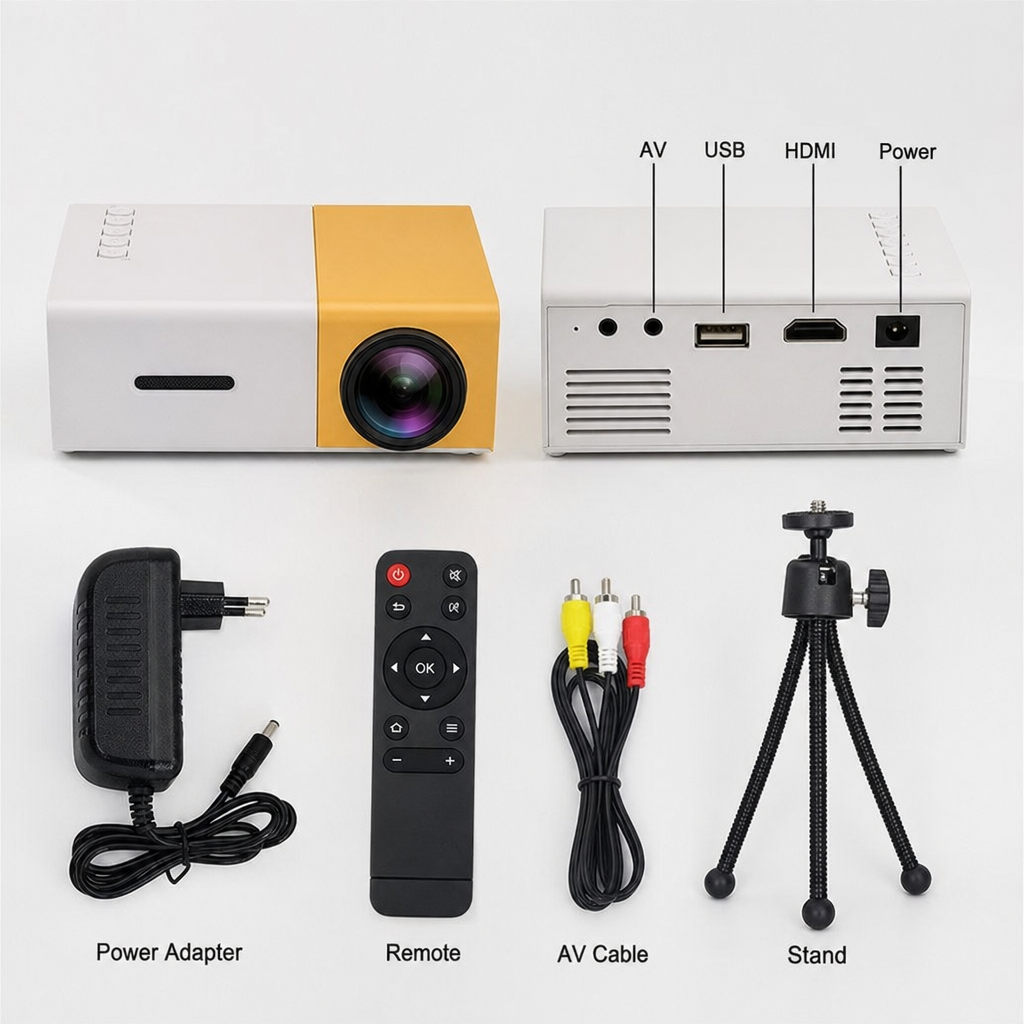
Inspect focus controls, stand stability, cable access, and remote responsiveness. Treat “portable” as a description to investigate, not proof of battery operation: BenQ's portable range includes models identified as having no built-in battery. Request the exact power arrangement for every quoted SKU.
How can retailers compare mini projector deals fairly?
Compare mini projector deals using the same specification requirements, included items, delivery basis, and support terms. A useful comparison shows what each offer costs to receive and sell, not merely what appears on the supplier's headline price list. Reject incomplete comparisons until missing charges and responsibilities are clarified.
Build a worksheet with one column per supplier and rows for:
|
Comparison item |
What to request |
|---|---|
|
Exact product |
Model code, hardware revision, and approved specification sheet |
|
Order requirements |
Minimum order quantity and quantity allowed per variant |
|
Included package |
Adapter, remote, cables, stand, manual, and retail box |
|
Delivery |
Named destination, shipping basis, and estimated dispatch window |
|
Defect support |
Reporting deadline, evidence requirements, and remedy |
|
Reorders |
Availability expectations and notification of product changes |
Compare the cost per saleable unit, not just per shipped unit. Mark uncertain costs explicitly instead of assuming they are zero. Ask suppliers to revise their quotations into a common format before making a decision.
Check the supplier behind the offer
For each mini projector wholesale supplier, request a verifiable business identity, a named commercial contact, and an explanation of whether it manufactures, distributes, or trades the product. Ask who controls firmware, packaging, replacement parts, and warranty decisions. These questions establish who must respond when something needs correcting.
Request evidence that matches the transaction you are considering. Product photographs should show the relevant model and connections; supporting reports should identify the product they cover. If documentation uses a different model number, ask for a written explanation rather than assuming the relationship.
Before paying for a production order, agree on:
An approved reference sample: Identify the version, accessories, packaging, and firmware accepted.
Substitution controls: Require approval before changes to the adapter, hardware, software, or supplied accessories.
Inspection arrangements: Specify when checks happen and how discrepancies are resolved.
Payment milestones: Connect payments to clearly defined deliverables and agreed verification.
Defect remedies: Document replacement, credit, repair, or refund arrangements and associated freight responsibility.
Consider communication part of the evaluation. Send the same technical questions to shortlisted suppliers and assess whether their answers are specific, consistent, and documented. Do not treat quick replies alone as proof of reliability; use the sample and agreed terms to test the substance behind them.
Calculate margin beyond the purchase price
Use a landed-cost worksheet before committing to wholesale projectors. Begin with the quoted product cost, then obtain estimates for the expenses relevant to your order. Separate confirmed amounts from assumptions so you can see which uncertainties could change the decision.
Your worksheet should consider freight, insurance, applicable import charges, customs handling, inspection, packaging changes, and inbound delivery. Then model selling expenses separately: fulfillment, payment processing, marketplace fees where relevant, promotions, customer support, and a returns allowance. Confirm charges with the parties responsible rather than relying on a supplier's informal estimate.
For pricing decisions, use two distinct calculations:
Gross margin percentage = (selling price − cost of goods sold) ÷ selling price × 100
Contribution per unit = net sales revenue − product cost − variable selling and service costs
Keep your accounting treatment consistent and ask your accountant which landed expenses belong in cost of goods sold. Do not confuse markup on cost with margin on sales.
Run a base case and a cautious case. In the cautious version, allow for slower sales, a promotional discount, and greater support expense. Cheap mini projectors deserve consideration when they satisfy the intended use case; reject them when the numbers work only if every unit sells immediately at full price.
What should a sample inspection include?
A sample inspection should reproduce the customer's journey from opening the box through setup, viewing, and shutdown. Test the exact configuration you intend to buy, using a written checklist and repeatable conditions. Approve the sample only after recording both strengths and limitations.
Use this practical sequence:
Inspect the delivered package. Check product identification, accessories, instructions, visible damage, and protection around the lens and controls.
Complete first-time setup. Follow the supplied instructions without relying on supplier coaching. Record confusing steps and missing explanations.
Evaluate the image. Display subtitles, fine text, dark scenes, and bright scenes at your intended image size. Compare focus across the picture.
Test advertised connections. Try the laptops, phones, streaming devices, and cables you expect to mention in sales material.
Verify streaming claims. Open and play content through the exact apps and connection methods you plan to advertise. Ask for written confirmation of supported services and regional limitations.
Run a realistic viewing session. Note fan noise, interruptions, focus changes, and any unexpected shutdowns. Record the operating mode and power source.
Check recovery and reset. Restart the projector, reconnect sources, and perform a factory reset before preparing it for another user.
If battery runtime is a selling point, measure it under a documented mode and volume setting. Keep your observations separate from supplier claims. Arrange production-order checks as well; approving one sample should not replace checking what arrives.
Plan delivery, documentation, and warranty support
Before approving shipment, confirm carton quantities, receiving arrangements, identification labels, and the documents your freight or customs partners request. For battery-equipped models, obtain shipping advice early. DHL notes that battery shipping requirements depend on factors including battery type, packing configuration, and destination.
Ask a qualified compliance partner to identify the product-safety, electrical, wireless, labeling, and import requirements relevant to your destination and exact model. Request matching evidence before shipment. Avoid assuming that a logo on a listing establishes compliance.
Keep the supplier's business-to-business remedy separate from your obligations to shoppers. For U.S. consumer sales, the FTC explains that express warranties can arise from product promises and that written consumer warranties have specific requirements. Have your warranty wording and sales claims reviewed before publication.
Create an internal returns workflow covering troubleshooting, proof of purchase, serial-number recording, authorization, and resolution. Assign an owner to supplier claims so unresolved cases do not disappear between purchasing and customer service.
Merchandise the range with evidence
Write product pages from your approved specification sheet and test record, not from a copied supplier headline. Give shoppers an understandable intended use, setup requirements, included items, and known limitations. Where performance depends on particular conditions, describe those conditions beside the claim.
Prepare a quick-start insert showing the first connection, focus adjustment, and route to support. Train staff to ask about room lighting, available placement distance, source device, and access to power before recommending a model. Use those same prompts in online buying assistance.
For accessories, offer only combinations you have checked together. If you bundle a stand, cable, screen, or streaming device, confirm fit and operation and state exactly what is included. Avoid implying that an optional accessory comes with the base product.
Keep demonstration photos representative of the setup shown. A clear explanation of how you obtained the image gives shoppers more useful context than an unexplained promotional picture.
Start small, then reorder with evidence
Place an opening order that fits your cash-flow limits and gives you room to learn. Track sell-through, realized contribution, support time, return reasons, and supplier response by SKU. Use those records to decide which mini projectors earn a larger reorder.
Before replenishing, confirm that the specification, firmware, accessories, and support terms remain unchanged. Expand the range only when another model serves a distinct customer need. The strongest wholesale purchase is not the largest discount—it is stock you can sell accurately, support responsibly, and replenish on terms your business understands.
Frequently Asked Questions About Mini Projectors Wholesale Buying
What specifications should I prioritize when selecting mini projectors for wholesale?
When choosing mini projectors, focus on key specifications such as brightness, native resolution, connectivity options, and usability features. Additionally, consider the intended use case (like home entertainment or professional presentations) to ensure the projectors meet customer needs.
How can I compare mini projector deals from different suppliers effectively?
Create a standardized comparison worksheet that includes parameters such as product specifications, minimum order quantities, included accessories, shipping terms, and defect support. This will help you evaluate what each supplier is truly offering beyond just the headline prices.
What is the importance of inspecting a sample before placing a wholesale order?
A sample inspection is crucial to verify product quality, usability, and performance under real-life conditions. It helps ensure that the projector meets your customers' expectations and aligns with the specifications you've approved.
What should I consider regarding warranty and after-sales support when buying mini projectors?
Make sure to clarify warranty terms, including duration, coverage specifics, and the process for claims. Understanding the supplier's after-sales support structure is essential to ensure you can adequately assist your customers and resolve any issues promptly.
How can I determine the appropriate pricing strategy for wholesale mini projectors?
Calculate gross margin percentage and contribution per unit based on all expenses involved in bringing the product to market. Be sure to factor in costs like shipping, customs duties, and customer support to set competitive yet profitable pricing.