Back To Blog
OEM vs ODM Electronics: Detailed Manufacturing Guide
OEM and ODM are two approaches to electronics manufacturing: one generally starts with a buyer-controlled design, while the other includes supplier-led product design.
The difference affects engineering responsibilities, customization, and how your product reaches production.
This complete guide to OEM vs ODM electronics manufacturing explains the trade-offs and offers a practical framework for comparing partners—not just their labels.
What is the difference between OEM and ODM electronics manufacturing?
In a typical OEM arrangement, the buyer supplies the product design and specifications, and a manufacturing partner builds to those requirements. In an ODM arrangement, the supplier contributes product design as well as manufacturing, either by adapting an existing platform or developing a product around the buyer’s requirements.
The central distinction is who provides and controls the engineering work.
OEM stands for original equipment manufacturer, while ODM means original design manufacturer. However, industry terminology varies: OEM can also describe the brand-owning equipment company that outsources production. For any supplier discussion, define responsibilities explicitly rather than assuming everyone uses these terms identically.
|
Decision point |
OEM-style arrangement |
ODM arrangement |
|---|---|---|
|
Starting point |
Buyer’s design and technical specifications |
Supplier design capability or product platform |
|
Engineering responsibility |
Buyer-led, with agreed supplier support |
Supplier-led within an agreed scope |
|
Customization |
Driven by the buyer’s design |
Driven by platform flexibility and development scope |
|
Buyer preparation |
Detailed manufacturing inputs |
Clear requirements and design evaluation |
|
Main qualification focus |
Manufacturing readiness and process capability |
Design suitability and engineering capability |
These are working distinctions, not guarantees about ownership, price, or delivery. Confirm the actual arrangement before comparing quotations.
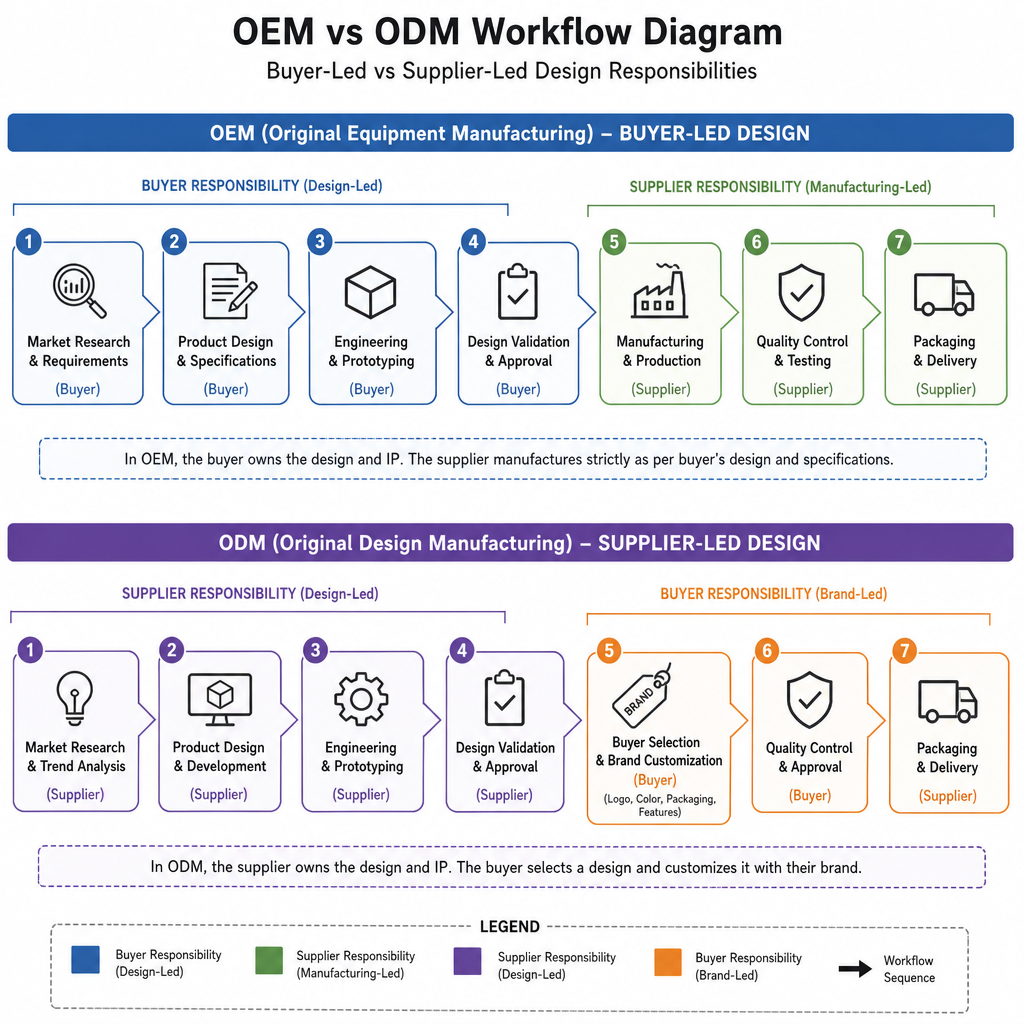
How each model works in practice
With OEM electronics production, the handoff typically includes detailed design files and specifications. The manufacturing partner may manage procurement, assembly, testing, quality assurance, and packaging. This approach suits a team that has developed its product and needs help turning that design into repeatable production.
For your project, prepare a revision-controlled package covering schematics, printed circuit board files, the bill of materials, mechanical drawings, firmware releases, and acceptance criteria. Mark unresolved decisions clearly. Ask the supplier to identify missing information before accepting its production quotation.
ODM electronics can involve substantially more than adding a logo to an existing device. For example, Seeed Studio describes ODM work that includes schematic design, board layout, enclosure development, embedded software, and prototypes based on customer requirements. An existing platform is one possible starting point, not the definition of every ODM engagement.
If you take this route, write requirements around outcomes: operating environment, interfaces, power constraints, dimensions, and user behavior. Then ask the supplier to map each requirement to an existing capability or a development task. Keep assumptions visible so that a promising demonstration does not become an undefined engineering commitment.
Which model is better for your product?
Choose a buyer-controlled OEM approach when your design is sufficiently developed and maintaining engineering control is a priority. Consider ODM when you need supplier-led development or an adaptable platform that fits your requirements. Neither model substitutes for checking design readiness, manufacturing capability, documentation, and long-term support.
Use these starting conditions to guide your shortlist:
You already have a tested design: Ask build-to-specification partners to review the manufacturing package and explain any remaining production engineering work.
You have requirements but little hardware engineering capacity: Ask ODM candidates to propose development milestones, deliverables, and review points.
An existing supplier platform appears suitable: Request a requirement-by-requirement gap assessment before commissioning modifications.
Your differentiation depends on proprietary hardware or firmware: Establish the access, control, and transfer rights you need before selecting a partner.
You are unsure whether the concept is feasible: Separate feasibility work from the production commitment and define what evidence would justify proceeding.
For a hypothetical monitoring device, compare two proposals: manufacturing your completed sensor board, or adapting a supplier’s platform. Evaluate both against the same performance and documentation requirements. Do not reward the platform proposal merely for having a working sample, or the custom proposal merely for offering more design freedom.
Compare total cost, not just the quoted unit price
OEM vs ODM cost comparisons should include development, adaptation, tooling, validation, and production—not just assembly. Neither model is automatically cheaper or faster. Minimum order quantities also depend on the product, materials, processes, and commercial arrangement rather than the acronym alone.
Request an itemized quotation that separates these categories:
Engineering: Design, adaptation, firmware work, manufacturing review, and project management.
Production setup: Tooling, fixtures, programming equipment, and line preparation.
Validation: Prototype builds, qualification work, test development, and external testing where needed.
Recurring supply: Components, assembly, testing, packaging, and shipping assumptions.
Ongoing support: Engineering changes, repair arrangements, software maintenance, and lifecycle support.
Ask suppliers to identify exclusions and explain what triggers a revised quotation. Compare equivalent quantities, configurations, and test coverage. Keep one-time charges separate from recurring costs, then assess the combined commitment against realistic demand rather than an optimistic sales forecast.
Set design ownership and lifecycle expectations early
Do not treat the OEM or ODM label as proof that you will receive every design file or have exclusive access to the product. Design ownership, firmware access, tooling rights, and the ability to move production deserve explicit review. These questions are particularly important when the supplier contributes the underlying platform.
Build a deliverables checklist before approving development:
Engineering files: Identify which schematics, board layouts, mechanical files, and manufacturing documents you will receive.
Software access: Specify whether delivery includes source code, binaries, build instructions, and programming procedures.
Tooling and fixtures: Record ownership, storage, maintenance, access, and transfer expectations.
Change control: Define who approves component substitutions, firmware updates, and design revisions.
Product continuity: Ask about platform support, component availability reviews, and discontinuation notice arrangements.
Supplier exit: Describe the documentation and assistance needed if production transfers elsewhere.
Use this checklist to surface unresolved commercial questions, then obtain appropriate professional review of the agreement. For custom electronics, also separate supplier background technology from work developed specifically for your project. Ask for a clear explanation of what your team can maintain independently after launch.
Make quality and production readiness visible
Manufacturing capability extends beyond placing components on a board. Electronics production can include system assembly, inspection, traceability, test development, and reliability evaluation. Jabil’s published capabilities illustrate this range, including optical and X-ray inspection, in-circuit testing, environmental stress testing, and component lifecycle planning.
Instead of requesting every available test, ask each candidate to propose coverage linked to your product’s risks. Request an explanation of what each inspection or test detects, what it does not establish, and how failures are handled. Review the proposed acceptance criteria with your engineering team before approving the production plan.
Use a pilot build as a review milestone rather than treating the first successful prototype as permission to scale. New product introduction work includes preparing manufacturing operations, supply chains, and production teams for launch. Ask your partner to identify the evidence required to demonstrate that readiness.
Before release, review pilot results, unresolved defects, approved revisions, test records, and operator instructions together. Assign owners and closure dates to open issues. Keep the production release decision documented so both teams know which configuration and process have been approved.
Turn supplier discussions into a decision
Give shortlisted partners the same brief and request responses against the same assumptions. Ask them to distinguish confirmed capabilities from proposed development, and existing evidence from work still to be completed. This makes the comparison about your project rather than the breadth of a sales presentation.
For each proposal, record the engineering scope, deliverables, cost assumptions, production plan, and support commitments on one scorecard. Weight the criteria according to your priorities before reviewing final prices. If a critical requirement remains unanswered, request clarification rather than averaging that uncertainty into an overall score.
The practical takeaway
The strongest OEM vs ODM decision starts with a clear view of what you already have and what you need a partner to provide. Define engineering responsibilities, compare complete costs, review ownership expectations, and require evidence of production readiness. Choose the arrangement that supports your product’s requirements and future—not simply the proposal with the lowest unit price.
Frequently Asked Questions About OEM vs. ODM Electronics Manufacturing
What are the key differences between OEM and ODM in electronics manufacturing?
OEM (Original Equipment Manufacturer) focuses on producing products based on designs provided by the buyer, while ODM (Original Design Manufacturer) includes designing products according to the supplier's specifications and adapting them as needed.
Which model should I choose for my electronics project, OEM or ODM?
The choice depends on your specific needs. Choose OEM if you have a tested design and want to maintain control over engineering. Opt for ODM if you lack engineering resources and require development support from the supplier.
How do cost structures differ between OEM and ODM manufacturing?
Cost comparisons should include all aspects of production: development, adaptation, tooling, validation, and recurring supply costs. Neither model is inherently cheaper; it depends on the specific circumstances and requirements.
What should I include in my requirements when working with an ODM?
Clearly outline operational requirements, interfaces, power constraints, and user behavior expectations. Additionally, ask the supplier to demonstrate how they can meet these requirements using their existing capabilities.
Can I gain ownership of design files when working with an OEM or ODM?
Design ownership and access to files can vary significantly between agreements. Clearly define expectations around engineering files, software access, and tooling rights in your contracts to ensure you retain necessary control and access.