Back To Blog
Mini Kitchen Appliances for Small Apartments
Mini kitchen appliances for small apartments should make everyday cooking easier without taking over the space you need to prepare food.
The right setup starts with your meals, available counter space, and storage—not a matching collection of gadgets.
This guide helps you choose useful compact appliances, spot hidden space demands, and build a kitchen that works comfortably for your routine.
Which mini kitchen appliances do you actually need?
Start with the cooking tasks you repeat most often, then choose the fewest appliances that handle them well. If you mostly reheat leftovers, prioritize your reheating setup; if you cook rice several times a week, investigate a small rice cooker. There is no universal shopping list that suits every small apartment.
Before browsing, write down what you ate at home over the past week. Include breakfast, drinks, snacks, and meals assembled from leftovers. Beside each item, note what felt inconvenient: waiting for an oven, washing a large blender, or finding somewhere to chop vegetables.
Use those frustrations to create three categories:
Daily essentials: Equipment that supports something you already do regularly, such as making coffee or reheating lunch.
Useful additions: Appliances that solve a recurring problem but do not need permanent counter space.
Occasional extras: Specialty gadgets you would use infrequently or mainly for entertaining.
Give daily essentials first claim on your space and budget. Keep occasional extras off the initial shopping list unless they support a hobby you genuinely enjoy.
Also account for the appliances your apartment already provides. If you have a satisfactory microwave and range, your next purchase should address a different need rather than duplicate them automatically.
Measure the working space, not just the appliance
Treat the listed dimensions as a starting point. Before buying, check the manufacturer's instructions for installation clearances, ventilation, placement, and access. Countertop cooking appliances need an approved operating location, not simply an empty gap where their casing fits. Follow the specific appliance manual rather than borrowing clearance advice from another model.
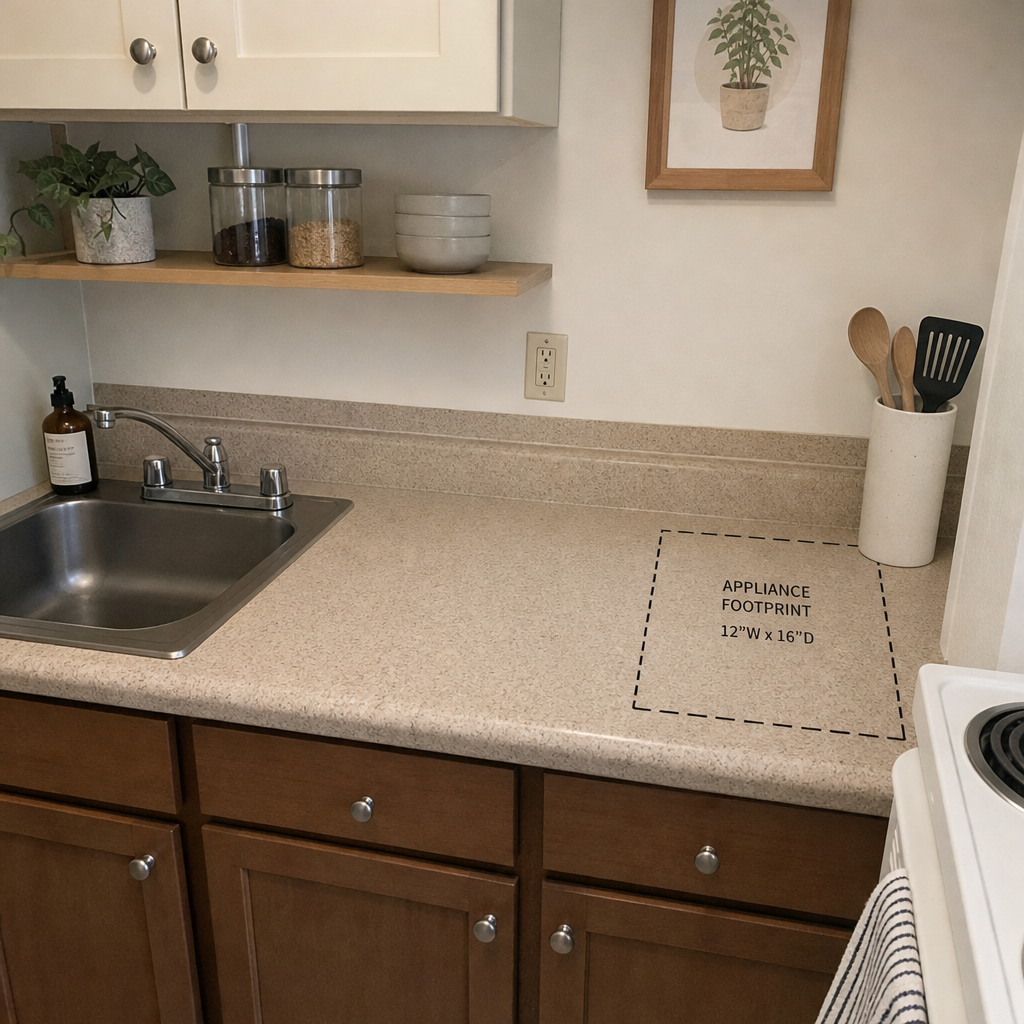
Make a paper template of the appliance footprint and place it on your counter. Then imagine filling it, opening it, removing hot food, and cleaning around it. Leave your usual cutting board nearby during this exercise so you can see what preparation space remains.
Record these measurements before comparing models:
|
Measurement |
What to check |
|---|---|
|
Counter width and depth |
Space available without blocking your main preparation area |
|
Overhead room |
Access for lids, reservoirs, and any manufacturer-required clearance |
|
Front access |
Room to open doors, pull out drawers, and remove containers |
|
Storage opening |
Whether the appliance fits through the cabinet doorway |
|
Usable interior |
Whether your own dishes, pans, or typical portions fit |
|
Outlet locati0n |
Whether the supplied cord reaches an appropriate outlet safely |
For stored appliances, measure the shelf as well as its opening. Plan where accessories will go, including lids, baskets, blending cups, and detachable cords.
Try lifting a similarly sized object from the proposed storage spot. If retrieving it requires moving several other things, reconsider that locati0n before committing to the purchase. Storage should support your routine rather than become another task you postpone.
Which compact appliances best match your cooking routine?
Choose appliances by the meals and tasks you want them to handle, then compare capacity, access, and cleanup within that category. A compact oven deserves consideration for baking and toasting; a blender belongs on the shortlist when blending is a regular task. Start with one clear job for each purchase instead of treating every available function as a reason to buy.
Reheating: evaluate a compact microwave first
If reheating is your main frustration, begin your comparison with compact microwaves. Take measurements of the bowl or plate you use most often and check them against the model's usable interior. Read the manual for approved containers and operating instructions before deciding that it fits your routine.
Compare controls as carefully as dimensions. Look for a layout you can understand quickly, a door you can open comfortably, and an interior you can reach for cleaning. If possible, inspect a display unit with your usual dish measurements in hand.
Think through a complete lunch rather than a single container. Would you heat everything together, or would the proposed size require several separate rounds? Choose the smallest option that accommodates your normal meal without creating a process you would find irritating.
Toasting and baking: consider a compact countertop oven
A compact countertop oven is worth investigating if your routine includes toast, small baking projects, or oven-cooked meals. Some models combine several cooking modes: Cuisinart, for example, lists convection baking, broiling, air frying, toasting, pizza, and warming on its compact air fryer toaster oven. Check the exact model rather than assuming every small oven offers the same functions.
Start with the food or cookware you intend to use. Compare the usable rack area with your preferred baking dish, and check whether you can remove that dish comfortably. Include the supplied trays and racks in your storage plan.
For an oven-style air fryer, ask whether the combined appliance would genuinely replace another purchase. If you already own equipment you enjoy using, adding another overlapping appliance needs a stronger justification than an appealing feature list.
Rice and one-pot meals: inspect capacity descriptions closely
If rice or one-pot cooking dominates your weekly menu, put a small rice cooker or multicooker on your comparison list. Read each capacity description carefully, including whether a rice quantity refers to cooked or uncooked rice. Use the manufacturer's portion guidance and fill instructions rather than estimating from the outer size.
Choose around your actual cooking pattern. Someone who wants leftovers should evaluate a different batch from someone preparing one serving at a time. Write down the amount you normally cook and compare that requirement with the manual before ordering.
For a multicooker, identify the functions you would actually use. Check lid access, removable parts, cleaning instructions, and where the appliance would operate. Do not count a long menu of settings as useful versatility unless those settings match meals you intend to prepare.
Blending and preparation: choose the right format
Compare a personal blender, immersion blender, and small food chopper around your most frequent preparation task. KitchenAid describes immersion-blender uses including soups and sauces, while also distinguishing them from food processors. That makes task matching more useful than choosing whichever machine has the smallest container.
List the ingredients and quantities you want to process. Then check the model's instructions for suitability, minimum quantities, attachments, and cleaning. Do not assume a compact blender can handle every job associated with a larger machine.
Keep the complete kit in view when comparing tiny kitchen appliances. A narrow motor unit may appeal, but you still need somewhere for its cup, lid, blades, or attachments. Buy the accessory bundle you will use rather than the largest bundle available.
Coffee and hot drinks: plan the whole station
Build your drink setup around what you prepare most often. If you mainly drink one morning coffee, compare equipment for that serving rather than planning around hypothetical guests. Include your preferred brewing method, mug size, and cleanup routine in the decision.
Before buying, identify where you will fill the appliance, store coffee or tea, and dispose of used grounds or other waste. Check reservoir and lid access with overhead cupboards in mind. Set aside room for the supplies as well as the machine.
If an electric kettle is on your list, check its minimum and maximum fill guidance against your normal use. Choose controls and a handle that feel comfortable to you, and verify the placement instructions for the exact model.
Multifunction appliances need a replacement plan
A multifunction appliance is most persuasive when you can name the separate purchases it would eliminate. Before buying one, write a simple statement: “This will handle my weekday toast and small baking jobs, so I will not buy a separate toaster.” If you cannot complete that sentence convincingly, reconsider whether the extra functions matter.
Next, map a normal dinner. Suppose you want two components ready at the same time: determine whether they can share the appliance or whether one must wait. Compare that sequence with your willingness to cook in batches.
Check the accessories with equal care. Decide where every tray, basket, rack, and lid will live, and review how each part must be cleaned. Include setup and cleanup in your assessment rather than judging only the cooking stage.
Use these questions to narrow the choice:
Which existing appliance or planned purchase will this replace?
Can it accommodate my normal meal, not just a demonstration recipe?
Will I use its main functions regularly?
Can I store and clean every included accessory?
Am I comfortable relying on one appliance for several tasks?
Treat multifunctionality as a way to simplify your kitchen, not an invitation to acquire features you have no plans to use.
Are smaller appliances always more energy efficient?
No. Smaller size alone does not guarantee lower energy use across your routine. The Department of Energy recommends small cooking appliances for small meals, but ENERGY STAR notes that compact dishwashers may use more energy over time because of their smaller capacity. Match the appliance to the task and compare relevant energy information rather than relying on the word “mini.”
When an EnergyGuide label is available, use it to compare the estimated consumption of suitable models. ENERGY STAR explains that dishwasher labels show estimated yearly electricity use and energy cost based on specified assumptions. Treat those figures as comparison tools, not a prediction of your exact bill.
For your own decision, note how often you expect to run the appliance and how many batches each meal requires. Compare equipment that can complete the same practical job. Avoid rejecting a usable size merely to obtain the smallest casing, especially if you would immediately need additional cooking or washing cycles.
Add small kitchen tools before another motor
Before buying another electrical appliance, try solving the task with a manual tool you already own. Put a knife, whisk, grater, or mixing bowl into your proposed workflow and decide whether the task still feels inconvenient. This gives you a practical test instead of relying on how useful a gadget looks online.
For a starter collection of small kitchen tools, consider:
A cutting board you can comfortably use: Choose around your working surface and where you will wash and dry it.
A knife suited to your usual ingredients: Prioritize comfortable handling and a safe storage locati0n.
A nesting bowl set: Check that the sizes fit both your recipes and your cupboard.
A whisk and flexible spatula: Include them if stirring, mixing, and scraping are regular tasks.
A grater or peeler: Select only the functions you use rather than a large accessory set.
Apply the same restraint to manual tools as to appliances. Do not buy a drawer full of miniature versions simply because they are small. Keep the tools that support your meals, and leave room to retrieve them without emptying the drawer.
Create an appliance layout you can use every day
Organize the kitchen around preparation, cooking, and cleanup. Assign each appliance an operating locati0n and, where relevant, a separate storage locati0n. Before moving anything permanently, walk through making breakfast or dinner with the proposed arrangement.
Give frequently used equipment the easiest approved access. For occasional appliances, choose storage that lets you retrieve them without dismantling the rest of the cupboard. Leave your main preparation area out of the storage competition.
Try these kitchen space savers as planning options:
Group accessories by appliance. Keep detachable parts together so you can retrieve the complete set.
Reserve accessible shelves for frequent use. Match storage height to what you can lift and handle comfortably.
Keep one preparation zone unassigned. Resist filling every open section of counter with equipment.
Separate storage from operation. A shelf or cabinet that holds an appliance is not automatically an approved place to run it.
Review the layout after regular use. Move awkward items before deciding that you need more storage furniture.
If you are considering a cart, verify its dimensions, stability, load rating, and intended use before purchase. For portable kitchen appliances, also check that the proposed operating surface and locati0n meet the appliance manufacturer's instructions. Portability should not substitute for a safe, workable setup.
Keep electrical and heat safety in the plan
Do not assume a compact appliance has modest electrical demands. NFPA notes that appliances intended to heat food can draw significant power and that operating several together can overload a circuit. Plan your cooking sequence with electrical capacity in mind rather than treating every nearby outlet as independent capacity.
Follow the manufacturer's connection instructions and avoid using extension cords or power strips as a workaround for an unsuitable appliance location. The U.S. Fire Administration advises plugging major appliances directly into wall outlets and not overloading outlets or power strips. If the kitchen's electrical setup is uncertain, ask building management or a qualified electrician for help.
Keep cords away from hot surfaces and check them for damage. Leave combustible items out of the cooking area, including paper, towels, and packaging. The Consumer Product Safety Commission's home electrical checklist specifically calls attention to cord placement, appliance condition, and combustibles near cooking equipment.
Make these checks part of choosing the appliance, not something you resolve after it arrives.
Compare value beyond the purchase price
Set a budget for the complete setup rather than the appliance alone. Identify any required accessories, compatible cookware, filters, or other supplies in the product documentation. Check what is included before treating a lower advertised price as the better purchase.
Build a shortlist of only a few suitable models. For each one, record:
Whether your normal serving or cookware fits.
Whether the controls are easy for you to use.
How the removable parts must be washed.
Where the appliance and its accessories will live.
The warranty terms and availability of replacement parts.
The seller's return conditions if the fit proves unsuitable.
Use reviews to investigate specific concerns rather than collect general praise. Look for discussion of the exact model, then verify important specifications and care requirements in official documentation. A review describing someone else's large kitchen may not answer your question about cabinet access.
When shopping for mini appliances for kitchen use, start with the problem you most want to solve. Buy one item, use it through ordinary meals, and reassess before adding another. This keeps later decisions tied to experience rather than an imagined complete collection.
Distinguish apartment appliances from Mini Brands collectibles
If you search for “mini brands kitchen appliances,” check the product category carefully. ZURU's Mini Brands range includes collectible miniatures and a Magic Cook Kitchen line marketed with working miniature appliances. Those listings serve a different purpose from choosing everyday equipment for an apartment kitchen.
Read the intended use, instructions, dimensions, and product description before ordering. For daily cooking, focus your search on the task and usable capacity you need. Do not assume that “mini,” “working,” or a realistic appearance establishes suitability for your normal meals.
Build your setup in stages
Start with a short trial period using the equipment already available. Write down recurring frustrations, choose the most important one, and investigate a single purchase to address it. After using that purchase, update your list before spending again.
For a reheating-focused routine, review your existing microwave setup and food containers first. For regular home cooking, prioritize the task that your current range or cookware does not handle comfortably. For smoothies or soups, investigate the appropriate blending format before buying unrelated countertop gadgets.
Keep a simple rule: every new appliance needs a clear job, an approved operating locati0n, and a storage plan. If one of those is missing, pause the purchase.
The goal is not to collect the smallest Kitchen Appliances available. It is to create a compact, dependable setup that supports the way you actually eat—and still leaves you somewhere to prepare dinner.
Frequently Asked Questions About Kitchen Appliances
What are the essential mini kitchen appliances for a small apartment?
For small apartments, essential mini kitchen appliances typically include a compact microwave, toaster oven, rice cooker, immersion blender, and a coffee maker. These appliances help facilitate common cooking tasks without consuming too much space.
How do I choose the right mini appliance for my cooking needs?
Consider your daily cooking habits and the types of meals you prepare most often. Identify the tasks that frustrate you and prioritize appliances that can simplify those tasks. Always measure your counter space and storage options to ensure a proper fit.
Are mini kitchen appliances energy-efficient?
Not necessarily. While smaller appliances are often marketed as energy-efficient, the actual energy consumption varies. It's essential to check the EnergyGuide label and compare energy use based on your cooking habits rather than relying solely on size.
Can I use manual kitchen tools instead of mini appliances?
Yes! Before purchasing additional electrical appliances, consider whether you can achieve your cooking goals with manual tools you already have. Simple tools like a mixing bowl, knife, or whisk can often be just as effective for smaller tasks.
How should I organize my small kitchen appliances?
Prioritize accessibility for frequently used appliances while ensuring that occasional items are stored away conveniently. Create a designated cooking and preparation area, and consider grouping accessories by appliance for easy retrieval. Avoid cluttering your counter space.