Back To Blog
Cordless Vacuum Cleaners Wholesale Guide
Buying cordless vacuum cleaners wholesale means evaluating the product, supplier, and purchasing terms together—not simply choosing the lowest unit price.
This complete guide helps retailers, distributors, and cleaning businesses compare specifications, verify suppliers, calculate purchasing costs, and test products before committing to bulk orders.
The goal is a buying process that supports your customers or cleaning workload without leaving you with unsuitable stock.
What should you look for when buying cordless vacuum cleaners wholesale?
Look for a model that fits its intended use, a supplier that can document exactly what it is selling, and written terms covering delivery, defects, warranty support, and replacement parts. Request a sample before placing a substantial order. Evaluate its performance against your actual requirements rather than relying on promotional specifications alone.
Start by deciding whether you are buying for resale or internal use. A retailer needs accurate product information, consistent packaging, and a workable customer returns process. A cleaning business needs equipment that suits its surfaces, cleaning schedule, storage arrangements, and maintenance capacity.
Build a short purchasing brief before contacting vacuum cleaner suppliers:
Intended user: Household customers, property managers, cleaning teams, or another defined audience.
Main tasks: Hard floors, carpets, upholstery, stairs, or vehicle interiors.
Work pattern: Occasional spot cleaning or repeated cleaning sessions.
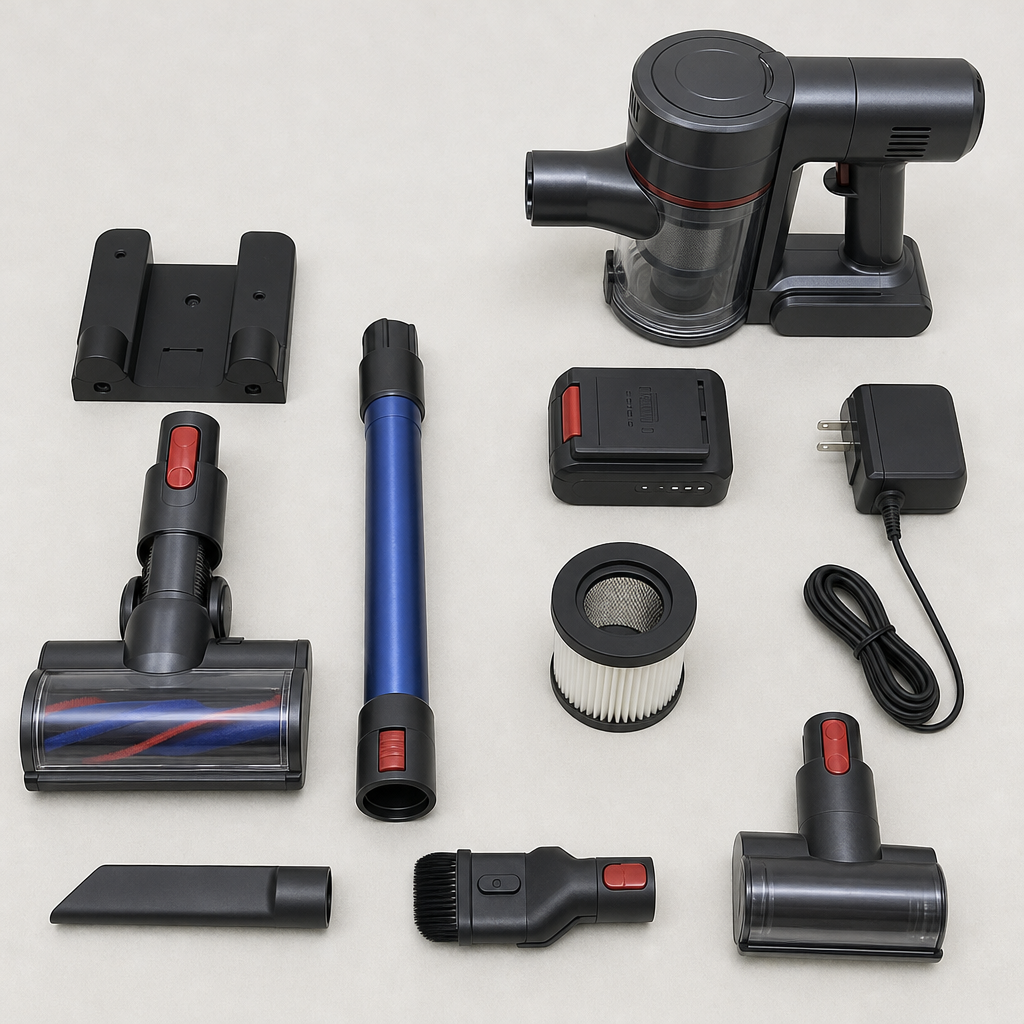
Required package: Vacuum, battery, charger, floorhead, and task-specific accessories.
Support expectations: Replacement parts, troubleshooting, warranty handling, and reorder availability.
Use this brief to compare equivalent offers. Otherwise, you may be comparing a complete working kit with a machine that requires additional purchases.
Match the product format to the cleaning job
Do not treat every cordless model as interchangeable. Kärcher’s professional range, for example, separates battery-operated dry vacuums, wet-and-dry machines, and upright brush-type models by application. Use those distinctions as a reminder to specify the cleaning task before choosing equipment.
For a household retail assortment, consider separate roles for an everyday floor-cleaning model and a compact option for smaller tasks. For business purchasing, begin with the cleaning route: surfaces, furniture, stairs, debris, and opportunities to recharge. Ask the supplier to explain why each proposed model suits that route.
Avoid buying a broader specification than you need. If your customers mainly want quick kitchen cleanups, assess convenience and storage carefully. If your team needs to clean carpeted corridors, test that exact task rather than judging the machine through a handheld demonstration.
Treat specialist applications separately. Ask for explicit manufacturer confirmation before considering a model for liquid pickup or unusual debris. A supplier’s general description of “powerful cleaning” is not a substitute for documented intended use.
Compare specifications without getting distracted by headline numbers
Build a comparison sheet around the complete machine and its working configuration. Record the exact model identifier, included battery, charger, floorhead, accessories, and supporting documents. Mark missing information as unverified instead of filling gaps with assumptions.
Runtime and charging
Check how advertised runtime was measured. Dyson states that actual runtime for its Gen5 cordless vacuums varies with power mode, dust level, floor type, and attachments. Its extended-runtime claim for one configuration also depends on consecutive use of two batteries, illustrating why the battery count matters.
Ask suppliers for runtime using the floorhead and mode your customers or staff would normally select. During sample testing, record cleaning time and charging time separately. If you are considering spare batteries, verify compatibility, availability, price, and whether the package includes a suitable charger.
Floorheads, handling, and access
Test the assembled vacuum on representative surfaces, around furniture, and under low obstacles. Include carrying, tool changes, and emptying—not just straight-line cleaning. Ask the person who will use it regularly to assess balance and control placement.
Check floor compatibility against the relevant instructions. Dyson’s V15 manual warns that its rotating brush bar can damage certain carpet types and floors, and advises checking the flooring manufacturer’s cleaning recommendations. That makes surface compatibility a purchasing requirement, not an optional detail.
Filtration and maintenance
Request documentation for filtration claims and keep any qualifications attached to them. Avoid turning a component description into a broader claim about the entire vacuum. If the supplier cannot substantiate wording you intend to use in a listing, leave it out.
Review maintenance before ordering. The V15 manual, for example, requires its washed filter to be completely dry before refitting and warns against operating with a damp filter. Ask each supplier for model-specific instructions, then decide whether spare filters belong in your purchasing plan.
How do you evaluate vacuum cleaner suppliers before placing an order?
Evaluate vacuum cleaner suppliers through verifiable business information, product documentation, samples, and written commercial terms. Ask them to identify the exact stock offered, explain their supply relationship, and document how problems will be resolved. Use their responses to decide whether a trial order is justified.
Make your checks specific rather than asking whether a supplier is “reliable.” Request a quotation showing its legal business name, contact details, model numbers, quantities, payment terms, and delivery responsibilities. If branded merchandise is involved, ask for evidence supporting any claimed authorization and verify it through the brand where possible.
Use the following checklist to organize follow-up questions:
|
Area |
Evidence to request |
|---|---|
|
Product identity |
Exact model, manufacturer details, condition, and package contents |
|
Stock availability |
Available quantity and estimated replenishment timing |
|
Product documentation |
Manuals, specifications, and relevant test documentation |
|
Defect handling |
Reporting window, required evidence, and proposed remedy |
|
Warranty support |
Written terms and the party responsible for handling claims |
|
Parts support |
Orderable batteries, chargers, filters, and other service parts |
|
Order consistency |
Confirmation that supplied goods will match the approved specification |
Separate new, refurbished, returned, and clearance stock in your evaluation. Ask for condition definitions and supporting photographs where appropriate. Do not accept an ambiguous description simply because the quotation is attractive.
For ongoing vacuum cleaner wholesale purchasing, also request a reorder quotation. Compare the proposed lead time and terms with the initial offer before treating the supplier as a long-term source.
Calculate the real cost of a wholesale order
Compare quotes using a shared costing worksheet. Include every expense you expect to pay, and identify anything still excluded or awaiting confirmation. Keep purchase cost separate from operating costs so you can see where each offer differs.
A useful starting calculation is:
Landed unit cost = total acquisition cost ÷ accepted, saleable units received
Your worksheet may include:
Product cost: Machines, batteries, chargers, and required accessories.
Delivery costs: Freight, handling, insurance, and receiving charges where applicable.
Import-related costs: Any applicable charges confirmed for your transaction.
Preparation costs: Inspection, labeling, packaging, or listing preparation.
Support allowance: Your own planning allowance for returns, replacements, and service work.
For resale, compare your intended selling price with landed cost and channel expenses. Include marketplace fees, customer delivery, and promotional spending where relevant. Use your own records or clearly labeled assumptions; do not adopt a supplier’s suggested margin as a forecast.
For internal use, evaluate a defined period of ownership. Request prices for replacement batteries, filters, and other expected service items, then add your own maintenance assumptions. Review how you would cover cleaning work while a machine is unavailable.
Ask for quantity-based quotes without assuming the largest order is best. Compare the discount with storage capacity, available cash, and a realistic sales or deployment plan. Set the order size from that assessment, not from the supplier’s next price break.
Assess cordless vacuum offers beyond the discount
Treat cordless vacuum offers as invitations to investigate, not conclusions about value. Request the regular package specification alongside the promotional one. Check whether the offer changes the battery count, accessories, condition, support terms, or delivery arrangements.
When comparing cordless vacuum deals, ask these questions:
What exactly is included? Obtain an itemized package list with model identifiers.
What condition is the stock in? Request a written definition and any inspection records offered.
What support applies? Establish who handles defects and warranty claims.
Can you reorder it? Ask whether the quoted product and package will remain available.
What makes the promotion conditional? Confirm quantity requirements, payment timing, and quotation validity.
If you purchase wholesale cleaning tools alongside vacuums, price each part of the bundle separately. Keep only the accessories that serve a defined customer need or operational task. A mixed order should follow your purchasing plan rather than reshape it around unwanted items.
For private-label proposals, request approval samples of the product, packaging, instructions, and branding. Document the agreed specification before approving production. Keep any claims on the packaging tied to evidence supplied for that exact model.
Test samples before scaling up
Create a repeatable sample test using ordinary cleaning tasks and manufacturer-approved materials. Decide your acceptance criteria before testing, then use the same process for each candidate. Keep photographs, observations, and the supplier’s specification together in one record.
Start with these checks:
Inspect the shipment: Compare model numbers, contents, packaging, and visible condition with the quotation.
Prepare the machine: Follow the manual for assembly, charging, and initial use.
Run representative tasks: Test your main surfaces, edges, furniture access, and attachments.
Record usability: Note handling, control access, emptying, and tool changes.
Complete maintenance: Follow the instructions for cleaning and reassembly.
Review exceptions: Send discrepancies to the supplier and obtain written responses.
Keep runtime observations tied to the tested configuration. Record the selected mode, fitted attachment, surface, and starting charge. This gives you a useful internal comparison without presenting a small sample test as independent certification.
Next, consider a limited pilot order. Inspect several units against the approved sample and track discrepancies. Agree on how substitutions or specification changes will be handled before authorizing a larger purchase.
Plan support and replenishment from the start
Before buying wholesale cordless vacuum cleaners, assign responsibility for customer questions, troubleshooting, replacement parts, and supplier communication. Request the relevant manuals and support contacts while evaluating the order. Write a simple process your team can follow when a unit arrives damaged or stops working.
For resale, prepare product listings from verified specifications and approved images. Explain included accessories, intended use, and maintenance requirements without broadening the manufacturer’s claims. Keep records linking each batch to its supplier and purchase documents.
For operational use, assign equipment and maintenance responsibilities clearly. Record faults and repair actions so repeat issues are visible. Use those records when deciding what to reorder.
Set replenishment decisions around your own sales or usage history and the supplier’s confirmed lead time. Review the assortment before repeating an order automatically. Keep purchasing and service feedback in the same decision process.
Build a purchasing process you can repeat
A sound wholesale decision begins with a defined cleaning need and ends with a documented support plan. Compare equivalent packages, test representative samples, and calculate costs before increasing order volume. Use the first order to validate the supplier as well as the product—then scale only when the evidence supports it.
Frequently Asked Questions About Cordless Vacuum Cleaners Wholesale
What factors should I consider when purchasing cordless vacuum cleaners wholesale?
When buying wholesale, it's essential to evaluate product specifications, supplier reliability, delivery terms, warranty support, and maintenance requirements. Make sure the model fits its intended use, and always request samples before committing to large orders.
How can I assess the quality of a vacuum cleaner supplier?
Evaluate suppliers based on verifiable business information, product documentation, customer service responsiveness, and written commercial terms. Request quotations with detailed specifications and clarification on handling defects and warranties.
What should I include in my purchasing brief before contacting suppliers?
Your purchasing brief should specify the intended user (e.g., households, cleaning services), main tasks (cleaning surfaces like carpets or hard floors), work patterns (occasional or frequent cleaning), required packages (vacuum, batteries, accessories), and support expectations.
How do I calculate the total cost of a wholesale vacuum cleaner order?
Calculate the total cost by adding up product costs (including machine and accessories), delivery charges, import-related costs, and preparation costs. Use the formula: Landed unit cost = total acquisition cost ÷ accepted, saleable units received to determine the cost per unit.
What are some common pitfalls to avoid when buying cordless vacuum cleaners wholesale?
Common pitfalls include assuming all models are interchangeable, overlooking the importance of accurate product information, failing to document supplier agreements, and not accounting for all associated costs in the purchase decision. Always compare offers and verify details with suppliers to avoid surprises.