Back To Blog
Best Portable Massage Devices to Sell Online
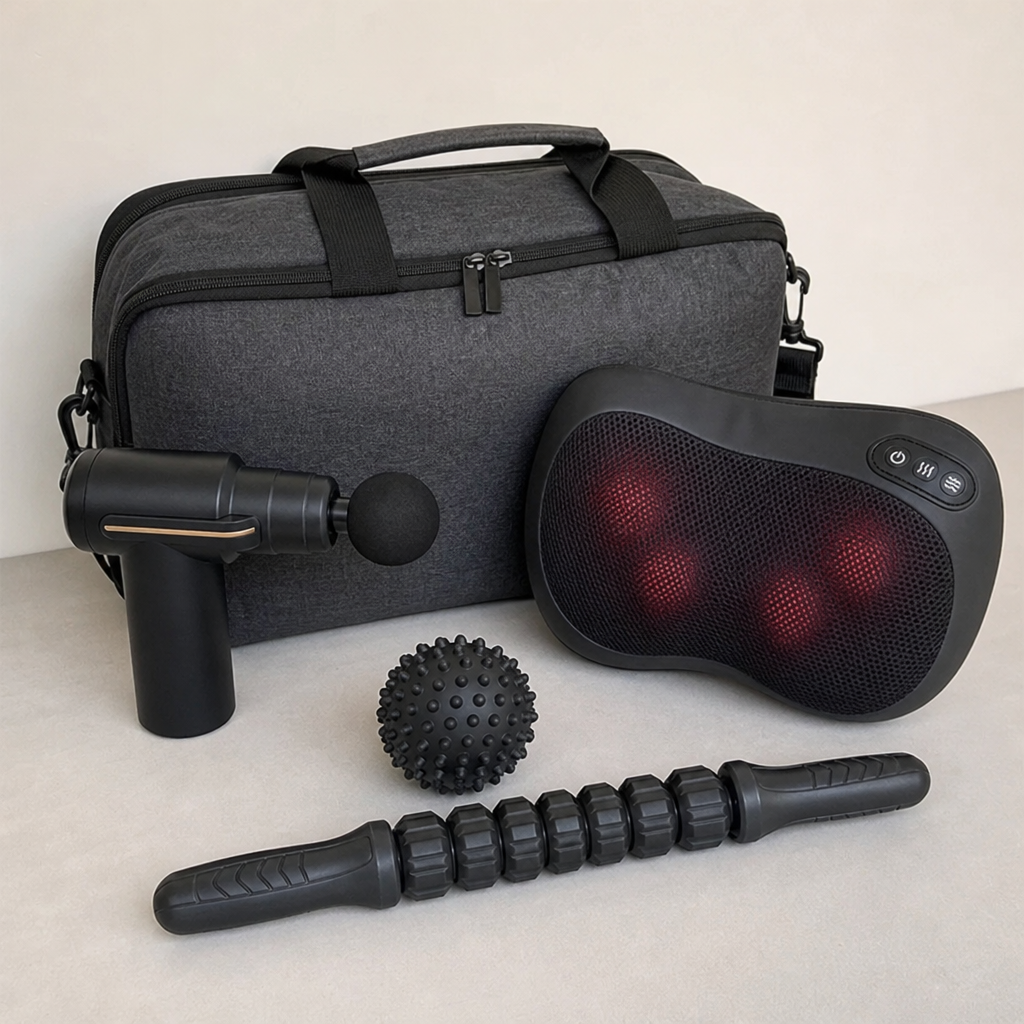
Portable massage devices give online sellers several distinct product opportunities: compact massage guns, manual massage balls, roller sticks, and cordless kneading massagers.
The strongest assortment is not necessarily the one with the most features; it is the one that matches a clear customer routine and stands up to inspection.
This article compares practical categories to consider, explains what to check before stocking them, and outlines how to present them without exaggerated promises.
Which portable massage devices are best for online sellers?
For an initial assortment, consider a compact massage gun as the featured powered product, massage balls as a simple manual option, and a roller stick as a complementary tool. Add cordless neck-and-shoulder massagers or massage pillows when your audience values seated use more than minimal packing space. These are merchandising recommendations, not a verified ranking of sales volume or profitability.
Choose according to the customer you intend to serve. A fitness-focused store might organize its range around gym-bag storage and adjustable settings. A travel-oriented shop might prioritize packed size, straightforward controls, and protective cases. A home-comfort retailer could emphasize cordless operation and easy-to-clean surfaces.
Use the following shortlist to establish a role for each category before comparing suppliers:
|
Product category |
Suggested assortment role |
Main evaluation priority |
|---|---|---|
|
Mini massage gun |
Featured powered device |
Grip, controls, charging, and included accessories |
|
Manual massage balls |
Standalone entry option or bundle component |
Firmness, surface finish, and instructions |
|
Roller stick |
Complementary handheld tool |
Handle comfort, rolling action, and packed length |
|
Cordless neck-and-shoulder massager |
Seated-use option |
Fit, positioning, cleaning, and power requirements |
|
Cordless massage pillow |
Chair-side or room-to-room option |
Dimensions, support requirements, and controls |
Treat this as a starting hypothesis. Test whether your customers understand the differences before investing in a wide range of overlapping products.
Five product categories worth evaluating
Compact percussion massage guns
Mini massage guns deserve consideration when you want handheld massage devices with clearly demonstrable controls and accessories. As one example, Therabody lists its Theragun Mini 3rd Gen with three attachments, a USB-C charging cable, a soft travel case, and a travel lock. Those details provide concrete comparison points without requiring a seller to make therapeutic promises.
When reviewing samples, assess how the handle feels, whether settings are easy to distinguish, and how securely attachments fit. Film the actual product changing speeds and packing into its case. Avoid judging quality by attachment count alone; evaluate whether each included part has a clearly explained purpose.
For your listing, state exactly what arrives in the box. Distinguish a charging cable from a wall adapter, and identify the model or generation so shoppers do not confuse similar-looking versions.
Manual massage balls and compact ball sets
Manual massage balls are worth evaluating when you want personal massage tools without powered controls. TriggerPoint offers massage balls alongside its handheld tools and travel rollers, illustrating how a manual range can sit beside larger products. Its catalog includes both a GRID Ball and a GRID Travel roller.
Compare samples for firmness, texture, seams, and ease of cleaning according to the supplied care instructions. If you offer several versions, explain their physical differences rather than assigning unsupported medical benefits. A side-by-side photograph can communicate size more clearly than an isolated studio image.
Consider a small set only when the pieces serve distinct preferences. Two nearly identical balls and unnecessary packaging are not automatically a stronger offer than one well-described product.
Handheld roller sticks
Roller sticks provide another manual option for an assortment of portable massage tools. TriggerPoint's range includes the GRID STK alongside massage balls and foam rollers, giving sellers an established product format to examine. Use the manufacturer's product instructions, rather than assumptions about appearance, to establish intended use.
During sample inspection, pay attention to handle comfort, rotating components, and any catching or uneven movement. Measure the complete stick, including its handles, before describing how it fits into luggage. A product can be handheld without fitting comfortably into every travel bag.
Show the tool next to familiar objects and include a full-length image. Position it as an alternative format, not as an inferior substitute for a powered device or a guaranteed solution for a particular condition.
Cordless neck-and-shoulder massagers
This category is worth exploring for a seated-use collection. Homedics offers a cordless neck-and-shoulder model with kneading settings, integrated controls, a positioning strap system, and a removable cover. These are useful features to compare when evaluating fit, setup, and cleaning requirements.
Ask suppliers to explain whether the device operates while unplugged, which functions depend on battery power, and how users position it. Check the instructions against the sample rather than accepting a generic specification sheet. Photograph its storage footprint as carefully as its in-use appearance.
Keep this category separate from pocket-sized tools. For on-the-go massage, clarify the intended setting: taking a device between home and office is a different proposition from carrying it in a small day bag.
Cordless massage pillows
A cordless massage pillow offers another option for customers comparing portable massage formats. For example, Homedics lists a rechargeable shiatsu pillow with integrated controls, heat, and a reversing massage function. Its product page also identifies charging and runtime information, which sellers should verify for the exact model they stock.
Inspect the cover, seams, control access, and charging connection. Check what positioning or support the instructions require, and demonstrate only approved uses. Do not photograph the pillow in a setting that implies an unsupported application.
Make dimensions prominent. A shopper should be able to distinguish a pillow suitable for room-to-room carrying from a device intended for minimal luggage, without guessing from lifestyle photographs.
What should you check before choosing a supplier?
Choose a supplier only after checking a physical sample, model-specific documentation, fulfillment arrangements, and the process for handling faults. A persuasive catalog is not enough to establish that the delivered product matches your listing. Build a written acceptance checklist so every candidate is assessed against the same requirements.
Start with product identity. Record the manufacturer, model number, version, included accessories, and packaging contents. If your supplier substitutes components or changes the model, require approval before shipment rather than discovering the change through customer complaints.
Use this checklist during sample review:
Documentation: Request the exact user manual, care instructions, warnings, and relevant product documentation. Confirm that model numbers match across records.
Physical inspection: Examine seams, grips, moving parts, connectors, and accessories. Record defects with photographs and describe what would make a shipment unacceptable.
Powered functions: Test the advertised settings and charging process according to the instructions. Ask how quoted runtime was measured before repeating it.
Packaging: Review protection, labeling, accessory organization, and the condition of an unpacked sample. Photograph what customers will actually receive.
After-sales support: Establish who supplies replacement parts, who evaluates faults, and which party pays agreed return or replacement costs.
For lithium-battery products, verify shipping eligibility before promising delivery services. USPS applies specific restrictions to lithium batteries, including requirements that depend on battery configuration and device condition. Review outbound shipments and customer returns separately; do not assume one shipping workflow covers both. )
Also establish your authorization to use brand names, photographs, and warranty descriptions. Obtain written answers rather than relying on a supplier's informal assurance that everything is included.
Build an assortment around a specific customer routine
Instead of presenting unrelated massage therapy gadgets, build a small collection around one recognizable situation. You might test a gym-bag collection, a compact travel collection, or a seated relaxation collection. Treat those themes as merchandising concepts, not evidence that customers already want every proposed bundle.
For a gym-bag concept, compare a mini massage gun with a manual ball and a clearly illustrated storage setup. For a travel concept, prioritize verified packed dimensions and a complete view of the accessories. For a seated-use collection, show the space and setup required by each cordless product.
Keep bundles purposeful. Explain what each component adds, offer clear care instructions, and make the contents visible before checkout. Avoid filling a bundle with duplicate accessories merely to inflate the apparent item count.
Before setting prices, calculate the costs relevant to your operation: product acquisition, inbound freight, packaging, fulfillment, payment processing, customer support, and expected returns. Use your own quotes and results rather than assuming a category has an attractive margin. Set a purchasing limit for the test and decide in advance what would justify reordering.
How can you create product pages that help shoppers choose?
Create product pages that resolve practical uncertainties: size, power, controls, included items, intended use, care, and support. Shoppers should understand how products differ without interpreting vague phrases such as “professional quality” or “ultimate recovery.” Use your own sample observations for descriptive details and manufacturer documentation for specifications.
A useful page can follow this sequence:
Show the complete product. Include front, side, control, and accessory views, plus a scale reference that does not distort dimensions.
Explain operation. Demonstrate switching settings, fitting accessories, or positioning the device exactly as instructed.
Clarify portability. Provide verified weight and dimensions, including the case when relevant. Show the complete packed setup.
List box contents. Identify cables, adapters, attachments, cases, and any items pictured but not included.
Make support visible. Present care information, warranty terms, return conditions, and contact options without requiring a search through unrelated pages.
Use descriptive language for category navigation. “Compact massage guns,” “manual massage tools,” and “cordless kneading massagers” tell readers more than a single undifferentiated Massage Devices collection. Place portable massage wording where it describes a real attribute, not as an extra phrase in every sentence.
Keep health-related claims especially disciplined. The FTC says advertising must be truthful, not misleading, and supported before publication; health-benefit claims generally require competent and reliable scientific evidence. That includes implied messages created by product names, images, and testimonials, not just explicit promises in the description.
Accordingly, do not turn a supplier's generic sales pitch into claims that a device cures injuries, treats disease, or guarantees recovery. Describe verified functions and review the evidence for any proposed benefit claim. A disclaimer does not replace the support needed for the claim itself.
Test a focused range before expanding
Start with a manageable selection and document what you want to learn. Compare customer questions, completed purchases, return reasons, and support workload across the products you offer. Avoid declaring a winner solely because one listing attracts more clicks.
Use those observations to make specific improvements. Repeated questions about adapters suggest the box contents need clearer presentation. Confusion about size calls for better scale photography. Complaints about setup warrant checking both the product instructions and your demonstration.
Choosing the best portable massage devices to sell online ultimately means matching a dependable product with an understandable use case and a workable selling process. Begin with a focused assortment, inspect it carefully, and publish precise product information. Expand when your own results support the next purchase—not simply because another gadget looks impressive..
FAQs About Portable Massage Devices
What are the benefits of using portable massage devices?
Portable massage devices offer convenience and flexibility, allowing users to enjoy massage therapy anywhere and anytime. They can help relieve muscle tension, reduce stress, and promote relaxation on-the-go.
How do I choose the right portable massage device for my needs?
Selecting the right device depends on your specific preferences and intended use. Consider factors such as the type of massage you prefer (e.g., percussion, manual), size and portability, ease of use, and desired features like heat settings or speed variations.
Are portable massage devices safe to use?
Yes, most portable massage devices are safe for use by the general public. However, individuals with specific medical conditions or injuries should consult a healthcare professional before use to ensure that the device is appropriate for their situation.
How long should I use a portable massage device in one session?
It's generally recommended to use portable massage devices for about 15 to 30 minutes per session, depending on the device and your comfort level. Always follow the manufacturer’s guidelines for specific recommendations.
Do I need to follow any maintenance practices for my portable massage devices?
Yes, regular maintenance is essential for optimal performance. This may include cleaning the device according to the manufacturer’s instructions, checking for any loose parts or damage, and ensuring that batteries are charged if applicable.